
JEO trails study serving as basis for volunteer-led effort, beginning with Phase 1
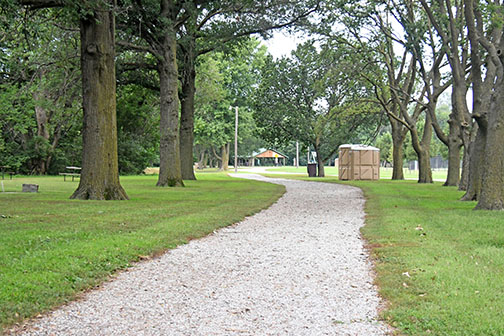
A new sidewalk planned on the east side of the renovated 1st Street project will be widened from five to six feet in the coming weeks, with the expansion funded by a newly formed committee announcing the change as Phase I of a long-term mission to expand and possibly connect existing trail systems in Aurora and Hamilton County.
Initially formed in 2024 as the Aurora Trails Committee, board president Will Jackson announced this week that the name has been changed to Hamilton County Trails, reflecting the organization’s broader mission.
“Twenty to 30 years from now we are hoping that we can tie into other communities in the county with the trail system, so it’s not just exclusively Aurora,” Jackson explained. “I know that our Phase I project is in Aurora, but we’re thinking big picture down the road.”
Jackson noted that the group’s early discussions have been focused on a trail study completed last year by a team of JEO Consulting interns, who spent the summer of 2024 studying Aurora’s existing trail system. The group shared its findings on how the city might consider expanding its trail network in a 33-page report presented to the Aurora City Council last August.
“Our objective with this presentation and with this report was to find and present some recommendations on proposed trail alignments for the city of Aurora,” Haley Lux, a JEO intern and engineering student at Iowa State University said during that August meeting. “As you are well aware, Aurora is currently experiencing a lot of growth in both residential and business aspects and there are several new subdivisions and businesses that are developing all throughout the city. And so while these trails can be used a lot for recreational purposes, as many trails are, it can also be used as alternative routes of transportation throughout the city and it’s a great way to keep this ever-growing community closer than ever.”
Jackson, who was in attendance at that meeting, commended the intern study for its depth of detail and long-term potential.
“The great thing about this study is that it’s not targeted at one specific demographic,” Jackson explained during a recent presentation to the Aurora Rotary Club. “Trails can be used by people of all ages, from young kids on their bikes with parents to people who are retired and staying active and engaged in the community. There are just a lot of healthy by-products that come from having a healthy trail network.
“I think the history of our trail network is that it has been funded by public dollars,” he continued. “We’re trying to do this in a way that is similar to many other projects here in Aurora, with private donations, foundations and external grants that we’re going to apply for, so that’s kind of what we’re doing.”
Within the last few months, the trails committee has expanded its list of volunteers, which now includes Brett Mitchell as secretary, among others.
“The entire group is very motivated and passionate about seeing the trails network expand throughout Hamilton County,” Mitchell said. “When I joined the group, the discussion was going on about what should be the next priority or the correct bite size to take, because through our current activities we know we’re not building the network of our dreams to connect every part of the county that we want, so we had to pick something. We’re very thankful for the JEO study that came about, which is a great baseline at least for the Aurora vicinity to consider for prioritization.”
“We’re also excited to partner with the Hamilton Community Foundation and its 501(c)3, to help us with their expertise and fundraising through a nonprofit,” Mitchell said.
1st Street sidewalks
The first project rose to the top of the list somewhat based on timing. With 1st Street now under construction as part of a major renovation project from Highway 34 to the railroad tracks, the committee realized a need, which turned into a timely opportunity. When the group learned that the sidewalk planned for the east side of 1st Street from West L north to Highway 34 was scheduled to be five feet wide, members quickly raised the $12,000 necessary to widen it by a foot.
“There were plans already to have a sidewalk there, but the city approached us to see if we could fundraise to secure funds to widen it to just have a little bit more room so maybe two bikers going different directions, or someone with a stroller or a walker, would have more room,” Jackson said. “As a teacher, I also think it’s going to be great for kids walking that way.”
Though the dollar amount raised was relatively small, Jackson viewed it was a significant accomplishment.
“When you look at the grand scheme of the bids that we’ve received for some of what we want to do for our Phase I projects, it’s just a tiny fraction of what we need, but it’s a start,” he said. “I know we have a long way to go, but it’s something to celebrate.”
“We are appreciative to the Farr Foundation for their contribution,” Mitchell added. “We were on a tight timeline to get those monies to the city since construction is on-going and we needed to pay for those materials to widen the sidewalk a little bit.”
Both emphasized that the JEO study presented to the city is a helpful starting point, though efforts to fund future projects will not involve public dollars.
“We’re engaging with the city and they’re supportive of what we’re trying to accomplish,” Mitchell said, “but we’re driving this effort.
Phase I projects
The other two parts of the group’s initial fundraising effort include what is referred to in the JEO study as the Streeter Subdivision Trail, located on the west side of town in the new Streeter Subdivision, and the Northridge Trail, which essentially runs from the north side of Streeter Park connecting north to the Northridge Subdivision.
“We’re calling this Phase I,” Mitchell explained. “Our plan is to be back in five or so years to do this again, when there will be a different focus on different trails.”
Jackson and Mitchell emphasized that the JEO study offers a good starting point for discussions, though the end result may look very different years down the road. Those discussions may eventually expand to include a long-term trajectory that could connect, for example, to the cemetery, further north to the Dark Island Trail near Marquette, as well as perhaps Pioneer Trails.
“Our committee’s approach is to highly rely on the trail route suggested by the JEO study,” Mitchell said. “We’re looking at the exact best path for each of those segments that JEO recommended for our future trail, but we haven’t made any decisions on where the paths will be.”
“It’s really helpful to have it as a draft,” Jackson added. “We can look at things like safety, is this ideal or is there a better way, and also look at options like are there some easements that will allow us to move it a little bit?”
Beyond the route itself, both said there needs to be clear communication about any plans moving forward, beginning with descriptions and definitions of what a trail might look like.
“I’ve learned that people in their head have different visions of trails,” Jackson said. “To some people, a trail is 18 inches of dirt with tall grass on the side. To some people, it’s a really wide bike path. We’ve got to kind of filter and educate people on what our trail system looks like.”
Project timing
Though plans are in place to expand the sidewalk on 1st Street later this summer, the timing for planning and construction of future phases will likely be a ways off.
“Frankly, the biggest challenges, or the biggest workload in front of this committee is going to be fundraising the final path and getting hard quotes,” Mitchell said. “Our best guess on when construction on these will start is probably spring of 2027 because just with the dollars involved it’s going to be a considerable fundraising lift. Construction companies, understandably, aren’t able to give us hard quotes on that timeline that far out, so there are going to be multiple phases. We need to have ballpark numbers for when we start going to potential donors, including individuals, businesses and foundations, and then once we get the bulk of that fundraising done we’ll couple that with the effort of looking for grants throughout the state or region to help directly with trails. There may be a way we can work in grants that are oriented more towards habitats or water management that the trails are helping to accomplish those goals. So we’re really trying to catch a wide net of where we can raise these fund.”
At this point the committee itself is growing, and still seeking input from anyone who wants to get involved.
“We’re just excited,” Mitchell said. “We believe in this project. We believe in the capacity of and generosity of Hamilton County donors, both individuals, businesses and foundations, and the ability to source outside grant funds to accomplish this. There is no doubt in my mind that it’s in the long-term best interest of this community to continue growing and show the lifestyle that we have to offer here, which trails can be an integral part of.”
The Hamilton County Trails Committee is tentatively planning a 5K event on Nov. 1 to help raise additional awareness.