
Data on average daily vehicle count a factor in economic development efforts
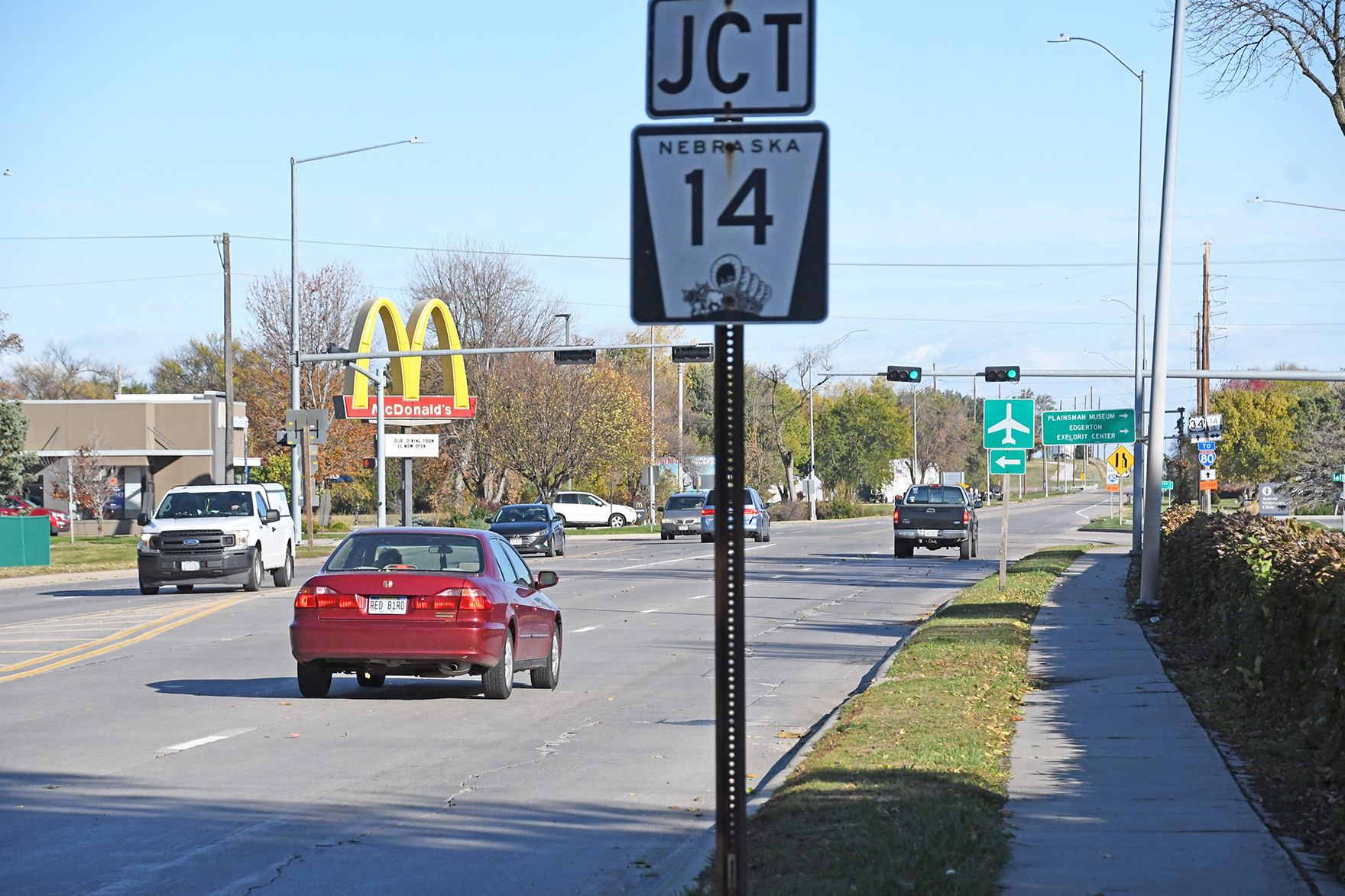
The combination of traffic counts at the 332 Interstate 80 intersection and along highways 14 and 34 are a definite business recruitment advantage for Aurora, state and local economic development officials agree.
The number of vehicles passing by a given location each day are tracked and posted by the Nebraska Department of Transportation, providing critical data for business and industry leaders considering possible locations. That data touts consistently high traffic on local roadways, while also showing variations at specific intersections which often reflect daily commute patterns.
“I do not use traffic counts in every project that I write a proposal on, but they are very helpful in some of the projects where traffic is a big factor,” noted Kelsey Bergen, executive director of the Aurora Development Corporation. “It’s important information, whether it’s a business that is going to be creating a lot of traffic and they need to know if it’s going to overpack the roads in that area, or if they need to be a highly visible business and we need to know how much traffic is going in front of that business each day.”
In a report she shared during last month’s annual ADC meeting, Bergen noted that though traffic is busy on Highway 14 and 34 through Aurora, the counts going east, west, north and south of that intersection vary greatly. The number of vehicles counted west of the intersection on Highway 34 is listed at 7,495 per day using 2019 data, while the count going east toward Hampton is listed at 4,015. Similarly, the count going south of the intersection on Highway 14 is 6,540, compared to 4,695 going north
“So I look at the numbers right around the intersection and I think the greater number of vehicles driving to the west is likely due to the ethanol plant just because you have vehicles funneling from the north and the south onto Highway 34 heading to the ethanol plant and back,” Bergen said. “It does help us looking at a variety of areas to kind of see where people are going, though you don’t know if it’s 100 percent accurate.”
Bergen pointed out another number variation around Memorial Hospital on Highway 34, where the count is listed at 8,145 vehicles per day, just a few blocks from the west side of 1st Street, where the count is listed at 6,100.
“We know that a lot of people are going to work there (Memorial Hospital) because it drops off after 1st Street, which means they they’re coming to town either to turn into the school or go to the hospital,” she said. “Then again out at the interstate, we can see that half of the vehicles that pull off (going south) are going to Love’s and the other half are continuing straight south. You can really tell a lot from that data.”
Those commuting patterns can be as important as the actual traffic counts, according to Dave Dearmont, research administrator for the Nebraska Department of Economic Development.
“For us, when we’re looking to help recruit a business looking at say Aurora to put in a new manufacturing facility, or something like that, what they’re more interested in is the commuting patterns,” Dearmont said in a phone interview from his Lincoln office. “We do labor availability studies to understand the workforce and the skills in the workforce and their occupations that are commuting from one place to another. Sometimes it’s the case where if you look in that city or in that area there’s not really the kind of skill set that’s needed, but if we take a look at the commuting area and think about labor shed, we’ll find that there are plenty of people with the necessary skills in the area. A lot of them happened to be perhaps commuting on a path somewhere else.”
Scooter’s example
Having recently announced plans to build a Scooter’s Coffee on the busy Highway 34 stretch rolling east and west through Aurora, Todd Vettel confirmed that daily traffic was one of the determining factors.
“One of the first things they look at is demographics and traffic count,” Vettel explained. “They have a model they use and they don’t give licenses” unless the traffic count is favorable.
Vettel shared that the Omaha-based Scooter’s company is quite detailed in the way it tracks and analyzes traffic data, sharing with him a color-coded map reflecting the hottest periods of the day for potential customers driving by.
“It’s like a heat map,” he described. “It has the hours and it shows a darker tint of red or orange for hours that are more active so that’s a cool grid to look at. Then it breaks down and summarizes the numbers as well. Between 7 and 9 a.m. there is just a constant, basically a lighter color of orange all throughout, then it gets hot again and is darkest about 3 to 5 p.m.”
As the prospective licensee, Vettel was then asked to validate the data by doing a manual traffic count, using a phone app to count the number of personal vehicles, excluding 18-wheelers, passing by during a typical busy morning commute. Vettel said he and his partners, brothers Trevor and Tim, were pleased with the final results.
“It’s the same thing we did on College Avenue in Fort Collins (where the Vettels were also considering a Scooter’s location),” he said. “We looked at the numbers side by side and they were just a tad higher in Fort Collins than Aurora, but that is a city of 150,000 people, and that was a premiere part of town we were looking at. We were impressed that the traffic count was that high in Aurora compared to a place like Fort Collins.”
Vettel reported, based on his personal counts, that traffic at the future 5th Street Scooter’s location on Highway 34 came in at 3,586 eastbound vehicles, with 4,066 heading west.
I-80 data
A recent look at the NDOT’s website showing annual data by county lists daily traffic at Aurora’s I-80 intersection at 23,942 vehicles per day in 2019. The number was down slightly in 2020, though DOT officials report that stations all across the state experienced a decrease in traffic last year due to the pandemic.
A look back over the past several years shows that I-80 traffic has been fairly steady, ranging from a high of 24,201 in 2017 to a low of 20,987 in 2012.
By comparison, the highest daily traffic on I-80, by far, is at the 36th Street intersection in Omaha, where 178,417 vehicles rolled by each day, according to 2019 data. The count continues to decrease the further west you travel, with the DOT reporting 52,251 vehicles per day at the Gretna interchange, 32,321 at Milford, 28,331 at Seward and 22,790 at Kearney.
“I know that a lot of people think traffic slows down the further you get outside of Lincoln and while it does decrease a little bit there’s not a significant decrease in traffic until you hit the junction to go down to Colorado,” Bergen pointed out. “I think that’s a story we need to continue to tell in order to generate more leads and business prospects. It’s just nice to have this data to back it up.”
According to 2020 data, daily traffic at the Aurora interchange was listed at 22,116, increasing slightly in Grand Island to 22,635, then decreasing to the west with 20,525 vehicles per day counted in Kearney, 16,455 in North Platte, 15,070 in Ogallala and 7,348 in Sidney.