
Students, advisors discuss challenge of keeping numerous activity balls in air
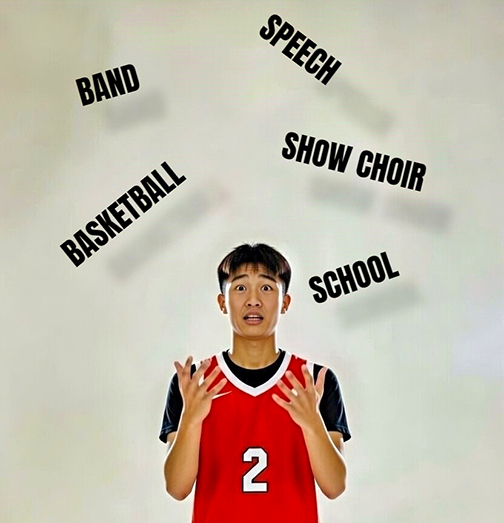
If readers take the time to look closely at the photos in this week’s Extra Extracurriculars section they will notice something interesting – often the same faces appear in multiple photos.
The “Cindy” who is a member of FBLA is also on the speech team and participates in Quiz Bowl and plays in the Jazz Band. Furthermore, looking at pictures published throughout the rest of the year, you’ll find that Cindy also is active in her church youth group, volunteers at the Hamilton County Youth Center and lifeguards at the pool during the summer.
All those involvements both in and outside of school, cause one to ask, “Where do they find the time?” and, even more pertinent, “How do they manage to juggle their schedules to fit it all in?”
Those were the questions on our minds as we were putting together this spring edition of Extra Extracurriculars, so we decided to ask school counselors and the students themselves what motivates them to be so active and just how they manage to juggle their busy schedules throughout the school year, while still giving attention to keeping their grades up.
Jake Willems, the counselor at Aurora High School, is a big proponent of students being involved in various activities beyond academics, and said when he has an opportunity to talk to a group of students he promotes extracurriculars as a way to get the most out of school.
“For instance, last week we did our incoming freshmen registration, and during that I have a slide that shows every activity and every sport that we have at the school,” he said. “I specifically talk about how we know that students have better experiences and feel more ownership of the school when they’re involved in a variety of activities. They’re able to build those relationships with teachers in a different capacity than the classroom. And they are able to really enjoy their time there when they’re involved in a variety of things.”
Willems said another benefit has to do with preparing for college and career.
“Usually in September I do a senior parent college planning event, and I have started the last few years doing an underclassman parent college planning,” he said. “We talk about how to prepare yourself for senior year, be it applying to some kind of post-secondary institution or filling out scholarship applications. The more that you’re involved in and the more that you can talk about with activities is going to make someone a more attractive recipient of a scholarship. So we talk about how investing in these different clubs and activities is going to, first of all, maybe give some clarification about what they want to do for a career in the future. It also helps them really have a leg up when it comes to applying to schools and scholarships and things.”
Small school = diversification
Having worked in larger schools earlier in his career, Willems said having students involved in so many diverse activities is somewhat unique to smaller schools like the ones in our rural area. He said in larger schools students tend to specialize more, participating only in those activities at which they truly excel. Smaller schools, however, give students more opportunities to be involved in a range of activities depending on interest, with greater chances of being a vital part of the group.
With so many overlapping schedules and responsibilities for students, Willems acknowledges that sometimes students struggle to keep up with it all. In those cases, he encourages them to maintain good communication with teachers, coaches and their parents and to give themselves permission to step back if they’re feeling overloaded.
“Emma Bullerman (Class of 2023) was feeling extremely overwhelmed in her junior year, and she stepped away from speech for a year,” Willems related. “I was so proud of her, because there are pretty high expectations on them, but she was at that stage of burning out and to make a decision that’s probably not very popular, but is in the best interest of them, to not have a crash out or have bigger issues, takes a higher level of maturity... So a lot of it is just empowering kids to make decisions that are right for them and for their family, and helping them not feel undue pressure. It’s healthy for kids to step back and say, ‘This senior year, I want to prioritize my friendships and my parents, and I want to be able to spend more time with them instead of practice in the morning, school all day, practice at night, FFA meeting in the evening, and then homework for the next day.’ You know, it’s okay to prioritize others, those relationships that you have.”
Maddie manages
One of Willems’s students who is currently performing the juggling act is senior Madelyn “Maddie” Ramaekers, whose list of activities is as eclectic as it is long. This year she has been involved in high school choir and show choir, band, FBLA, Student Council, National Honor Society (NHS), basketball, soccer, golf and the Aurora mentoring program. Outside of school she dances with Tempo Performing Arts and participates in Fellowship of Christian Athletes (as well as her own church youth group), and Youth Engaged In Philanthropy while also serving as a D.A.R.E. program role model.
Our first question was “When do you find time to eat and sleep?” to which she replied with a laugh, “It’s definitely a struggle!”
“I enjoy being busy,” she explained. “But it’s taught me time management for sure... But all of the things that I do, I truly enjoy doing, and that’s really helped me to stay involved and find people and a whole bunch of different activities that have made it worth it. And it’s super rewarding to be able to compete on a team, or be able to compete at state for FBLA, and just get to show off my many different skills alongside my friends and teammates as well... You make so many connections and relationships with your teammates, your coaches, and it teaches you how to lead through a lot of these activities that I’m in... So I think all of my involvement has just helped me become a well-rounded individual.”
Ramaekers agreed that it’s important to give oneself the permission to step back or away for a time and to prioritize the most important things in life. She said she would advise other students to do the same.
“I definitely would just say try to get involved in as much as you can, and don’t be afraid to try new things,” she said. “Like my junior year, I went out on a whim and I quit volleyball and joined golf, kind of out of nowhere, and that was one of the best decisions of my life, because I made new friendships. I tried something new, and I ended up loving it. And so don’t be afraid to do things that your friends aren’t in, and just be able to say no to things that you don’t enjoy, but you can always step out of something if it’s not what you want to do. A lot of these things that I’m in, I didn’t realize at the beginning how much I would enjoy them until I started, and so I’m just glad that I stuck with it, and that I even tried it in the first place.”
Henry’s helps
Ramaekers’ classmate, junior Henry Christenson, is also involved in multiple activities both at school and away. His sports involvements include basketball, soccer and football, and other extracurriculars include band, FBLA and NHS.
“Outside of school I’m involved in Youth Engaged in Philanthropy (YEP) and the Monroe (Evangelical Free Church) Youth Group,” he said. “The primary factor that drives me to be involved in most of my activities is that I really enjoy them. Sports have been a large part of my life since I was about 5, and I really enjoy the physical activity and sense of connectedness that comes with them. Outside of sports, I mainly do activities like FBLA, band, and YEP because I find them to be good catalysts for skill development and a great way for me to socialize and have fun with my friends.”
Christenson said his go-to technique for dealing with scheduling conflicts involves good communication.
“When I have two conflicting events, I just go to whoever is managing the event, whether it’s a teacher or a coach, and I work things out,” he said. “Oftentimes we can come to a compromise, where maybe I can go to one event for a period of time, and then I can leave that event early to make it to another event. I would say that most of my coaches and teachers are very understanding and easy to work with, which makes balancing my schedule a lot less stressful than it would be if they weren’t so considerate.”
However, Christenson said there have been times when the juggling act has caused him to “hit the wall.”
“Seldom do I reach that point, but when I do, it’s a very overwhelming feeling,” he said. “One thing I do to manage that feeling is trying to think about the positive things I have going on in my life. Things like the fact that I might be hanging out with friends over the weekend, or that there is a Creighton basketball game or Nebraska football game that I can watch, will often provide a positive boost to my head space. Another thing I tend to do is take like five minutes or so out of my day and just say a prayer. That moment where I can be alone and fall back on my faith really helps me to understand that my life will get better, and that there is more to my life than getting good grades or being a good athlete.”
He also reminds himself in those moments just how important those activities are to his personal development.
“My involvement outside of just academics has been so helpful in preparing me for the real world,” he said. “Through sports I’ve learned how to effectively communicate with both coaches and teammates and resolve conflicts effectively. I’ve also learned the importance of hard work and how difficult it is to really become adept at something. My involvement in FBLA, while it has allowed me to develop good public speaking skills and communication skills, has also provided different benefits that I feel will serve me well in my future career. As I’ve gone through my past three years of FBLA I’ve really developed a love for the business field which is now the field that I intend to pick some major in for college. I’ve learned important business concepts like how to adequately lead in a business, how to effectively market a product and how financing in a business works. By being involved in all my activities, I feel like I am better prepared for the future than I ever would have been without my involvement.”
Brayden’s balancing act
One of Hampton High School’s extracurricular stars is Brayden Wolinski, who participates in such diverse activities as one act, speech, FFA, football and track.
Asked what motivates him to do the juggling act required to be involved in so many school activities, he said being the youngest of three siblings and seeing their high school involvement he was drawn to it from an early age.
“Growing up watching all these things, you start to look up to the older high schoolers in these activities and want to follow in their footsteps,” he said. “When you are finally old enough, you find your part and your role in the activities, and you have your success, which really brings joy and makes you want to keep participating.”
However, he admitted there is a downside sometimes to having so many commitments.
“Hitting the wall is definitely something that happens with all these activities,” he said. “It always feels like everything piles up at one time, and the stress of big competitions just overloads within just a few days. I always try to look ahead and make sure I know what is going on and when it is going on. It is important to plan ahead and not wait until the last second to do things. Whenever I have free time I always try to make it productive. If I want to just sit down and watch a movie, I usually have work in my hands or am studying for the next competition. It takes a lot of time management, a lot of scheduling, and planning to make sure you can balance all your activities and get things done that are needed when they are needed.
“Sometimes you will be faced with the tough challenge of picking one event over another, and that is okay,” he continued. “You have to make sure you are still doing your part and getting all your priorities finished. Sometimes you just have to ask an older role model, who has experience and has balanced their priorities for many years, for help which is okay because at one point they were in your spot, too.”
“From the process, I have learned a lot about time management and how to budget the 24 hours I am given in a day,” he concluded. “I have also learned many different techniques to get stuff done efficiently. From the process, you really learn a lot more about yourself and what you enjoy doing and what you do not enjoy doing. In the end, I would not trade the process for anything because it has shaped me into a better, more responsible person and given me skills I can keep with me for the rest of my life.”