
Architect will complete design work on historic preservation project
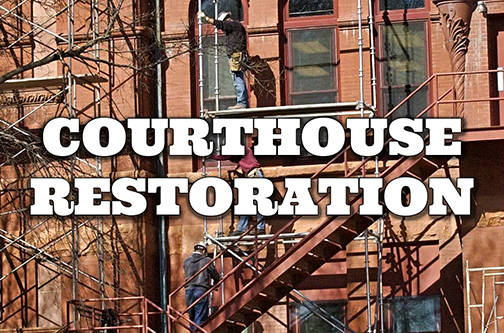
There were long moments of silence in the Hamilton County Commission meeting room on the second floor of the courthouse Monday morning as the commissioners mulled over how to proceed with the restoration of the 129-year-old building they were occupying at the moment. Restoration architect Jerry Berggren had returned for one of his increasingly regular visits with the board and he was joined via Zoom by Rick Wintermute, vice president of Kingery Construction Co.
Berggren was asking for direction and action from the commission on several matters related to the planned restoration and renovation of the courthouse, a project that has been in the planning stages for the past several years.
First Berggren and Wintermute asked the board to decide how it wanted to proceed with so-called “emergency work” to be done on the mechanical room and fire suppression system located in the custodian’s area of the first floor.
Wintermute pointed out that the antiquated pump for the fire sprinkler system is so heavy it is causing the wood floor beneath it to sag and the weight of it is also pulling on the pipes above causing the ceiling to come down. His solution is to construct a concrete pit for the pump to rest in. In addition he said the project would replace pipes and valves and an electrical box just outside the room in order to bring everything up to current code. He said while the work is being done the suppression system would be out of commission so a fire watch would have to be in place. He said that job could be done by a local teenager whose sole job in the event of a fire would be to pull the fire alarm.
It was shortly after his presentation that the meditative silences began. Chairman Rich Nelson broke the silence at one point to express his sticker shock at the overall price of the project which was quoted at $418,875.
Berggren and Wintermute went on to point out, however, that the county has little choice in the matter. They said the pump which was installed many years ago is so old that getting parts for it is becoming a problem and newer components attached to it are not compatible. Berggren said if the pump ever had to be used the resulting vibration might cause the entire system to collapse, leaving the courthouse with no fire suppression whatsoever.
“You literally have a historic fire suppression system,” Berggren quipped, to laughter from the board.
At length a motion was made and the vote to proceed with the work on the mechanical room passed on a 4-1 vote with Commissioner Francis McDonald voting no. Berggren estimates the work on project could begin in about three months, noting the limiting factor is the time it takes to get the new pump.
Preservation tax credits
Next Berggren told the board he would like to proceed with filing Part 2 of the application for historic preservation tax credits on the project with the state as soon as possible. The architect said his plan is to include the emergency work and a drainage system for the exterior base of the building in the same request totaling $2 million.
Regarding the drainage system, Berggren said the soil around the base of the building has built up over the years to the point that water is soaking into the porous sandstone blocks on the foundation and deteriorating the stone. His plan is to install drainage tiles around the building to drain the water toward the city storm drain at one corner of the property. He said the plan also includes removing the courthouse lawn’s sprinkler system which he says is contributing to the problem.
The architect said his goal at the meeting was simply to get direction for the board regarding which projects on the list it wanted to include in the application the tax credits, noting that the tax credits could be applied to future phases of the project.
Again, after much discussion and several stretches of silence, a motion was made and seconded to include items A,B and D in the application and that motion passed on a 4-3 vote with McDonald again voting against.
The final ask from Berggren was for the board to make a decision as to what phases of the renovation project should be next to be pursued, saying his hope would be to proceed with the next steps in about 18 months.
“My biggest concern is that we keep moving,” Nelson said. “We’ve been putting this off at least 10 years.”
Berggren said his advice is to address the base of the building first to get the water away from the foundation to stop further deterioration of the base course of stones. He said his advice is to save the tuck pointing of the tower for last, noting that when it comes to working on the outside of the tower getting to it will be the biggest problem. He said the roof of the main courthouse is slate which could easily be damaged if something were dropped on it. He also questioned how a scaffold could be built in order to reach the tower without the scaffolding itself causing roof damage.
At length a motion was made to direct Berggren to complete the design work for the rehab work considering the base, the tower and a combination of the two projects separately for the purpose of getting bids.
The vote to approve was again 4-1 with McDonald being the lone no vote.
Election integrity discussion
It was a standing room only situation again this week for the beginning of the meeting as Greg Epp of Giltner returned to speak during the public participation time at the meeting’s start. Epp, accompanied by two others there for the same reason, continued to address the board on the theme of election integrity. Epp said he had recently read how the nation of France had successfully completed a hand count of 34 million votes in an election. He pointed out that hand counting of votes is not susceptible to internet issues such as the cyber attacks that disrupted business and communications over the past weekend.
Epp said contrary to what he had been told by County Clerk Jill DeMers and commissioners at the previous meeting he had attended, he still believes the machine used to count votes in Hamilton County is vulnerable to tampering via the internet. He also expressed skepticism with regard to mail in voting as he must do in Giltner as he lives in a mail-in only voting precinct.
He concluded his presentation by offering to demonstrate hand counting for the board and again urged that the county not use the automated ballot counting machine.
County Attorney Doug Dexter responded by noting that the machine comes from the Secretary of State and stated, “If we don’t follow state law we risk losing every ballot.” He went on to say he couldn’t advise anyone to ignore the state and do elections their own way.
“We are required to follow state statutes,” Nelson added. “So if the state statute tells we have to use this voting machine, we have to use this voting machine. We all think voter integrity is extremely important and we’re trying to do everything we can to make sure that’s protected.”
In other business conducted in Monday’s lengthy meeting, the board approved using Hall County Housing Authority resources to help provide federally subsidized housing to individuals in Hamilton County.