
Listing provides fire chief contacts for 9 area fire districts
As hot as the weather has been recently, it’s hard to even think about purposely starting a fire. Nobody wants to roast hot dogs over an open flame when nighttime temperatures are hovering around 70 degrees. But with fall coming on, people around the area will be planning to burn road ditches and brush piles during the colder months. With that in mind, Hamilton County has posted information of its website to help people in various parts of the county know who to contact to obtain a burn permit.
The need for a clearing house for such information was brought to the attention of the Hamilton County Commission by a local resident recently during the board’s public comment time at one of its meetings. That prompted County Business Administrator Pat Shaw to contact the fire chiefs in each of the county’s nine fire districts to find out the contact person and the procedures for each district.
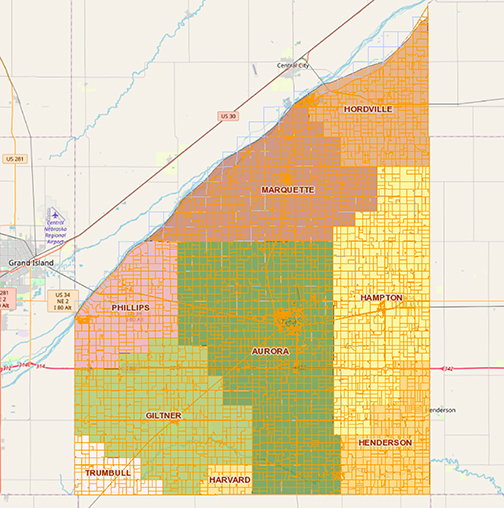
On the home page of the Hamilton County website (hamiltoncountyne.gov) users will see the words “burn permits” in all caps followed by the names and contact information for the fire chiefs in each district. If rural residents aren’t sure what fire district they are in, a link to the county fire district map can also be found on the page. He said the fire chief in each district will be able to instruct the applicant how to apply for the permit and provide further guidance.
Not every outdoor fire needs a burn permit, however. Hampton Fire Chief Dane Schafer notes that recreational bonfires within a fire pit don’t need a permit, but fires such as burning brush or road ditches and fire used to burn cut down trees and other debris do require a burn permit under state statute.
Schafer said when deciding whether or not to issue a burn permit the fire chief will take several factors into consideration.
“There are a lot of times that we are not issuing burn permits due to windy or dry conditions, and so that’s the main purpose for that,” he said. “A lot of people don’t understand how dangerous it can be at certain times, and so that’s the whole purpose of the permit.”
Schafer said while different fire districts may have slightly different procedures, some things hold true across the board.
“Essentially, anyone who is burning needs to have a burn permit on their person at all times,” he said. “And that fire needs to be managed and watched by that person who has the permit. So, in my district, any of our fire officers can issue a burn permit, and essentially that’s just giving us a call. If I’m out of town, I just have them call at one of the other officers. They can also stop into my business (Danish Oak in Hampton) and pick one up. And essentially, we just look at the weather conditions, and as long as the weather conditions are perfectly fine, we have no problem issuing that burn permit.”
In Hampton burn permits are only authorized on the day the fire is to be started because weather conditions can change quickly.
“Sometimes people call and say, ‘Hey, can I have a burn permit permit for next Tuesday?’ We we don’t do that in the Hampton Fire District. I tell them to give me a call on Monday evening or Tuesday morning, and we’ll get you the burn permit because we don’t know what the wind’s going to be doing. On our burn permits it states that if the wind is over 15 mph, the burn permit is null and void. I don’t mind that language, but at the same time, sometimes when it’s 12 miles an hour, if it’s dry conditions, it should also not be lit.”
When a burn permit is issued, Hamilton County Dispatch is to be notified, so that if someone sees smoke and calls in a fire, the dispatchers will know whether or not fire crews need to be paged out. Schafer said the procedure for calling dispatch may also vary from district to district, noting that sometimes the permit holder is asked to call dispatch before the fire is lit.
One other issue Schafer discussed was the need to keep an eye on the remains of the fire even days afterward because high winds can stir up smoldering embers causing the fire to reignite and spread.
“I think everyone needs to be mindful that if there was a fire there, even a week or two weeks after it may still be smoldering,” he said. “Typically what happens is they go to throw more stuff onto that fire, and down below it’s still hot. So we recommend that the pit gets stirred up with a backhoe. Throw a little dirt on it, stir that up, and get it completely cooled off before you throw anything else onto it. We have seen pits light up even after heavy rains, and everyone thinks the rain put it all out. And we have also had people call and say, ‘Hey, we need a little water on this to cool this thing completely off, so that we can start putting more stuff back in the hole.”
Fire district contacts
Aurora Volunteer Fire Department – 906 13th Street, Aurora, NE. 68818 Fire Chief – Tom Cox Phone: (402) 694-3855
Phillips Volunteer Fire Department – 234 5th Street, Phillips, NE. 68865 Fire Chief – Justin Brandt Phone: (308) 379-9544 Assistant Chief – Rob Evens Phone: (308) 379-4747
Giltner Rural Fire Department – 3009 Commercial Ave, Giltner, NE. 68841 - Fire Chief – Bradley Consbruck Phone: (402) 631-3387
Hampton Volunteer Fire & Rescue – 110 North 3rd Street, Hampton, NE. 68843 - Fire Chief – Dane Schafer Phone: (402) 631-7249
Marquette Volunteer Fire Department. – 409 Marquis Avenue, Marquette, NE. 68854 - Fire Chief – Dylan Christenson Phone: (402) 604-1435
Hordville Volunteer Fire Department – 104 Main Street, Hordville, NE. 68846 - Fire Chief – Matt Veburg Phone: (308) 940-1204
Henderson Volunteer Fire Department – 1319 Birch Street., Henderson, NE 688371 - Fire Chief- Sheldon Epp Phone: (402) 363-4683
Trumbull Volunteer Fire Department – 110 Miles Street, Trumbull, NE. 68980 - Phone: (402) 460-7398
Harvard Volunteer Fire Department –208 N. Harvard Avenue, Harvard, NE. 68944 - Phone: (402) 772-5555