
Aurora businessman Matt Griess recounts thrill of black bear hunting in Washington backcountry
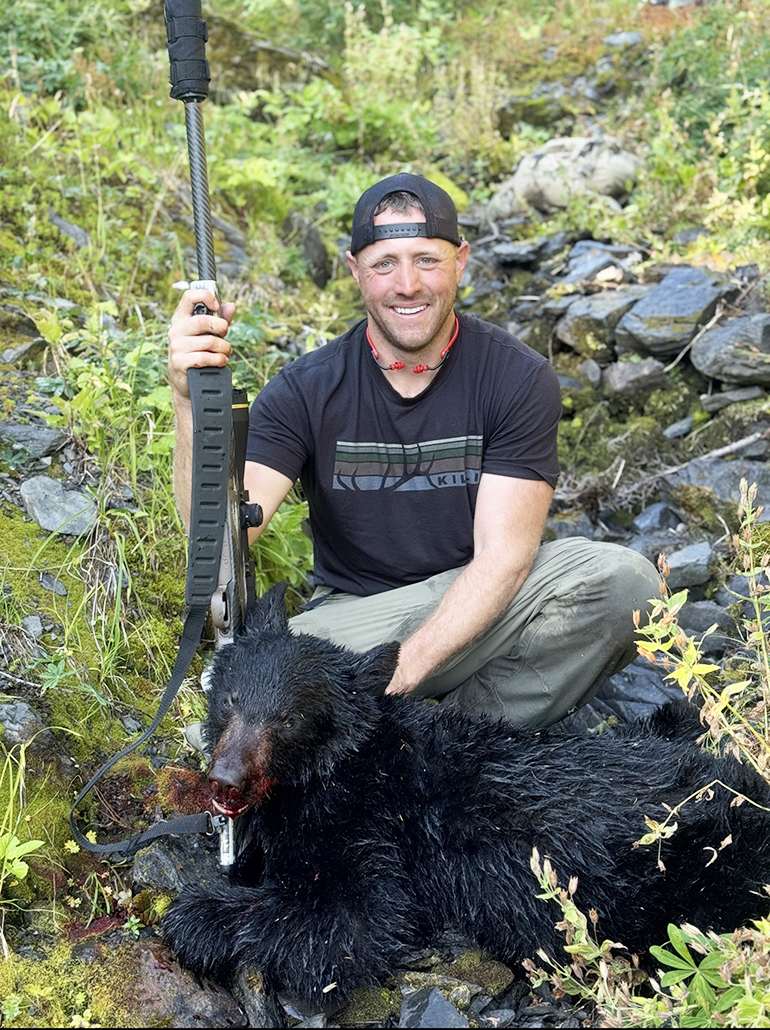
There’s something uniquely satisfying about backcountry bear hunting that grabs Matt Griess’s attention like nothing else can.
It’s challenging, physically and mentally, canvassing mountainous terrain for days. It tests your skill as a hunter, both in finding your prey and nailing the shot when it counts, sometimes more than 400 yards away. And it can be oh so rewarding, not just when you have a successful hunt, but in the relationships your build with fellow hunters out in the wilderness doing something you love.
Griess grew up in a hunting family and has a lifetime of stories to tell about various trips, but his recent adventure to Washington state may well top them all, at least at this point in his young life. He sat down to share his experience and was still bristling with excitement six weeks after harvesting his first-ever black bear.
“There is just something about it that makes me want to keep doing it,” he said. “You know, it’s not like I want to move on to a grizzly. I put so much work into these black bear hunts and had all those times when I wasn’t successful, so now that I’ve done it I want to share that experience. I really, really enjoy it and at this stage of my life it’s been very cool.”
Griess grew up in Sutton, where he and his father and brothers would hunt white-tail deer and pheasants, mostly in Nebraska. At the age of 14, the family moved to Washington state, where he first learned about bear hunting.
“When I graduated college, my dad took all three of his boys on a five-day elk hunt in Montana, and that was kind of my first experience in the mountains,” he recalled. “I shot an elk and a mule deer. We all did, and it was a really great hunt.”
About seven years ago, Griess and some of his college buddies decided that they wanted to hunt black bear. Though as a group they tagged only one bear in several trips to Montana, Griess was hooked, realizing it was unlike any hunting he had ever done before.
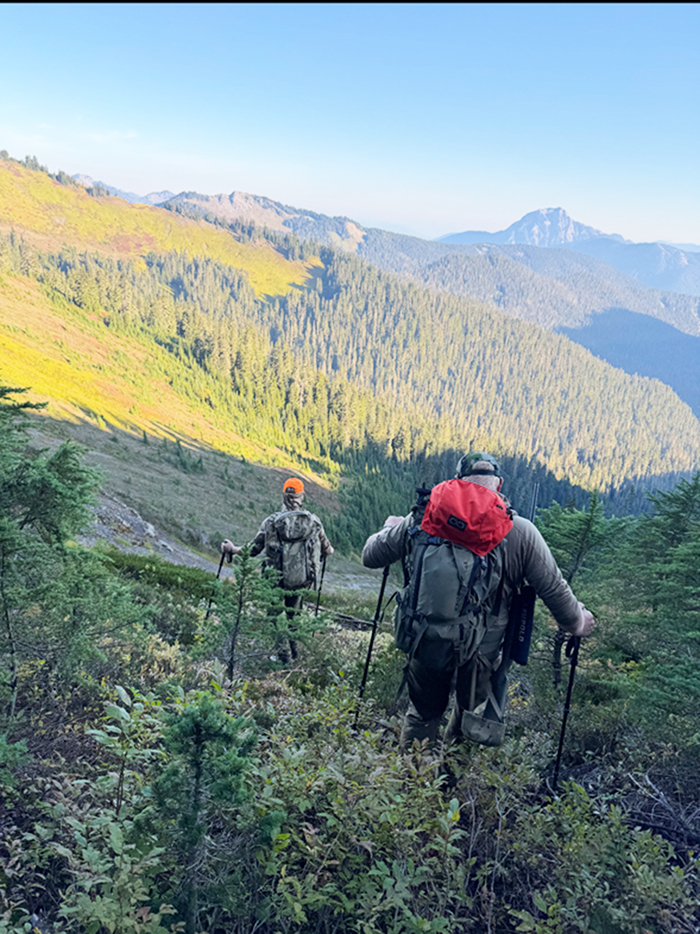
“It’s backcountry hunting, so you go up in the mountains and you’re up there for five or six days, just roughing it in a sense,” he explained. “You are putting on a lot of miles and it’s not the easiest hunt at all, but it’s also just a way to connect with friends.”
After several fun but somewhat unsuccessful hunts in Montana, Griess decided to reach out to an old friend from high school in Washington state, who is an avid bear hunter.
“I hadn’t seen him in about 20 years so it was really good to connect,” he said of Scott Tinklenberg, a former high school classmate. “The one thing I noticed about this backcountry mountain hunting is the relationships you build up there because you’re just all working together, surviving together. It’s a good way to build relationships.”
The hunt
Griess flew to Seattle in late September and started his trip with some family time as he stayed with his sister, Rachel Graham, where he met his young niece Abby for the first time.
“Her husband, Joel, had gone out on a bear hunt about a week before I got there and his buddy had shot one,” he said. “So that night for dinner they cooked bear meat, which kind of set the tone for the hunt. It really got me excited and motivated to go get my own bear, and it was also nice to connect with them out there.”
Griess then drove about two hours north to the Mt. Baker Wilderness area, where black bear season runs from August to October, peaking typically in sync with the blueberry season.
“Bear hunting there differs from Montana because Washington state has a really high berry population,” he said. “Wild blueberries grow up there and that’s the bear’s diet, and I mean that’s what they’re eating all day long. Scott was watching the berries bloom, since every year can be different if they get less rain or more rain, so he notified me maybe four weeks before the hunt. You’re really targeting the berry patches.”
Bear tags are easy to attain in Washington with so many animals running wild in the mountains. Griess was designated as the first shooter in his threesome, with his two friends — Tinklenberg and Joel Keizer — on board to help track their prey. The first day was washed out by rain and on the second day a heavy fog set in, which was frustrating though somewhat anticipated as part of the experience.
“Those first couple days were a little rough because you get wet, then you lose visibility so you’re kind just sitting and waiting,” he said. “You’re glassing different mountain ranges looking for black dots in berry patches, so if you don’t have visibility you really can’t hunt.”
On the fourth day, the fog finally lifted and the trio actually spotted a bear from camp at about 5:30 a.m. The hunt was on.
“We made a play on the bear and we got to within about 430 yards,” he described. “The wind was swirling and all of a sudden the bear stands up and looks at us and kind of nods his head like he caught our scent. But then he went back down and kept eating, so at that point I kind of knew I had to make a shot somewhat quickly because once they smell you they’re gone. They have terrible eyes, but their scent is unreal. It’s their No. 1 protection.”
Griess had prepared for months if not years for what happened next. He had done a lot of physical training to be able to log mile after mile on foot along rugged terrain. He had purchased a 6.5 PRC rifle from Schneider’s Hardware in Aurora, a gun made specifically for long-range shots. And he had completed a long-distance shooting class offered by Hornady Manufacturing in Grand Island, which proved invaluable.
“So on my phone I have an app where I’ll put in the temperature, the humidity, the windage and my scope is set up in that phone,” he explained. “Once I put that in through the Hornady app, it tells me exactly where I need to dial my scope to, and then you just put it right on the animal. I have never, ever made a shot like this, so I wasn’t sure it was going to be accurate or not, but it was.”
Once Griess pulled the trigger, he lost site of the bear, which had been standing in a berry patch approximately 428 yards away. His buddies reported that the animal went down, so they set off down the canyon to find their prey.
“Shooting a bear is a little tough because all their fur kind of deceives you,” he said, having researched the topic extensively. “You don’t want to hit that fur. You want to hit the middle of the bear to try to take out his lungs because they are tough animals. When I shot it, the bear dropped but then got up and took off running. When we got down there, there was no blood so I wasn’t sure if we were going to find this bear or not.”
The group kept searching, and about 30 yards away in a drainage area they finally found the beast, lying dead.
“I was just so relieved,” Griess said. “You know, I had worked so hard going on all these hunts and this is the first time I really had a legitimate shot. I really appreciated those guys out there, too, and I mean the teamwork aspect of it was just great. I hadn’t talked to these guys in 20 years and since then we’ve been talking every single week about hunting or life.”
The bear weighed 150 pounds, which Griess said was a “pretty average” size for a two-year-old bear.
“I couldn’t tell the size at all before I shot it,” he recalled. “I thought it was a really big bear, but it’s hard to identify bears in the mountains from that distance. Sometimes you look at how close the belly is to the ground because the closer the belly is to the ground the better. Also, if it looks like it’s got a big head, that means it’s a little bear because the body is smaller.”
Once the bear was skinned out, the group hiked about five miles back to camp, having logged an estimated 30 miles over the four-day hunt. The hide was eventually taken to taxidermist Doug Penner here in Aurora, who will create a half-body mount in time. As a local business owner himself, Griess said he tries to buy all his equipment and gear locally when he can.
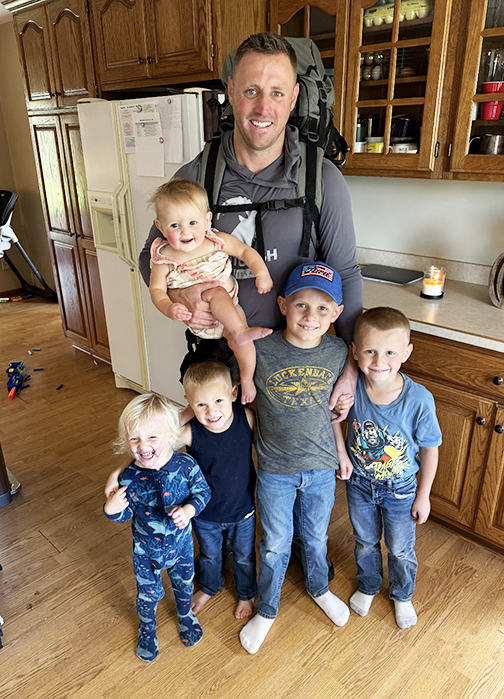
“It wasn’t the biggest bear in the world, but it meant a lot to me so I wanted to spend the money to do a body mount just because I have really great memories from that hunt,” Griess said. “When I brought the bear home my boys were just ecstatic to see a bear hide and head. I mean, you don’t see that in Nebraska, right, and they’re very excited to someday be able to do this.”
Griess and his wife, Rachel, have five children, including four boys and a girl ranging in age from 8 to just under a year. The thought of one day sharing the thrill of bear hunting with his kids is something he looks forward to, especially after watching his friend Scott experience both ends of that spectrum.
“When Scott was a little kid his dad would take him bear hunting,” he said. “Before I left, Scott told me that his dad, Gene, who is 76 years old now, wanted to go up there again to try to kill one more bear. The next weekend Gene killed one of the biggest bears (estimated at 300 pounds) they’ve ever killed and I just felt like Scott kind of returned the favor for what his dad did for him as a little kid. That’s kind of what I want to do with my kids, too. It was kind of a full-circle experience.”
Hunting trips with his kids will have to wait a few years because of their age, but Griess is already planning a trip to try and help his brother and business partner David, as well as other family members experience what he did, for lots of reasons.
“I really enjoyed it because, one, you’ve got to rough it and you have to have teamwork,” he said. “Second, you’re not always comfortable because you’re going to get wet, you’ll get cold and you know you have to persevere. Then you’ve got to learn that you’re not always going to be successful.
“I compare that a lot with business because you’ve got to work together as a team, you’ve got to learn to deal with things that don’t go your way and then you’ve got to learn that if you don’t want to do something, sometimes you’ve got to stick with it and keep going,” he continued. “I just feel like there is a really big connection with backcountry hunting and being an entrepreneur, running your own business.”
Cooking up bear
Another aspect of bear hunting that Griess now better understands and appreciates is what the animal’s fat adds to the menu.
“Back in the day that was Daniel Boone’s No. 1 thing when he would be trading is the bear fat,” he said. “It can be used to treat leather and it’s really great for cooking. When we broke the bear down I took all that fat off, we cubed up some of the bear right there and took some of the fat and put it in a pan. It was the most unbelievable wild game I’ve ever eaten fresh. It’s weird because bear gets a bad rap because in other states they’re eating junk and carcasses, but these bears in Washington are eating berries all the time so it’s a really clean, good-tasting meat. I brought it home to my kids and they loved it too.”
The excess bear fat was later rendered down to make cooking oil to be used when preparing other types of game.
“I went pheasant hunting in South Dakota last weekend (in mid November) and I took some of that bear grease and cooked the pheasants,” he added. “Everybody said it was the best pheasant they’ve ever tasted, so people are just raving about the bear grease.”
Griess is back at work these days, with he and his brother leading a crew of 35 employees as owners of Griess Truck Wash just south of the I-80 intersection. In the back of his mind he’s already planning the next bear hunt, where he won’t be the one shooting, but rather sharing.
“David hasn’t killed a bear so we’re going next year and I really want him to get one in Washington,” he concluded. “Then my cousins want to go here in a couple years and at some point as my boys get old enough I want to do that with them. Everybody’s into different things, you know, different species, but I’ve really kind of locked in on bear and I’ve really enjoyed it. I just want to share that experience.”