
Older people are often targets of grandparent, tech support, phishing, vishing scams
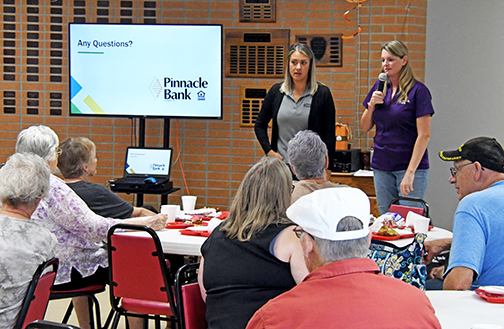
Faith Gustafson is the operations manager at the Aurora branch of Pinnacle Bank, but she told an audience at the Aurora Senior Center on Friday sometimes she thinks she should have the title of “Fraud Specialist.” That’s because her job often entails helping customers – many of them senior citizens – deal with the multitude of scams that seem to pop up every day.
Gustafson and assistant branch ops manager Selena Longoria were at the senior center to give a presentation on fraud prevention. It was an important audience for the presentation because many scams are often aimed at members of the older generation. Gustafson noted that often those attempts at fraud use fear and intimidation tactics and emotional appeals to try to bilk people out of their money, but she said being aware of the risks and paying attention to one’s gut instincts can help older people avoid being taken in.
She defined fraud as any intentional act of omission designed to deceive others and resulting in the victim suffering a loss and/or the perpetrator achieving a gain.
Citing statistics from the Federal Trade Commission, Gustafson said consumers reported losing more than $10 billion to fraud in 2023, marking the first time that fraud losses have reached that high a benchmark. It also marked a 14 percent increase over reported losses in 2022. Nationwide, tech support fraud was the No. 1 crime type impacting those over the age of 60 with almost $600 million in reported losses.
Gustafson listed the ways scammers contact potential victims such as phishing (using scam emails, text messages or phone calls to trick their victims; spoofing (when a scammer disguises himself as a trusted disguises themselves as a trusted person, brand or device); Vishing (scams over the phone, voice email or VolP); Smishing (through the use of SMS test messages) and through fake websites.
Phishing is a specially insidious kind of scam because the emails and text messages often appear to be from legitimate companies with whom the potential victims do business. The aim is to get the victim to visit a website or give out personal information (such as passwords or social security numbers) so they can use it for fraudulent purposes.
Fortunately phishing emails can often be spotted in several ways. For instance, they often have a generic greeting or no greeting at all, they contain buttons with hyperlinks to unfamiliar web pages, the “from” email address (in the header) is not official and they often contain spelling or grammar mistakes. (Editor’s note: If an email asks you to “kindly” do this or that, it’s probably not from an American company.)
Other types of scams Gustafson warned of include tech support scams, grandparent scams, government imposter scams (messages that appear to come from some agency of the federal government such as the IRS or Social Security), romance scams and identity theft.
Tech support scams occur when criminals pose as technology support representatives from companies such as Microsoft or Apple and offer to fix non-existent computer issues. These often occur after an internet search has taken the consumer to a fraudulent website in search of a product or service. The website generates a pop up on the victim’s computer screen that states the person’s computer has a virus and offering a phone number where they can get help to fix the issue. Often that “help” results in the company actually infecting the victim’s computer with spyware and is at a cost of potentially hundreds of dollars. If such a popup appears, the consumer should immediately shut down the browser and if that won’t work power off the computer.
Gustafson showed slides of the various kinds of pop ups supposedly originating from Microsoft or Apple.
One type of scam that particularly impacts older adults, according to Gustafson, is known as a grandparent scam. She said this happens when scammers contact elderly victims, usually by phone. Fraudseters pose as a grandchild or other family member – either by name or by starting the conversation with, “It’s me, Grandpa!” in hopes that the victim will say the grandchild’s name. The scammer then pretends to have been in an accident or some other kind of trouble (or is traveling overseas and needs money) and begs for help while at the same time pleading with them not to tell other family members.
Gustafson said a person should never send money unless they are 100 percent sure of the identity of the person calling and should never send money by wire transfer, gift card or other payment apps, as those are the types of payments scammers often request.
During a question and answer time at the end, Gustafson reiterated the advice to never call the phone number the person on the other end of the line gives them, but to make sure they are actually calling their bank or whatever institution is mentioned.
Gustafson concluded her presentation by saying, “Better safe than sorry is the best thing to remember. If you feel remotely uncomfortable, there’s something wrong. Trust your gut.”