
Community advisory committee asked to seek and share public feedback after reviewing initial plans, projected costs
More than three years after launching a strategic planning process designed to evaluate the Aurora school district’s facility status and future needs, Supt. Jody Phillips invited community members to “get into the weeds” of various construction options last week, sharing for the first time estimated price tags on a number of different what-if scenarios.
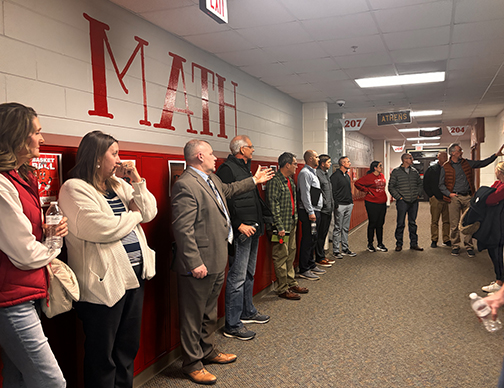
More than 40 members of a community advisory committee gathered for the second three-hour meeting Dec. 17 at the middle school, following up on a similar November session at the high school. Each meeting ended with tours of the facilities, allowing the group to walk through the buildings themselves, looking at individual classrooms and public use areas while hearing about infrastructure challenges involving safety and HVAC systems. Phillips shared with the group conversations he and the board have had with BVH Architecture over the past year involving facility master plans, which have resulted to date in seven different versions of possible solutions.
“We felt it was important to show you all the conversations that have been had and the options that were explored,” Phillips explained. “This is not to say that these are the only options. We might go back and have another seven versions of this, hopefully not, but we might have more options to consider. We just had to get something out there and we had to at least give a little bit of an idea of what it would take to address these issues and just exactly what the price tag is associated with that.”
Phillips began by explaining that a detailed master planning process with BVH has been conducted over the past year, which means that some of the figures being shared for the first time publicly were based on November 2024 estimates. The prices would likely be different today, he noted, let alone the actual cost at the time of construction, should a bond issue project eventually be approved.
“What’s going to end up happening is that whatever we decide on, it’s not going to look like this,” he said. “So let’s just dive into this.”
Option A
With that, Phillips began with an overview of Option A, displaying overhead drawings of the elementary, middle school and high school facilities, each reflecting areas shaded in green (new construction), blue (remodeling) and red (updated finishes).
“The one thing we heard through the process was that this drive right out in front here (the street between the middle school and high school) is not safe,” he said, “with kids walking across the street every 45 minutes, cars coming through there, buses coming through there, kids in the winter weather slipping on ice, all of that. So I’m just starting with one of the main items and components, or options, that was brought forth, which was joining the middle school and the high school.”
Phillips noted that enclosing that space involves more than just putting up walls and a roof, as there is a significant amount of infrastructure under the street that would have to be relocated. He also pointed out that closing the street means coming up with an alternative way for people to enter and exit the middle school, with particular focus on large crowds coming to the varsity gymnasium and theater. The proposed solution to that issue in all of the options reviewed is to move the main entrance to the south side of the middle school.
“So what we looked at as far as options is having two wrestling rooms on the south side of the middle school … and then in addition you now create a common entryway into the gym,” he explained of a space labeled “Husky Plaza,” which also includes buildings on the east side of the campus.
“And you’ll see we have some parking arrangements and improvements that we would propose that would accommodate people walking into this side, versus walking in over here (where they do now).”
Phillips reviewed specific Option A details in each of the three buildings, noting for example that many decisions have yet to be made which could impact space needs. One, for example, involves the concept of moving fifth grade from the elementary school to the middle school, which was proposed last year before being withdrawn in light of the pending strategic planning process.
“We talked about moving fifth grade over here to this building and having this be a fifth grade through eighth grade building, and then having our elementary school be turned into a pre-K through four building,” he said. “So in a lot of the renderings you will see that we have different options, where there’s an extra set of classrooms. And then when we get to the middle school, you’ll see that there’s an extra set of classrooms over there. That’s an either/or type thing, depending on what we decide to do with preschool and what we decide to do with fifth grade.”
Phillips spent more than 20 minutes reviewing various layout options with the classroom pods at the elementary school, while also addressing what have been determined as critical heating and air conditioning issues with the existing infrastructure. Phillips also pointed out security measures, such as installing a new double-door system at the main entrance.
While reviewing the middle school facilities, Phillips said the existing theater has been a big discussion item throughout the process. It’s a heavily used space, he noted, hosting musical and play performances, as well as staff meetings and large class gatherings. He also noted that more than $100,000 was spent this summer updating the lighting and projection systems, since some of the existing equipment was no longer functional. Option A featured a whole new theater, created by extending the existing footprint further to the east in a layout that includes balcony seating.
Option A also included a fully enclosed bus barn, on the same site as the existing facility.
Pausing for the first big reveal of the evening, Phillips displayed a screen listing projected cost estimates for the first master plan proposal. There were some ranges for each facility as follows: Elementary — $20.8 to $24.5 million; middle school/high school — $55.9 to $75.3 million; bus barn — $6.21 million; Husky Plaza -- $6.2 million; for a grand total ranging from $89 million to $112 million.
Option B
Based on the initial cost estimates, Phillips said he drove to Lincoln in January to meet with BVH staff.
“I told them I want to be able to give the board a little bit of something else here,” Phillips said. “Based off that discussion, it was, ‘My goodness. If you’re going to be spending this much money on the middle school and high school renovation, what does a new high school look like? Maybe we need to look at a new high school.’”
Phillips then displayed a layout showing much of the middle school facility changes remaining the same, with some remodeling and upgraded finishes and an expanded theater. A new high school was reflected as a large, two-story rectangular space located to the east of 4th Street in what BVH officials said was a 50,000-foot (as in elevation) concept only type view lacking any specific layout details.
The price tag listed for Option 2 ranged from $143 million to $158 million.
Based on the first two proposals and price estimates, Phillips said he had another key discussion with BVH hoping to provide the board, and ultimately the community, with more options.
“So part of this process was that version number one addresses all the needs that we came up with,” he said. “Version two, based off everyone’s reactions and feelings and emotions, what naturally came up in discussion is to look at a new high school. Version three was okay, that’s all a whole bunch of money. Now we have to go back to reality and let’s just see what we can do that is needed, not at bare minimum, but look at the minimum what we need to do in order to meet the needs of the district and still be somewhat manageable from a price tag standpoint.”
Option C
In March of this year, Phillips said discussions with BVH led to a third plan which involved less renovation work at the elementary school, where he reported that the 2006 bond issue provided some structural changes, adding that another $1.5 million has been spent in the past five years through normal budgeting on various updates. He displayed a drawing showing the new wrestling area and main entryway on the south side of the middle school, noting that the street between the middle school and high school was closed, but not enclosed.
“I told the staff this afternoon that this is addressing the safety issue without addressing the safety issue,” he told the advisory group of an area referred to on the layout as “Husky Plaza.” “This would be a green, grassy area, with maybe a couple of sidewalks that go straight across. You take the vehicles away, but you don’t take the (weather) elements away from that.”
He then went on to explain various changes to spaces being remodeled and/or getting new finishes, including a theater which would be updated, but not expanded, at a substantially lower cost. There were some spaces involving new construction, including an expanded ag shop, as well as the boys/girls wrestling area and new entry way commons area on the south side of the middle school.
The cost estimate for the third version, Option C, came back at approximately $85 million.
Whole new campus
Thinking way outside the box, Phillips said he heard one suggestion during the strategic planning process asking if he or the board had considered the option of building new elementary, middle school and high school facilities on a whole new campus. Without spending any time researching possible sites, land costs, etc., he asked the BVH team to put together a proposal.
That number, though he emphasized that it was a very rough estimate lacking detail, including demolition costs of existing facilities, site and road development, etc., came in at $168 million.
Option E
Having spent several months reviewing the initial BVH proposals, Phillips said the board began narrowing its focus this fall as this school year began.
“We had two meetings this year and really the focus was the high school, realizing that maybe the middle school and the elementary are buildings that are in okay condition,” he said. “They need some work, need some items done to them, but not near as much as what the high school needs. We’re hoping that you will either be able to confirm that or not confirm that based on the building tours that you take.”
Phillips then displayed the latest set of drawings, again showing green, blue and red shaded areas reflecting various levels of work. He noted that the elementary and middle school plans were similar to the previous proposals, then detailed some pressing needs at the high school.
“The key component that I told the staff today (during an all-staff meeting Dec. 17) is the 200 hallway,” he said, referring to a hallway that runs up to the front of the building. “That’s the original 1958 hallway and there’s a tunnel system that runs underneath there. Right in those tunnels are the boiler lines that go out to each classroom to the radiator heat. So if a line breaks, you may or may not know it’s broken.”
Phillips reported a recent problem at the high school where steam was reported coming out of an electrical outlet in the old gymnasium. Upon investigation, it was discovered that a pipe was broken under the stage.
“We had to have the HVAC people come out, go underneath the stage and replace that pipe,” he said. “So 1958 pipes are eventually going to go bad sometime.”
Breaking down a BVH report the board received in October, Phillips said the costs associated with just the high school facility came in at $73 million.
“This was part of the last meeting that we had before we said, ‘Okay, we’ve now explored enough options to be able to go to our community,”’ he said.
Phased approach
Phillips then began explaining the concept of taking a phased approach to any pending bond issue proposal, with an emphasis on addressing the high school facility.
“So you would start with Phase 1, which is build on to the north side, because building a new high school is going to take two to three years at least to complete,” he said. “And it doesn’t mean you just start working in May and then stop in August. It is truly about a two- to three-year process, so while we’re educating students, you would be building on to the Phase 1a, Phase 1b, and then Phase 2a, either to build new or completely remodel, knowing that you’re taking multiple years to be able to do that and have a place for the kids to go.”
In October, the board received a BVH report showing Option E with an estimated price tag of just under $70 million.
Bond election comparisons
Throughout the strategic planning process, Phillips has reviewed and shared the district’s history in terms of when each building was originally built and renovations that have been made since then, either through bond issues or within the district’s yearly budget. He pointed out how much things have changed regarding construction costs.
“The bond (approved by voters) in 1975 was $2.79 million, with another $1.8 or $1.6 coming out of the building fund for a total project of $4.4 million,” he said. “So for $4.4 million back in 1975 that was the middle school, and we got the commons, the kitchen, the theater and the new gym. We also added on to the high school and to the elementary school. I think it would be interesting to see what the same size and scope of project would be in 2025 just to give you a little bit of a reference point with inflation over the last 50 years.
“In 2006, that was a $6 million bond issue, which was 7.9 cents on the bond levy,” he continued. “Because of increases in valuation and refinancing that three times in the last 20 years, we’re now down to just under 2 cents on our bond fund and that bond expires in December of 2026. I think it would be interesting to compare the square footage we gained or remodeled at a $6 million price tag and how much that project would cost in 2025. We’re working on that, if any of you are interested.”
Seeking feedback
Having explained all of the proposed options to date, Phillips gave the advisory committee an assignment, which is to take all that they’ve heard and seen during the two meetings and share that information with the community.
“Here’s my ask of all of you,” he said. “Go and gossip. We just have to be able to put things forward as far as what this looks like, how much it costs, and how does it relate to the true needs. Then, from there we’re going to start narrowing down.”
Committee members were asked to provide feedback they hear from the community to Phillips and the board by early January. That information will then be shared with BVH, allowing time to create revised proposals by the next advisory group meeting, which is expected to be scheduled in February.