
Archuleta keynote speaker at Grain Place Foods annual Field Day event
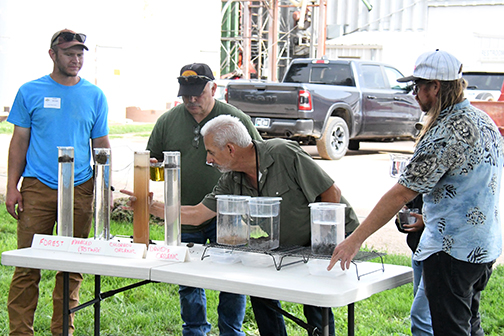
A keynote speaker known as “The Soil Guy” shared insight with more than 100 guests at Saturday’s Grain Place Foundation Field Day, emphasizing the vital role cover crops and reduced tillage play in improving soil health here in Nebraska, across the nation and around the world.
Ray Archuleta, a certified soil scientist with the Soil Science Society of America, said he had an epiphany years ago about the interconnectivity of soil health, water quality, animal health and human health, which in his view after 30 years of study is enhanced by keeping the soil covered.
“If you were to ask me what is your number one thing you would do, I would say cover the ground first,” Archuleta said during an hour-long presentation Saturday afternoon at The Leadership Center. “The first three to six inches in the soil is the most critical because if I don’t get the first three to four to six inches right I don’t care about the next five feet. This is where aggregation occurs, which allows water to infiltrate the soil, which is so critical.”
During a morning demonstration at the Grain Place farm north of Aurora, Archuleta put three samples of topsoil in plastic containers, including one from the Grain Place, one from a forest and a third from a farm which is tilled frequently and utilizes short rotations of corn and soybeans. He then poured water into each container and pointed out how well the water seeped through the first two examples, but was blocked by soil representing a traditional ag model.
“If you disc it a lot, if you bury it and spray it to death, please understand that those are living organisms that are changing and altering the soil,” he said. “They’re part of the water cycle. If we take care of them, folks, we improve human health, we improve the climate and we change everything. It’s huge.”
The more ag producers are able to build soil health, Archuleta continued, the more nutrients will be held in place, holding water, therefore reducing irrigation needs.
“I am personally convinced that we can reduce irrigation by 30 to 50 percent once we go to a no-till, cover crop or low disturbance cover crop system,” he said. “We can hold the water. We can hold the nutrients, and we can reduce the cost of pesticides, fertilizers and chemicals once you get the soil healthy. It’s a game-changer. That’s why I am so excited about regenerative agriculture. It fixes a lot of our issues.”
While showing photo examples of farms and ranches from around the world, Archuleta noted visible differences in what he called more healthy appearing landscapes covered by grass, crops and even weeds. Any kind of vegetation, he explained, impacts soil health in a positive way.
“For every 1 percent of organic matter I build in the soil by using more cover crops, I create more aggregate and those aggregates are super biotic glues,” he said. “They can hold on to nitrogen, which leaks if you have a sandy soil.
“I’ve heard you guys have one of the highest cancer rates here, because you have soil nitrates leaking into the aquifer, correct?” he said. “I have seen sandy soils in South Carolina changed to dark black in three to five years of cover crops. They hold those aggregates, those super biotic glues hold more nutrients, hold the water better, and then you start building more organic forms of nitrogen, which is more stable.”
NRCS background
Archuleta worked for years with the Natural Resources Conservation Service (NRCS) and said after retiring in 2017 he realized a missed opportunity.
“What if we covered the land and paid farmers 100 bucks an acre to cover the soil?” he asked. “What a novel idea. That’s what NRCS was intended to do and we were not getting our money’s worth because we didn’t teach first. If we could pay farmers $100 per acre, it would probably get them out of their financial predicament with corn and soybeans and we could restore the soil. The American people are paying for a functioning water cycle and a nutrient cycle and biodiversity, but we’re not getting it.
“What we need to do is teach producers a simple way,” he continued. “First, the soil is alive. Not one time did I say you can’t use tillage or even herbicides. Back off. You don’t need as much.”
Archuleta referred to the “Kiss the Ground” documentary now available on Prime Video several times during his presentation, saying that 2013 report caused a disruption in the agribusiness realm.
“I care about the land and the people,” he stated. “Am I against Monsanto and all this? I didn’t say that. I am against farmers going broke and the community going broke. I want restoration and that’s what the ‘Kiss the Ground’ documentary is all about. Millions of people are going regenerative ag. It’s gone global, folks. We are excited. Farmers are catching on and we’re backing off fungicides.”
Working together key
As keynote speaker for the day, Archuleta encouraged producers, livestock grazers, Extension representatives, government employees and others present to work together to learn about and understand various holistic management techniques, saying no one can do it alone.
“In agriculture it takes a whole year to find out whether you did the right thing or not,” he advised. “You don’t have years, you have opportunities. That’s why do not work by yourself. It’s too complex. Work as a team. What we do in southern Missouri is we go visit each other’s ranch every summer and we learn from each other. We do not work in isolation.”
By working together and learning from others’ experiences, he said like-minded people can make a difference, and, he emphasized, they already are.
“Here’s where we’re at in the national scale,” he said. “I’m here to help the early innovators. You guys here are the early innovators, early adopters. We are not mainstream. I’m focused on the first 3 to 4 to 5 percent and once they get it, they’re going to shift the community.
“It’s the Davids (referring to David Vetter, Grain Place founder) that are going to shift the local community, not me,” he added. “It’s tough to be in David’s job because they get beaten up, but his example is what’s going to really make the change. All of you are making the changes and the neighbors are watching you. If you think they’re not watching, you’re sadly mistaken. They’re watching.”
Archuleta concluded by noting that documentaries like “Kiss the Ground” and “Common Ground” are educating the public, as is YouTube University, which he said “has been the best thing ever” for global awareness about the importance of soil health.
“It’s happening,” he said. “It’s not happening as fast as I would like, but it’s happening. Washington is beginning to look as soil health was even put in the Farm Bill, which I never thought would happen. So it’s changing, but it’s slow, and we’ve got to be patient.”
Saturday’s educational event concluded with a viewing of “The Vetter World,” a 2018 film which documents the Vetter family’s mission to emphasize and educate the importance of soil health.
Allison Vetter, Grain Place board member and event chairman, reflected on the day’s message and educational activities.
“We’re thrilled with the success of field day,” she said. “More than 100 guests visited the farm, enjoyed a farm-to-table lunch prepared by John Boeder and his team at the Leadership Center, and participated in an engaging afternoon program.”
Vetter personally thanked the Grain Place Foods employees, farmers, farm interns, volunteers and fellow board members who helped make this event happen.
“I’m also deeply grateful to our generous sponsors, whose support makes the event possible,” she concluded. “What’s remarkable about Ray is his accessibility. No matter what kind of farming system you use, he offers practical guidance that improves your farm, supports the environment, and enhances the health of you and your family.”