
Irrigation usage expected to be down significantly in 2024
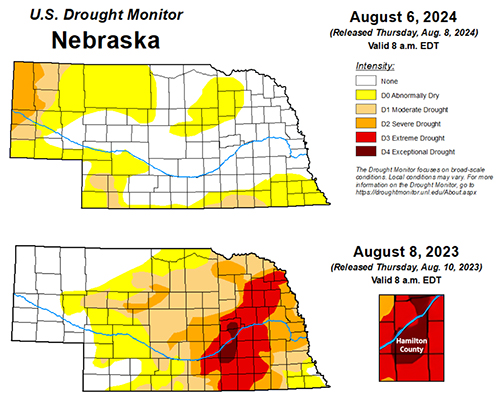
Many local irrigation systems that got a workout throughout most of the growing season last year just started spraying water on crops recently and Nebraska’s two-year drought appears to be becoming just an unpleasant memory. The early days of the 2023 growing season were so dry that most farmers with irrigated land started pumping water on their corn and soybean fields right away in order to get the seeds to germinate and activate fertilizer and chemicals. When the rains still refused to come, the pumping continued right up until harvest time. This year, however, although some producers started their pivots back in May for a short time to activate chemicals or fertilizer, the irrigation systems have stood mostly idle until just a few weeks ago.
In early August of last year the National Drought Monitor map for Nebraska was a collage of yellow to dark rust across the eastern two-thirds of the state showing drought conditions ranging from “abnormally dry” (The D0 category) to “exceptional drought” (D4). Most of Hamilton County at that time was stained in the darkest shade indicating the area was in the highest (D4) category.
However, the map released on Thursday showed a flip flop of drought conditions in the state in which the Panhandle and areas of southern and north central Nebraska are starting to creep back in to the D0 to D2 drought categories, while Hamilton and a large number of counties to the west and northeast of us show no drought conditions whatsoever at this time.
Abundant rains, some of them 1-2 inch downpours, throughout the first half of the growing season have, of course, helped the area turn the corner on the drought situation and the Hamilton County rain gauge shows a huge difference between the two years. The highest total precipitation so far this year (according to the year-to-date precipitation figures published in last week’s ANR edition) was recorded by a weather observer northwest of Giltner. That weather station is reporting a total of 24.992 inches of precipitation so far this year. By comparison, last year at this same time another observer in the same area was reporting less than half that amount–12.190 inches–for the year.
Easier on the aquifer
In addition to the evidence provided by the rainfall figures and drought map comparison, irrigation pumping figures provided by the Upper Big Blue Natural Resources District (NRD) also tell the tale of the two-year dry spell.
According to a chart showing the average inches pumped per acre across the district for agricultural irrigation each year since 2007 (the first year the NRD began collecting those statistics) 2023 was the third highest year for irrigation pumping at 9.56 acre-inches applied to crops. Meanwhile, the first year of the recent drought (2022) came in as fifth highest at 7.53 acre-inches.
The highest irrigation pumping took place in the year 2012 when an average of 12.2 acre-inches were applied to crops in the NRD. The following year was second with a total of 10 acre-inches. The year 2016 came in fourth highest at 7.6.
In looking at the drought maps for those years one learns that at the end of July 2012 much of Nebraska ranged from D0 to D2 and the next year was even worse with most of the state being in the D1 to D4 drought categories.
Henderson area farmer Jason Lewis remembers 2012 as being hot and mostly devoid of rain.
“There was none,” he said. “It was just sunny all summer.”
When told about the NRD pumping figures, Lewis said he was shocked last year wasn’t at the top in terms of acre-inches pumped.
“Just because there was no subsurface moisture, I mean, there was nothing,” he said. “Some of that corn would get up and it got like that tall and just turned purple. We put in some pivot stops and when we used the post hole digger it was just dry to three feet. There was nothing there. Some would say ‘It’ll root down,’ or “It’ll find it.’ And the old guys will be like, ‘Oh, it’ll always get knee high,’ but it wasn’t getting knee high because there was nothing there.”
Lewis says, like most farmers in the area, he started his pivots last year soon after planting.
“Yeah, it came up, and then we pretty well started,” he said. “We sprayed it to get chemical activation and then it just kind of kept going. It wasn’t the full inch, but it was put three quarters on or put a half inch on and it was pretty much every week just doing that.”
While official NRD irrigation pumping statistics for this year won’t be available until December, the figures are expected to go down significantly from 2023. For instance, Lewis estimates his irrigation pumping will perhaps be a quarter of what it was last year.
Meanwhile, Mike Bergen, president of the Hamilton County Corn Growers Association estimates that while he used between 12 and 15 acre-inches of irrigation water last year, he expects this year’s pumping to be more like 4-6 inches.
Of course, the amount of irrigation that takes place between now and harvest season will depend on whether the rains continue to come. And according Alan Hickford, a forecaster with the National Weather Service office in Hastings, the pumping may need to continue for a while.
Hickford says the region is currently in an El Ñino-Southern Oscillation neutral position which is expected to continue for the next several months.
“For the next three months we’re looking at below average precipitation and probably slightly above normal temperatures,” he said. “There’s a better than 50 percent chance of that occurring.”