
Brhel explains the genesis of recent farmer-led nitrogen reduction effort
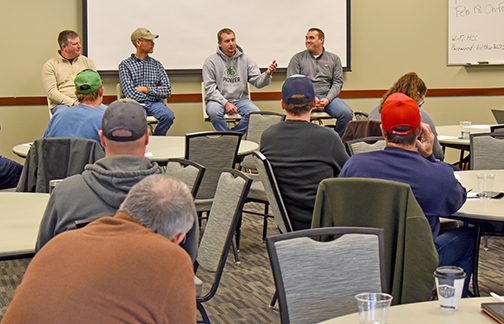
Agriculture is facing many challenges these days, not the least of which is low commodity prices coupled with higher input costs. Another concern has to do with how the over-application of nitrogen fertilizer may be leading to the rise of harmful nitrates in our area’s groundwater. One local UNL Extension educator is addressing some of those issues with a challenge of her own to area producers – use available technology to apply only the amount of nitrogen the particular field needs during the growing season.
Jenny Brhel is the Extension educator for Engagement Zone 7 (based in York) and writes a weekly agriculture blog that is published in this newspaper and elsewhere. She also operates a farming operation near Denton with her husband, Brian, and has been an active participant in the newly-formed Nebraska Soil Health Coalition. (See the Feb. 17 edition of ANR for an article detailing the award she recently received from the group.)
For about the past four years, Brhel has been working with a group of farmers in this area on what she calls the Nitrogen Challenge, a voluntary program that uses technology provided by Sentinel Ag to help those producers avoid over-application of nitrogen to their crops while still getting high yields on their crops.
“It really started back in 2019 when there were a lot of questions from producers about if they were still part of the problem regarding nitrates and groundwater,” Brhel said, going on to clarify the question she was getting from farmers. “They just wanted to know if they were still contributing to nitrates in groundwater, and how do we prove that, one way or the other? So from about 2019 on, a number of producers in the area have done on-farm research studies with me around the topic of nitrogen. And no matter what we tried and what we did, we never really saw any differences in yield. And what we kept finding, in general, was we’re still over-applying even though we’re reducing rates in these studies.”
Brhel says coinciding with those findings were negative articles being published which drew parallels between nitrogen use by agriculture and high levels of nitrates in the aquifer.
“And it was making the farmers upset,” Brhel continued. “And I asked, ‘Well, what do you want the headlines to be, and how do we change that story? How do we right now change the future?’ And so really the Nitrogen Challenge was born out of those conversations.”
Enter Sentinel Ag, a company developed based on research at the University of Nebraska – Lincoln that was “established with the goal of giving agronomists and farmers a win-win nitrogen management solution for farm profitability and environmental stewardship.”
Brhel said research on plant sensing has been ongoing at UNL since the 1990s.
Tech to the rescue
“We just didn’t have the technology to implement the research,” she said, noting that new technology has finally given researchers the information they need. “It’s basically using sensing imagery, using light spectra that our eyes can’t see – like infrared and far red, red edge – those are all light spectra that our eyes can’t see, but sensors can see them. And by using sensors, it can determine when a plant is stressed before our eyes can see it. And in this case, with these sensors, it can sense it seven days before the plant is stressed. But the thing is, we haven’t really had the technology to go with the research. In the past, you had to either use handheld sensors and walk fields or you had to mount them on a high clearance rig. And no one really did that... So then what happened is, with the advent of drone technology – it was a grad student at UNL, Jackson Stansell – he started with flying drones, and then he converted the formulas to use satellite imagery. And with satellite imagery, it just makes everything so easy, because the satellites go over the fields every day, and they can just process the imagery using the equations. So it’s just the fact that the advent of technology came so far in such a short amount of time that it made the research relevant.”
Brhel says Stansell went on to found Lincoln-based Sentinel Ag which provides the important information directly to farmers at a cost of between $5 and $12 per acre.
“And for several years, UNL and Sentinel have cooperated on on-farm research, and just trying to get more data around it for different situations,” Brhel said. “Different soil types, whether it’s irrigated or dry land, whether there’s cover crops in the system, and even for different crops, and so because of that, after seeing the on-farm research the first two years and after following Jackson as a grad student, I was sold, because of what the research was showing us... By that point, I had taken thousands of soil samples, and a lot of on-farm research studies, and nothing was showing a difference. And I knew we were still over applying, but I didn’t know how to show and how to make a difference in it, and I didn’t know how to change the story and how to help farmers see that we had an opportunity to change the story. And what I realized it was, it was in a couple of our on-farm research projects... they put on 30 pounds of nitrogen at one time, or 60 pounds of nitrogen at one time during the rapid growth phase. And there was a similar amount of nitrogen that was put on throughout the growing season, half the rate of what many growers would put on, but there was a 20 bushel difference between the timing. And I said, as an agronomist, I can’t do that. I can’t see when that crop needs that boost at the right time, so that we’re being that efficient with nitrogen. And I as an agronomist, will never be able to tell people how much nitrogen they need on their fields, because I can’t know. I mean your soil type, the hybrid, the mineralization, which none of us know how much that’s going to occur each year, how much rainfall or irrigation, all of that comes into play for the nitrogen that crop needs. And the other thing that happened during that time frame is we had those horrible hail storms, and we didn’t put on any other nitrogen on those replant crops. And it was an amazing thing to raise an over 200 bushel crop of corn with no nitrogen after a hailstorm. But the satellite imagery could tell us that kind of stuff, and I can’t see these things. I don’t know these things, but with the technology and the research, we can help farmers be that much more efficient and do that much better of a job for the future.”
Changing the story
Brhel says on the heels of that realization by herself and others, a core group of farmers quickly coalesced around the concept saying, “This is how we change the story” of nitrogen overuse.
Brhel says that original core group is still around and has grown, as those who had found success in reducing nitrogen inputs began to promote the challenge to their peers and then became mentors.
“So what that means is, this year we’re going to start the process of farmers walking alongside of other farmers who’ve never used the technology, teaching them how do they look at the imagery,” she said, adding that there’s another mission for those mentors as well. “Sometimes we need support when we’re not doing things the same way we’ve always done them. Sometimes we just need somebody to talk to about it so we don’t feel so alone.”
York County farmer Tyler Smith, a member of the Nitrogen Challenge team of producers, said he has been able to lower nitrogen use by 10-40 percent by using the technology, while at the same time achieving several new field-best yields.
“We don’t decide how much irrigation we will need for the next growing season in November or March,” he said. “It’s a real-time decision that we make as we go through growing season that accounts for changes in weather, yield potential, ROI, etc. We have the ability to manage nitrogen the same way that accounts for all of the unknowns in real-time with a sensor-based approach.”
Farmer Jason Richters adds, “The ability to know if the crop needs a nitrogen application based on satellite imagery is a game changer, and we have learned that we can better manage and reduce our nitrogen application rates while maintaining yields. This is good for our bottom line and may eventually reduce nitrate levels in our groundwater.”
Another Nitrogen Challenge participant, Erik Friesen, who farms in both York and Hamilton counties, asks an important question to his farming peers: “If people can update equipment, adapt to different tillage practices, use of autosteer and technology, why do people still use the same idea they did 40 years ago when it comes to fertilizer recommendations?”