
Resistant hybrids, timely application of fungicide are keys to management
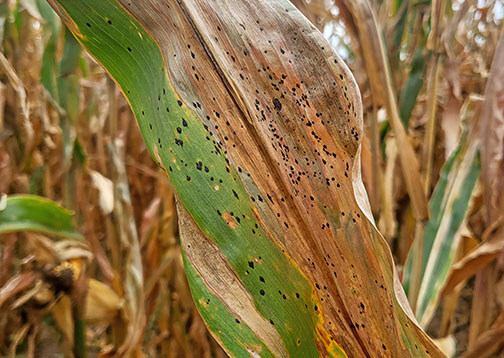
It looks like the fungal infection known as tar spot is here to stay in Nebraska corn fields, but fortunately there are ways to mitigate the impact on corn yields.
Concerned area corn growers were eager to learn more about the fungus and the ways to deal with it. So eager, in fact, that more than 70 of them turned out on a blustery winter Wednesday morning two weeks ago to attend a tar spot conference sponsored by Hamilton County Extension and several local businesses including cooperatives and seed corn sales reps.
The speaker for the presentation was Dr. Tamra Jackson-Ziems, a faculty member in the UNL Plant Pathology Department who leads research and Extension efforts related to tar spot in Nebraska. As a plant pathologist, she has been watching tar spot since it first emerged in corn fields in eastern states in 2015. She said since then it has quickly moved westward.
“So the fungus was first confirmed in Nebraska in 2021 and it was really late in the year, and it has continued to move further west in the state,” Jackson-Ziems said. “It’s about halfway across right now, and so the reality is it’s probably been in Hamilton County, for instance, for going on a second or third year now. It takes some time, usually – two to five years – before a fungus like this builds up to where we have enough of it, or what we as pathologists, call inoculum, where we have enough built up that it starts to cause more significant and consistent disease.”
“This fungus over winters in at least the old leaves and husks from the previous year that are infected, but this is a fungus that is strongly favored by certain conditions, temperatures, for example, in the 60s and 70s,” she said. “We think of that as being kind of cool, but it’s actually optimal for this fungus. Now when we get outside of that range. for example, when it gets hot in the corn in the summer, it doesn’t kill it by any means. It just slows it down. And so when we do have those conditions that are in the 60s and 70s, it will be more active during that time, and especially the second part is, if it has moisture. And so this fungus, like most of the others, it needs some level of moisture and high relative humidity for the spores that it produces to germinate and infect corn.”
As the name suggests, tar spot first appears as tiny black spots on the corn leaves. As the fungus spreads the spots cover more and more of the surface area of the leaves.
“The more of it there is on the leaf, the more that it inhibits that leaf’s ability to feed the ear, for instance, and fill the grain,” Jackson-Ziems said. “That leaf and the plant as a whole is programmed to fill grain at all costs. And so the leaf will try to do that and send those photosynthates back to the ear to make bigger kernels and higher yields. But when you start compromising part of it, that’s how we start to cost yield.”
Jackson-Ziems told the crowd at The Leadership Center there are currently only two tools at the farmer’s disposal to deal with the disease – resistant hybrids and fungicides.
“So I recommend people work with their corn seed corn agronomist and select hybrids that may have better scores or better resistance to tar spot,” she said. “On top of that, if we still have disease in the field, we do have very effective fungicides that are available to us right now. It’s difficult with the narrow profit margins and corn prices that our farmers are dealing with.”
Jackson-Ziems said Nebraska farmers are fortunate in that studies began on tar spot soon after it started to impact crops in states like Illinois and Indiana so much research has already been done. She said researchers have found that it’s not so much the early application of fungicides that makes the difference, but the proper timing of the application.
The right time to spray
She said her counterparts at Purdue University in Indiana have learned that it’s best to apply fungicide a bit later in the growing season.
“What they’ve seen in Indiana is it can start during the very young stages of corn, the six- and eight-leaf stage,” she said. “And it wasn’t until they saw disease begin to move higher in the canopy or higher on the leaves, we call it VTR one, that’s after the tassel has fully emerged, and it’s going through pollination and just past pollination, or into the R3 stage, up into what we would call milk stage, those fungicide applications during that time in Indiana had the best results for controlling the disease.”
Jackson-Ziems said those studies also showed that crop rotation, tillage and other practices seemed to have little effect on tar spot, and she added the bad news for area farmers is that it seems to thrive in fields with pivot irrigation.
“By irrigating over the top of these plants, we’re keeping it wetter and more humid inside that corn canopy,” she said. “And we knew early on that those conditions would be more favorable for tar spot once it did arrive. Watching what was happening in other states where they do have a little bit of irrigation, like Michigan and part of Illinois, they were reporting significant differences in fields that were irrigated, pivot irrigated in particular. And so once it moved into Nebraska, we knew this was going to be a critical area for us to research.”
Thanking the Nebraska Corn Board and the North Central Integrated Pest Management Center for supporting her research, Jackson-Ziems said graduate student and UNL Extension Instructor Talon Mues, is conducting research on tar spot under irrigation pivots to help to better understand how it behaves in that environment.
“I want to give my student credit for it, but one of the things we have learned is – and farmers know this – they know it’s not the same along the entire length of the pivot, but those inner irrigation spans that are closer to the pivot point stay wetter longer versus the outer end, where it waters faster. And so part of my student’s project was to look at disease under the different irrigation spans. And in 2023 he saw more tar spot, and that it developed up to two weeks earlier in the span closest to the pivot point than it did compared to the outer span.”
Where to check for tar spot
“Now, at this point, I can’t tell anybody to make any changes,” she continued. “We’re repeating that work. And in 2024 as long as it was irrigated, it didn’t matter where you were under the pivot. So this might be a year to year effect, but one of the things we’re recommending is that if people are scouting for this disease trying to see if it has developed, I would recommend that they go to the pivot point first, or at least the inner span or two, and look. And so in that case, it’s in contrast to what most of us do. You know, driving down the gravel road, you jump out and you walk in from the outer edge, through the end rows, for instance, where it’s easier, but I think we might have more success and know what’s going on if we go to the pivot point first.”
Jackson-Ziems said the difference at that location is temperature and humidity – the two factors that most impact tar spot growth.
“He has a mountain of data on how much the temperature decreases,” she said. “It was up to 13 degrees cooler under the inner span versus the outer span, and at its peak, it lasted for several hours. So that’s how we’re explaining that, plus it stays wetter longer on the leaf surfaces at the inner span versus the outer span. So we’ve got some data to back up why this might be occurring. Now, at this point, we need another year or two of data and then some, if we hope to tell farmers to change something to mitigate that. And so that’s Phases 2 and 3 of this research. Hopefully you and I will have this conversation again in two or three years, and I’ll have more to share with you on what we recommend.”
Speaking in reference to the turnout for that Wednesday morning conference in Aurora, Jackson-Ziems said she was “blown away” by the response and participation of area corn growers and agribusinesses.
“It was just amazing!” she exclaimed. “And I’m so impressed with what’s going on in your county, and so pleased to see so much support for Extension, and I’m grateful – so blown away, grateful and humbled. Because I never expected we’d get that many people on such a yucky day... and I’m just so pleased.”
Jackson-Ziems welcomes questions and comments from producers regarding her work on tar spot. Emails can be sent to tjackson3@unl.edu. She can also be found on X (formerly Twitter) where her handle is @tjcksn.