Hampton firefighters receive grain rescue training at Bradshaw event

Hampton Fire and Rescue joined together with the Bradshaw Fire Department and Henderson Fire & Rescue to test out Central Valley Ag’s (CVA) grain training trailer on June 11.
Arriving with 10 volunteers from Hampton, fire chief Dane Schafer said Bradshaw Fire had invited Hampton to participate in the session to try out the training trailer for grain engulfment rescue scenarios.
“We always jump at the opportunity to train with our neighboring departments as it really helps us work together in a real-life emergency,” Schafer said. “It also allows us to get to know personnel on each department and allows them to know what we have to offer and what they can offer us in a mutual aid situation.”
Through training at State Fire School or at Hampton’s monthly training sessions, Schafer said training exercises like this help prepare firefighters for any type of rescue.
“This is a great opportunity for us to get to refreshed in a safe environment and it’s nice that it is mobile so we can bring it to our station to refresh each year or as needed,” he continued.
Bradshaw EMS captain Erin Ditloff said her department reached out to CVA last year to create a $75,000 trailer designated for training local fire departments.
“We went to CVA and we wanted to do a grain rescue training because we have the coffer dam,” Ditloff explained. “But we just haven’t used it as much and it’s not easy to just go practice. When we went to CVA, there were some safety concerns, because most areas around here do it on a grain trailer, where they pull in a small trailer and they do it in there.”
CVA representative Joel Wochner explained that in addition to providing a grain trailer that will provide safer training opportunities, it will allow firefighters to try out their equipment in a variety of scenarios.
“It’s important training for the fire department, so if we have a farmer or somebody who gets engulfed in grain, they kind of have a general idea how to use all their equipment to get in there and get them out,” Wochner said. 
Pat Sheehan, who has served with Grand Island Fire as an EMT and firefighter for 23 years, has been instructing firefighters in grain engulfment rescues for 10 years. Prior to training, he went over potential scenarios that firefighters could face when rescuing someone from a bin.
“Sometimes if you don’t know where the person is, you have to cut a hole in the side of the bin to locate them,” Sheehan said. “We talked about that and I talked about how it’s very important to get advanced life support coming to the scene as soon as you get the call that it’s a grain entrapment.”
In addition to time, the preparation of the firefighters is just as crucial, from the equipment they have at their disposal to the gear they wear. 
“We don’t want to wear our bunker gear,” he stated. “It’s too bulky and too hot. Now if it’s 95 degrees outside, it’s probably 115 degrees in the grain bin. If you go down from heat exhaustion or something, you’re not doing anybody any good.”

Engulfment scenario
The first scenario Hampton firefighters participated in was the complete engulfment of a dummy within the grain trailer. Firefighters had to poke around to find the dummy before using coffer dams to block the grain from pouring back in as they dug.
“When we originally set it, we didn’t have it big enough with the way the rescue mannequin was sitting,” Sheehan said. “We didn’t go big enough to get around his feet so then we had to reposition and make a bigger circle around him.”
Schafer said that while it was challenging to recreate a realistic rescue, the trailer made it safe to try out the scenario in a realistic manner.
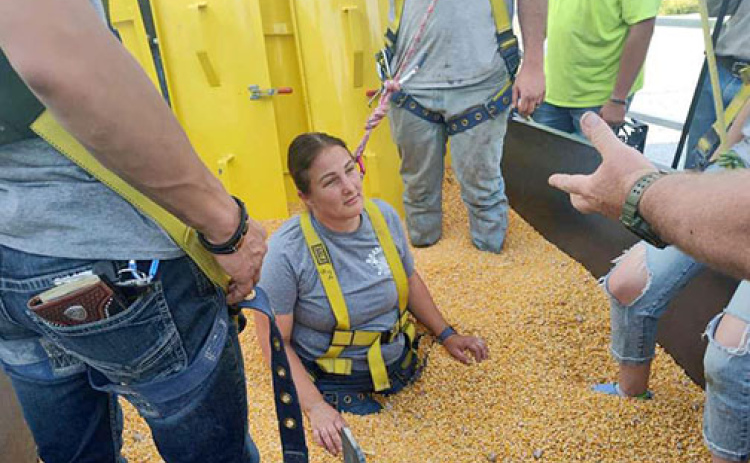
During the second practice, Ditloff submerged herself up to her waist for firefighters to practice a live grain rescue.
“I definitely felt claustrophobic in there,” she commented. “When I got buried up to my waist, I could wiggle a little bit, but every time I wiggled, the corn got tighter and tighter and there was less wiggling. There was no way getting out of that.”
In any situation, Ditloff stated that the best tool for survival is to keep calm.
“Even when I was entrapped in there, it makes your brain want to panic, but the biggest thing is to stay calm.”
Sheehan shared the same sentiment.
“If something’s happening and you feel that you’re starting to get buried, what I tell people and it’s real hard to do because of the panic and whatnot setting in, but to put your elbows against your chest and cover your nose and mouth with your hands,” Sheehan stated. 
Sheehan encourages farmers for their safety and to prevent grain engulfments, that they should always be prepared and take the necessary precautions when operating around a grain bin.
“Never enter a bin with the unloading auger running and it is always best anytime you’re going into a grain bin to have two people; one person at the door watching while the other person’s inside doing the work,” he stated. “If you think that something could happen because the grain is out of condition, spoiled a little bit or something, a safety harness and a rope leading to the outside will hold you and keep you from sliding in.”
While the trailer was made to train firefighters for grain engulfment rescues, it also provides farmers or anyone working with grain trailers the knowledge to safely use or move around them.
“I just encourage all departments, farmers or anybody that’s working around it to try to get at least some of the basic training, just for the safety of it and for the education,” Sheehan commented. “The more you do something a lot of times, the more complacent you get in doing it.”
Wochner acknowledged the sponsors that made the training trailer possible which include Agri Sompro, Circle D, CoBank, Cornerstone Bank, EBM Manufacturing, Express Feed and Grain Parts, Farm Credit Services, Green Plains of Central City, Jake’s Electric, Klute Truck Equipment and Sales, Louis Dreyfuss Company, McPherson Concrete Companies, OR Electrical, Ortmeier Technical Services, Pro Crane and Unverferth Manufacturing Inc.
“We would like to extend a sincere thank you to CVA and all the sponsors for putting this life-saving trailer together and we really appreciate being part of the first training session with it,” Schafer commented.
Sheehan looks forward in seeing the training trailer become more available for firefighters and the public.
“I’m hoping we can get this trailer out and around to different fire departments and if those departments want an instructor, I’d be more happy to come and share the knowledge I have with them to educate more people,” Sheehan concluded.