Meeting seeks solutions to lax driver safety in rural NE

Subhead

NDOT, County Highway sponsor brainstorming time

It seems because of the lighter traffic in rural areas of Nebraska like Hamilton County, people who live or drive through here tend to be less concerned about highway safety, but, according to the Nebraska Department of Transportation’s (NDOT) Highway Safety Office, that attitude can lead to carelessness which leads to a higher incidence of injury and fatal crashes in rural areas. State Highway Safety Administrator Bill Kovarik said in Aurora last week that there were 23 injury accidents in the county last year and one fatality. Kovarik said to blame is a casual attitude on the part of drivers when driving rural roads and lax seat belt usage in less populated parts of the state. 
Kovarik of Lincoln was one of the organizers of a highway safety public meeting held at the fairgrounds on Thursday evening. While the event didn’t attract many members of the general public, it was deemed a success by the organizers and attendees. The “planning and engagement meeting” was co-sponsored by the NDOT Highway Safety Office and the Hamilton County Highway Department. In attendance at the meeting held at the 4-H were Kovarik and Highway Safety Office Supervisor Greg McVey, County Highway Supt. Jeremy Brandt, Hamilton County Commission Chairman Rich Nelson, Hampton Ultilities Supt. Chris Friesen and this reporter. 
While much of the meeting consisted of an exchange of information about traffic issues in the county and brainstorming ideas for increasing awareness of traffic safety, Kovarik took time to speak to why his office has a special concern for rural areas. For one thing he said seat belt usage is low for the entire state but especially in the rural counties. Kovarik reported that Nebraska ranks 48th in the nation for seat belt usage and the usage has been declining since COVID for some reason. He said in a recent seat belt law enforcement campaign by the Nebraska State Partol, troopers had written well over 100 citations in just 10 days. He said in rural areas seat belt usage is even lower. 
He said because not wearing a seat belt is a secondary offense, officers can’t stop a driver for that reason, and notes that even if a driver is cited for a seat belt violation, the charge is often dropped or thrown out by judges. Therefore, he said, since enforcement efforts don’t seem to make much of a difference, his office is looking for ways to increase public awareness of the need for seat belts.
“We’re hoping to find out what the mindset is; why the people think they need not wear a seat belt,” he said, noting that seat belts have been proven over and again to save lives. “If you look at some of the recent fatalities in the state... There have been a few of the crashes recently where—one I know of was an individual in northeast Nebraska—where they ventured off the road, probably on their cell phone, and hit the side of the road and then rolled. The vehicle had a little bit of a dent in the top—I think it might have been dented down a little bit on one side plus the windows were gone—but they were dead because they didn’t stay in the vehicle.”
By comparison Kovarik described a recent head on collision a high rate of speed in which every part of the vehicle had sustained damage but the driver who was buckled in survived.
“He had a lot of injuries,” he said, “but the other guy didn’t have a seat belt on and the other guy didn’t survive.”  
Noting that one of the common objections to seat belt usage is worries about crashes in which the vehicle goes into water. 
“Well, that happens in Nebraska in like 3 percent of the crashes,” Kovarik said. 
He also noted that just because a vehicle isn’t traveling at highway speeds that doesn’t mean seat belts aren’t needed.
“Even at 35 mph, say there’s a speeding maniac coming the other way at 50 mph (if there’s a head on collision), there’s an 85 mph impact right there!” he said. “If you don’t have a seat belt on you’re not going to fare very well.” 
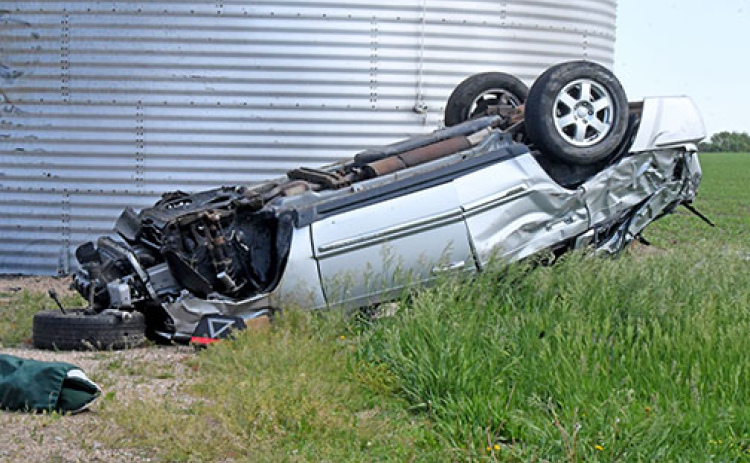
It was pointed out by meeting participants that a fatal rollover accident that occurred on Highway 34 east of Hampton last month involved a driver who was not buckled up. Kovarik said statistics show that more than 70 percent of traffic fatalities involved drivers or passengers who were not buckled up. 
Kovarik said another problem is complacency and carelessness on the part of locals who regularly drive certain roads. He gave the example of a 4-way stop intersection near Lincoln where a paved and a gravel road meet. There have been two fatalities at that intersection because in each instance one of the cars failed to stop. 
Brandt pointed out that just such a collision had occurred just the night before on County Road 6. He said one of the drivers had ignored a stop sign. 
Another major problem on both urban and rural roads is distracted driving, especially due to cell phone usage. Kovarik said while texting is the bigger distraction, even talking on a cell phone while driving can be enough to cause careless driving. 
Friesen estimated that up to 70 percent of the drivers he observes coming through Hampton on Highway 34 on a regular basis are on their cell phones and he said many of them are obviously texting. 
The conversation also included strategies for ways to reach drivers of all demographics to help them become better drivers. Of special concern is younger drivers who Kovarik said are over-represented in crash statistics. He noted that drivers education can make a major difference in lowering crashes among younger drivers and said a UNL study had shown that graduates of drivers ed were better drivers up to 10 years later. However, he said many schools no longer offer it and taking a private course can cost as much as $450. 
The biggest impact on teenagers, Kovarik pointed out, however, is the example of their parents. 
“The more the parents model and instill the behaviors, the better the kids will do,” he said. 
One suggestion offered up in the meeting was that localities could start a program to reward good drivers as an incentive for everyone to drive more safely. Kovarik said such a program would need sponsors such as local insurance offices to provide the prizes because state money cannot be used for such purposes. 
The NDOT representatives left the meeting vowing to continue their efforts to raise awareness of highway safety in Hamilton County and said they were hoping to find a better time for bringing more members of the general public into the discussion at a later date. Others in attendance seemed energized to help find solutions and Nelson said on Monday, “We were small in numbers but I thought we had some good ideas!”