
Aurora beacons at county courthouse were some of first in nation back in 1964
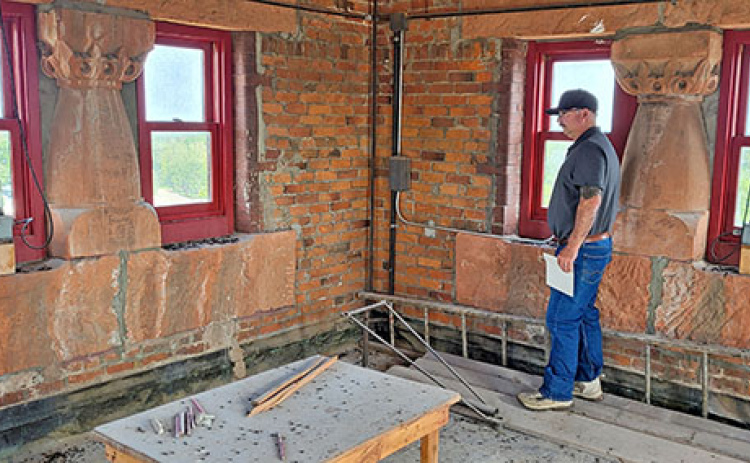
For six decades now a set of four of Dr. Harold “Doc” Edgerton’s strobes have been flashing out from near the top of the Hamilton County Courthouse spire to warn aircraft of the tall obstacle and reminding local residents of one of the town’s favorite sons.
Powered on by a photoelectric switch each evening at dusk (or even when dark clouds are overhead), the beacons flash out in four directions just as they have been doing ever since they were donated to the county by Edgerton himself.
While there is not a great deal known about how the donation came about, a front page article in the June 25, 1964 edition of the Aurora News-Register stated:
“Dr. Harold Edgerton of Boston has been visiting his mother, Mrs. F.E. Edgerton, this week and he has provided Aurora with one of the few new strobe lights he has perfected for use in calling attention to tall buildings for planes flying the airways.
Dr. Edgerton informed us this is the only light now being tried out for experimental use with the exception of several on the M.I.T. buildings in Boston,” the article continued. “This type light has been used in the waters off the eastern shore line to warn ships at sea. Dr. Edgerton is of the opinion that the light will prove to be valuable to air traffic. The light on the courthouse will flash every few seconds and operates from regular light circuits. The lights are visible for about seven miles.
The new type light is similar to the strobe light invented by Dr. Edgerton several years ago and used extensively in photography.”
Such beacons are a common sight at airports and on tall structures across the country today (Any structure more than 200 feet tall must have one at night.), but, as the article points out, they were something of an oddity in 1964 and the courthouse appears to have been one of the first buildings in the nation to receive one.
About Doc Edgerton
Edgerton, who was born in Fremont, moved with his family to Aurora where he graduated from high school in 1921. After getting his bachelor of science degree in electrical engineering from UNL, Edgerton went on to get his masters of science degree at the Massachusetts Institute of Technology (MIT). While at MIT he developed and perfected the world’s first electronic strobes for use in photography in 1930. Edgerton’s stroboscope was combined with a high speed camera to capture ultra-high speed photographs such as the impact of a football player’s foot striking the ball or the crown formed by a single droplet falling into a bowl of milk.
He later worked with the U.S. military on the development of a strobe powerful enough to be mounted on an airplane and used for nighttime reconnaissance photography over France prior to the D-Day invasion, 80 years ago this month. (See the article by Emma Bullerman in the June 5 ANR edition)
Edgerton went on to win more than 40 awards for his achievements in science and was presented the National Medal of Science award by President Richard Nixon at the White House in 1973. Through his technology he also helped famed ocean explorer Jaques Cousteau photograph the ocean floor. He was so much a part of those expeditions the crew of Cousteau’s ship, “The Calypso” gave him the nickname “Papa Flash,” which was one of several names he was known by locally as well.
However, for all of his fame and accomplishments as “the man who made time stand still,” Edgerton never strayed far from his Nebraska roots. In fact an ANR article at the time of his death in 1990 at the age of 86 stated, “Edgerton lived far from Nebraska, but it was never far from his heart.”
That loyalty to his hometown was no doubt the reason for his gift of the courthouse beacons in 1964.
How many steps?
The man who knows the most about the strobes today is the same one responsible for their care, Courthouse Custodian John Bish. He says two of the lights in the tower — the ones facing the north and south — are the original ones donated by Edgerton in 1964, however, the other two have been replaced at least once. The latest replacement took place about a year ago following a lightning strike which also took out the building’s elevator for several months.
The other big change over the last six decades has been the installation of 12 windows on the top floor of the tower where the beacons are placed in the middle opening on each side of the structure. Bish says that floor was originally open to the elements meaning that a weatherproof hatch had to be opened to access the very top of the spire. It’s uncertain when county officials decided to install windows in the openings.
Getting to where the strobes are installed takes quite a bit of time and effort and is not for the faint of heart. After signing a liability waiver, in order to be able to photograph the strobes, this reporter climbed more than 30 steps to the third floor of the courthouse where the courtrooms are located, and then went up several more stairs to a landing where the access door to the attic is located. From there it was up another set of stairs to the building’s spacious attic which is still used for storage, but the climb to the very top was just beginning.
From the attic there are at least three more wooden stairways that lead to the top of the tower where the strobes are located.
Once there, the tower offers spectacular views of Aurora. The water tower can be seen out the west windows and the Aurora Cooperative grain elevators are easily spotted through the southern windows.
Upon arriving at the top, Bish placed his hand over the electric eye mounted in one of the north windows and within seconds the beacons began their alternate flashing, just as they have been doing every night for the past 60 years, thanks to Papa Flash.
Thanks to the Plainsman Museum for access to their records and Edgerton displays for help in researching this article.