
Paider shapes manager training at Sodexo
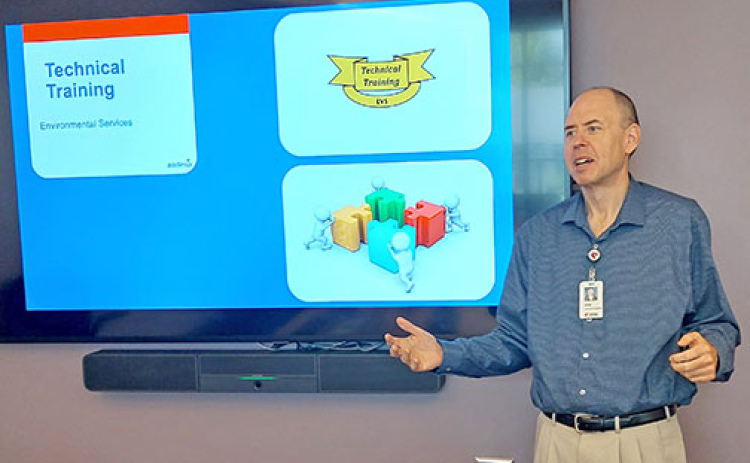
Improving the quality of life for others and finding the resources needed to solve challenges had been a driving point in Kevin Paider’s training curriculum at Sodexo in Omaha.
“I always make sure there’s a lot of discussion during my training about what does that look like day-to-day in the real world and what are some of the real-world challenges that you’re going to be encountering and talk through potential ways to address and learn from it,” Paider said.
Paider, the son of Ron and Fern Paider, grew up in Aurora. After graduating from Aurora High School in 1985, he attended Kearney State College originally to study accounting.
“I got deeper into accounting, realized that really wasn’t what I wanted to do and to change gears I went into the management function,” he explained. “I got a job on campus at the cafeteria and started working in food service and actually started supervising as one of my jobs there.”
After graduating from Kearney State College with a degree in business management in 1991, Paider followed his newfound gusto in management for Country Kitchen in Hays, Kan.
“I was with them a total of about seven years and then I joined Old Chicago Restaurants and worked for them for 18 years,” he shared, noting that he was at locations in Omaha, Denver and Minneapolis.
Paider took on the roles of general and regional manager in operations before finding a newfound passion as a training manager. Completing his time with Old Chicago Restaurants, he worked as the director of training for Culinary Software Services in Boulder, Colo., in 2015.
“It was called Chef Tec Software and it was basically software that assisted food service establishments, inventory management, ordering systems and things of that nature,” Paider explained.
When COVID impacted the United States in 2020, Paider was left out of work until the following year when sought out by Sodexo to become a training manager.
“It’s a very large global company in the Top 15 employers in the world,” he stated. “They specialize in contracts with companies that need services provided in a variety of things, mainly food and environmental services, but we’re (also) in schools and universities. Places that hire these contract companies to come in and manage parts of their business for them.”
Paider was hired to be one of six regional training managers that teach classes for upcoming managers in food and environmental services that help clean facilities.
“Managers come to Omaha from all around the country and attend the classes,” he said. “I train and teach people, so I found my true passion was in training.”
Paider expressed that while training for Sodexo was an easy role to take on, being part of a program that was restarting during COVID was more of a difficult task in addition to training managers at the Nebraska Medical Center in Omaha who will work within healthcare.
“The real challenge for me was learning everything about what the company expected and my job was to teach everybody what the standards are,” he said. “And yet, I had to learn all the standards, especially proper cleaning techniques inside of a healthcare environment, inside hospitals, because there’s a lot of regulations that quite honestly I didn’t have background in and was unaware of.”
Alongside learning the regulations of hospitals, he had to learn the standards for senior centers, businesses and healthcare designated for seniors.
When creating his curriculum, he had to adapt from how he was taught from training manuals in print to video-generated content and accessible training platforms.
“A lot of the trainings now has become much more micro-based in the sense that we live in a world where everybody digests things in a one- to two-minute clip,” Paider explained. “So building a 30-minute presentation is no longer as effective to building 15 two-minute presentations that people can click and get to exactly what they want the answer to.”
In addition to making sure his teachings are up to date with ever-advancing technology, he put focus on elements the managers could encounter in the real world.
“I’ve been to plenty of trainings where standards are covered and things of that nature, but it feels very theoretical during the training,” Paider commented. “I believe very much that people who are going to be in manager roles and live in operations on a day-to-day basis need to get a blend of real world application to the theoretical of this is how it should be done.”
Within teaching, Paider emphasizes the importance of understanding and caring for those who are unable to care for themselves, something that he himself learned firsthand in 2014 when a long-term illness finally caught up with him.
“I was diagnosed diabetic,” he said. “I was probably an undiagnosed diabetic for many, many years. I had neglected going to doctors and things of that nature. I didn’t realize I was having issues until all of a sudden it reached a critical stage. At that point, I was already on a path to having trouble.”
After several years of unchecked health issues, Paider became hospitalized in 2014.
“I had lengthy hospital stays and two lengthy hospital stays at senior centers that involved rehabilitation,” he recalled.
Having to spend a year and a half learning how to walk again and rely on people to take care of him, Paider said it was a refreshing insight into what patients he trained experience.
“I got to see the world through the eyes of a patient,” he stated. “I was very independent. I was very self-sufficient. I lived on my own for a long, long time and just take care of myself and all of the sudden I found myself in a situation where I couldn’t take care of myself.”
Having seen the perspective of a patient himself, he strives to make sure that he and the managers he trains continue to provide the best experience possible for patients.
“Helping other people is probably the biggest thing that brings me joy,” Paider commented. “Each day I get to go to work in an area where we get to help people who maybe are not best positioned to help themselves. As someone who’s been very independent throughout most of my life, I’ve always taken pride in just being able to do things for myself and all of a sudden being in a world where you see people every day that are in positions where they need assistance and they need help from others.
“Whether that’s doctors, nurses, people supplying food or cleaning the establishment, all the people that work in various jobs to help make sure they get a good experience is rewarding,” he added.
Paider continues to live in Omaha with his dog, Bailey, spending his time outside of work enjoying the festivities of concerts and games that take place throughout the U.S.
Now fully recovered and taking better care of his health, Paider takes his role at Sodexo in full stride making sure managers know where to seek help and how to solve problems they encounter after training.
“I value the experience I got to see and what it led to and I incorporate that into my trainings on a regular basis, because this is what we do for a living,” he said. “This is where we get to do it and this is what it means we get to do to help people.”