
African delegation visits Aurora as part of global workforce development effort
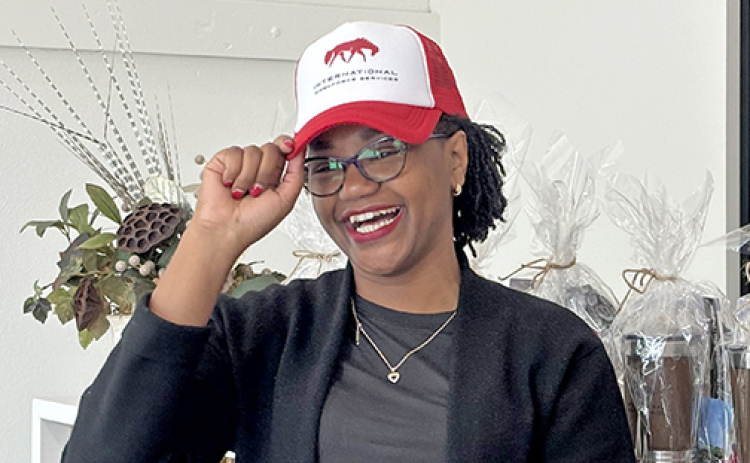
A delegation from Kenya led by a principal secretary with the African nation’s State Department spent time in Aurora Friday near the end of a two-week American tour focused on global workforce development.
The end result of that visit was an agreement to finalize a memorandum of understanding, which parties from both Kenya and Nebraska, including Todd Vettel and Laban Njuguna of Aurora, say is a major step forward toward a shared goal of training much-needed employees to fill jobs here in America.
“They have very high unemployment in Kenya and they have an abundance of educated and talented workers looking for in-demand jobs all over the world,” explained Vettel, co-owner of International Workforce Services here in Aurora who was part of a Nebraska delegation that joined Secretary of State Bob Evnen on a trade mission to Kenya in February. “Their objective is to go and represent the Kenyan diaspora (a population that is scattered across regions which are separate from their geographic place of origin) and to help find jobs for those unemployed, talented workers in Kenya.”
Roseline Njogu, principal secretary for the Kenya State Department for Diaspora Affairs, announced during a Friday meeting in Aurora that decisions have already been made in her country which indicate a strong and growing partnership with Nebraska.
“We’re very excited to be in Nebraska, and here in Aurora, having conversations with IWS, with TruckerForce, AjiraAmerica and other partners around the conversation of creating bridges between the U.S. and Kenya,” she said. “We are trying to think through how Kenya can match or collaborate with Nebraska to meet the labor shortages that you have here in Nebraska and we are interested in sharing the fantastic talents that can enhance across various sectors.”
Njogu reported that there are approximately 4 million Kenyans (8 percent of the country’s population) living outside of Kenya. It is her job as an appointed secretary for a somewhat newly-created Ministry of Foreign and Diaspora Affairs to champion the rights and welfare of Kenyans who live abroad, ensuring that those residents can vote and remain connected with their communities back home while also securing jobs for them in places, like Nebraska, with low unemployment.
“I would say that conversations are at an advanced stage as far as Nebraska is concerned,” Njogu said when asked how the Cornhusker state compares to others in terms of detailed business/government negotiations. “We think it’s important to deepen that collaboration by having conversations not just at the government level, but with businesses because that is where life happens. Life happens in the private sector and at the community level, so that’s why this conversation is going on. We think the best work is done, not necessarily just where the capitals are, so conversations should not be between Nairobi and DC only. Conversation has to get down to different communities where people are, which is why we’re here speaking with Nebraska.”
Sense of ‘shared destiny’
Njogu observed that Kenya and Nebraska have many similarities, including an economy rooted in agriculture.
“Sixty percent of the Kenyan workforce is employed in agriculture and we are primarily an agricultural country,” she said. “There are lots of similarities between what you’re doing, but also in the sense of a shared destiny. A lot of your beliefs are similar to Kenyan beliefs and a lot of things that Nebraska holds dear I think are similar to Kenya, so we think that this would be a natural fit. Of course Kenya is in conversation with a few other states, but we think that Nebraska would be a good partner.”
Part of her confidence in the Nebraska developments, Njogu shared, is the sense of shared vision, which is based in part on having already established relationships here.
“You want to have people who share a vision with you, but also people who get it, who understand where you’re coming from,” she said. “Laban (Njuguna) is a member of the Kenyan diaspora. He was born and raised in Kenya and now has made a home here in this community. Diaspora tend to be the glue, or the bridge makers between two societies. It might not have been possible for us to have had as engaging or as deep of conversations that we’ve had in the days that we’ve been here if we did not have one of our own, so to speak, already here saying: ‘I understand Kenya, I understand Nebraska, and I want to bring my two homes together.’ Having those kinds of connections is critical and this is really the essence of diaspora diplomacy.”
Njogu was actually given honorary citizenship in Nebraska during a Thursday evening event at the governor’s residence.
“It’s a great honor to receive an honorary citizenship to the great state of Nebraska,” she said, smiling. “I think I might officially be a Cornhusker.”
AjiraAmerica
The delegation from Kenya visited several states in the U.S., including Maryland and Minnesota, before spending three days in Nebraska. The group toured Aurora on Friday, exchanging gifts and ideas at the IWS location on the downtown square.
“They ended their trip with Nebraska and I can say with a high degree of confidence that Nebraska was their favorite state,” Vettel said. “Their trip culminated in an agreement to do a memorandum of understanding, an MOU, between the Foreign Ministry of Kenya and AjiraAmerica.”
Vettel described AjiraAmerica as a new entity formed jointly three months ago by International Workforce Services, Sycamore Investments (owned by Laban Njuguna), and Grand Island-based America Bound owned by Deen Albert with Grand Island Express.
“AjiraAmerica is there to interface with the Kenyan side of things,” Vettel explained. “To make a long story short, we’re going to be making super truckers in Kenya in about an 18- to 24-month program that will train not only the world’s best truck drivers, but eventually diesel mechanics. With the American equipment (which will be shipped to Nairobi soon as part of the MOU) we can turn wrenches and steering wheels over there in Nairobi with a partner university.
“With this two-year program, we have this idea that we’re going to re-professionalize the American trucking industry,” Vettel continued. “We’re going to qualify and select the very best Kenyans based off of personality tests, loyalty and retention, and of course aptitude, and we’re going to train them on character development, professionalism and all things trucking and transportation management. And then of course we’ll train the technical skills, so whether they are going to be a truck driver or a diesel mechanic or a dispatcher or transportation manager, all of these different things are going to be within this curriculum that we’re creating.”