
Editor describes immersive tour at Rowe Sanctuary
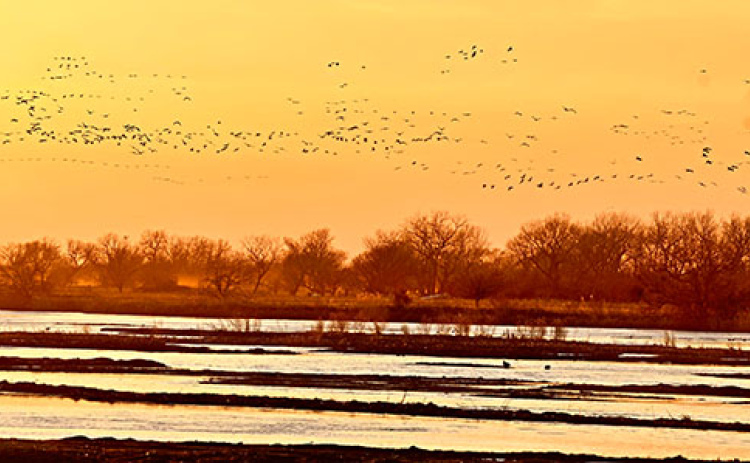
The annual spring migration of more than a million Sandhill Cranes from winter locations around the nation and the world back to their nesting grounds in the Nebraska Sandhills and beyond is quite a spectacle. Those who have lived long in this part of the country know that the familiar whirring sound of the cranes’ calls and the sight of long, twisting bands of the big birds moving through the skies can be found most anywhere in the region at this time of year. However, to truly experience the majesty of the migration, one really needs to attend one of the morning or evening guided blind experiences offered by the Iain Nicolson Audubon Center at Rowe Sanctuary on the Platte River near Kearney.
That’s just what this reporter was privileged to do on April 4, during the last week the tours were being offered. It was an experience not soon to be forgotten.
Massive migration
According to the National Audubon Society, which maintains the facility at Rowe (located about 30 miles this side of Kearney), each year from mid to late February until the middle of April, one million Sandhill Cranes migrate on the Platte River Valley in order to ‘fuel up’ before resuming their northward migration. The big, long-legged gray birds migrate long distances, some say as far as 7,000 miles, with some even crossing the Bering Straits from Russia to Alaska, every spring and fall.
Along their migratory route, the Platte Valley is the most important stopover. The river provides the perfect spot to rest, because, as our guide told us, the shallow river water acts as the birds’ night time burglar alarm to warn them of the approach of predators.
Meanwhile, the nearby farmlands and wet meadows offer plenty of food, which is important since the birds need to put on 20 percent of their body weight during this season.
The society says without the energy gained along the Platte, cranes might arrive at their breeding grounds in a weakened condition — where food may be limited until the spring growing season begins.
The Rowe adventure
Scheduled for an evening photography experience in a comfortable blind situated just a few feet from the river bank where the majority of that day’s arrivals would overnight, I arrived at the sanctuary at 6:30 p.m. while the sun was still high in the western sky. I was directed to a nearby tent which was serving as a temporary starting point for the tours while a brand new visitor center is being constructed. (It is expected to be completed in time for next year’s migration.)
There, I was introduced to our guide for the evening, Darrel Teply, a retiree from Kearney who volunteers annually with the sanctuary. We listened to a short orientation talk and then began to make our way out to the blind located about half a mile to the west.
The day that had been chosen for the tour happened to be my birthday, and I have to say, starting with the hike out to the blind on that balmy spring evening, the whole experience took me back to my boyhood, growing up along the White River in south central South Dakota.
As we walked, already we could see flights of cranes circling in the area and landing to feed in the nearby fields. And, of course, there were other spring sounds such as the calls of robins, mourning dovers and red wing black birds. As we finally approached the blind on a twisting path through the cottonwoods we saw a brown bunny who didn’t seem to be afraid of us at all.