
County evaluates use of space in courthouse

Subhead

Moving county attorney to the courthouse a priority
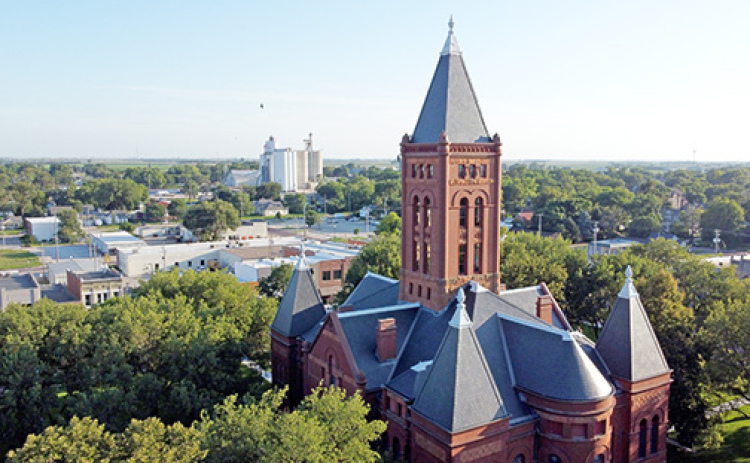
 

A lengthy discussion at Monday’s weekly Hamilton County Board of Commissioners meeting focused on the subject of space, or more specifically, the lack thereof in the county’s nearly 130-year old courthouse. 
The wide-ranging conversation involving several county officials who happened to be in the board room, began with an agenda item to discuss next steps in a plan to create new office space for the Hamilton County Extension Service, which is currently housed on the first floor of the courthouse. 
More than a year ago the county set about a plan to convert a building at the fairgrounds into a new headquarters for the Extension service. Commissioner Francis McDonald, who along with Commissioner Nicole SaBell serves on a committee to work on the project, was to report on the progress of securing a contractor to renovate the early 1960s steel building. 
“It seems like there’s only one contractor who even wanted to bid on the project,” McDonald reported, adding, “It’s really expensive.” 
Further discussion revealed the fact that renovating the building’s exterior is made more difficult by the fact that the steel skin of the building provides much of its structure.
“There are no cross girts,” explained County Highway Superintendent Jeremy Brandt, who was sitting in on the meeting along with County Assessor Pat Sandberg.
Because of these issues it was suggested it would be best for the county to give the building back to the fair board and start fresh with another building the county owns on the west side of the fairgrounds property. 
At that point Chairman Rich Nelson spoke up to point out that part of the reason for moving the Extension office out of the courthouse was to provide a space for County Attorney Douglas Dexter (not present at the meeting), who currently has his office across the street, to move into the courthouse. He said Dexter is facing some challenges in working as county prosecutor at his current location and noted the attorney had inquired about moving into the first floor rooms on the west side of the building which are currently used by the DMV for driver’s license testing on Tuesdays.
Since the DMV uses the space only one day a week, it was suggested the operation might be moved into the second floor room where the board meets on Mondays and which is typically otherwise unused. 
That idea met objection from County Clerk Jill DeMers, who said the room is sometimes used for other purposes such as storing election ballots. Treasurer Jody Griffith, who had also joined the meeting, asserted that the DMV would not fit in the commission chambers because of the needed equipment, such as an area for taking photographs, and the need for space for several people to test at one time. 
A question from the audience asking whether the DMV could be moved out of the courthouse to another public building in the community prompted county officials to point out that a part of the license procedure is a visit to the Treasurer’s Office to pay for a temporary license. Griffith said she was hesitant about sending one of her deputies to another location with cash for security reasons. 
As the discussion progressed, other individuals joined the meeting including County Veteran Service Officer Mike Irons and Extension Educator Mariah Newmyer. Irons, whose office is also located on the first floor of the courthouse, said he would be willing to move his office to another location offsite to make room for the DMV or something else. 
Various options for moving the DMV were discussed, including the meeting room of the Extension Service, the current Probation Office and the Planning & Zoning office, both of which are located on the second floor, but logistical problems were identified with all of those locations. In the end no firm decisions were made but undoubtedly the conversation will continue at future meetings.

Other agenda items 
In other matters discussed at the weekly meeting, the board:
* heard a budget proposal update from Irons for the Veteran Service Office;
* approved Resolution 1177 dealing with the Ryde Transit Program. Charles McGraw of the Community Action Partnership told the board that boardings for the transit program in Hamilton County are up and are averaging more than 400 a month, not only for Aurora but throughout the county. McGraw said the bus charges $2 for rides within Aurora, $4 for rides within the county and $6 for rides out of the county. He said the service is often used by seniors for rides to doctor visits in Grand Island and elsewhere. He stated that the resolution from the county is what the agency will use to secure federal funding for the program through 2025; 
* viewed to a report from County Business Manager Pat Shaw showing the breakdown of how the county’s share of American Recovery Plan Act (ARPA) federal COVID relief funds had been allocated. Shaw pointed out that as of Feb. 21, nearly $553,000 of the funds had been spent within the county and approximately $944,000 remained to be utilized. 
“It’s helpful to see where we have been spending these ARPA funds,” Nelson said, adding that in going through the accounting he hadn’t seen any expenditures the county would not otherwise have had to “charge our taxpayers for.”