
City to put sales tax proposal on primary ballot

Subhead

Aurora citizens to decide on 1-1/2% tax in May election
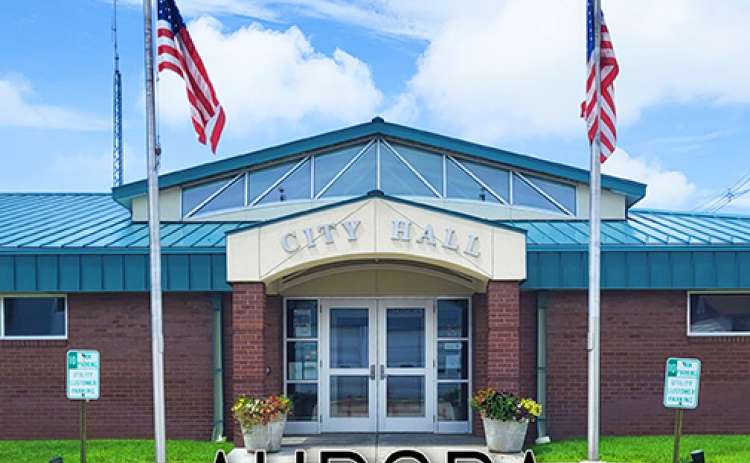
The Aurora City Council voted unanimously Feb. 13 to place a question on the May primary ballot asking citizens of Aurora if they want to approve a 1-1/2 percent city sales tax.
The issue prompted considerable discussion during a two-hour meeting which drew approximately 15 local residents, some of whom spoke both for and against the proposal. Mayor Marlin Seeman explained the rationale and timing behind the resolution, defining the proposal as a tax shift from a reliance on property taxes to a sales tax. He suggested that a 1-1/2 percent sales tax, if approved by local voters, could help the city fund operations in five specific categories, including public safety; property tax relief; recreation; civil and social activities; and economic development involving expansion and rehabilitation of local infrastructure. (See related article on Page A3 outlining the mayor’s vision for potential sales tax use.)
“All this resolution calls for, and quite frankly very simply says, is the right of the people to vote,” Seeman began. “That’s all. It’s not about the sales tax being implemented or placed into law by this elected body. It’s about giving the citizens the opportunity to dialogue during the next coming timeframe about what could be done or should be done, and if they even want it on the ballot. The question will quite frankly say, ‘I vote yes or I vote no.”’
After hearing the mayor’s explanation and five residents airing support for or concern with the proposal, council members had no discussion before voting unanimously to approve a resolution placing the sales tax question on the May ballot.

Public input
Last week’s council meeting was the first open discussion regarding a proposed sales tax, which drew concern during a public comment period before Seeman addressed the issue.
“I come to plead to the city council to table this vote until the city and other community leaders who help with economic development efforts in this community have a moment to talk about what impact that would have on our various projects,” said Jannelle Seim, speaking as president of the Aurora Housing Development Corporation. “It’s not something I’m in favor of, but at this point I don’t have enough information to really stand by that decision.”
Seim, who said she learned about the proposal just 24 hours before the meeting, noted that the AHDC has more than $3.5 million in funds that are continuously rolling over into various building opportunities to complement the work of the Aurora Development Corporation in bringing new industries and new residents to Aurora. A sales tax, she said, could possibly hinder that growth and momentum.
“Without that understanding, if it is voted to be put on the ballot tonight I feel like I have no choice but to combat it immediately because in the time between February and May I don’t have enough time to learn my position and then either help support it or not,” she said. “So, again, all I’m asking for today is that you table that discussion until several others in the community get a better understanding and then we can build consensus.” 
Jim Ediger, president of the Aurora Development Corporation, echoed similar concerns.
“The city, the development corporation and housing group seem to be really in lockstep right now and I think that is shown in the number of successful projects that we have going on,” Ediger said. “We’ve had more economic development and housing in the last two years than we have the 20 years prior and I think that is a testament to all of us coming together, working together rather than working on our own individual projects.”
Ediger said he too learned of the proposal just a day before the council meeting, thus asked the council to allow more time to discuss possible options and consequences.
“My request for the city council is let’s hold off on approving this resolution,” he said. “Let’s get together, run the numbers, see if there is going to be a deficit in the budget or a gap that needs to be filled with the sales tax ... It is significant, especially to the lower income folks in our community, and so really I think this would be a step backward in the relationships we’ve built and all the work we’ve been doing on housing and economic development. 
“We know this is going to be a divisive issue,” Ediger concluded. “I think this is going to be a distraction to all the positive things we have going on. Let’s come up with a solution, together. I think the development corporation wants to be part of those conversations, as well as the housing group or any businesses that are impacted by this. I know there’s a lot of stakeholders in our community who are really interested in this.”
Jeff Morris, a member of the Aurora Planning Commission, voiced support for placing the question on the ballot for local voters to decide.
“I’m not in general a person that’s for higher taxes and as a local business owner looking at some of the legislation from the state with respect to the kind of sales taxes they would implement, it would affect me most likely because they want to tax services,” Morris said. “But I’m also a realist, and I know it takes money to run a city and I know that you’re dealing with a lot of unknowns. Between now and May is a good bit of time for people to get educated. I think I’m in favor of getting the sales tax on the ballot and having some education for this as to whether or not it’s a good idea.”

Moyer Q&A
Well after the public comment period, and following the mayor’s explanation of the sales tax proposal, semi-retired local banker Sam Moyer requested an opportunity to address the council, which Seeman allowed. Moyer asked the mayor a number of specific questions in an exchange which became somewhat heated.
“Mr. Mayor, are you looking for a net tax neutral situation or are you trying to increase the revenues available to the city through your proposal?” Moyer asked.
“What you’re really asking is are we trying to increase the number of dollars available to the community to spend by the city council,” Seeman responded. “We’re not asking for that. Just by virtue of the rules of the legislature 2-1/2 percent increase is the maximum growth you can have in restricted funds, so that isn’t even a feasible alternative. If you’re asking to grow, it’s not possible.” 
Moyer cited Seeman’s reference to Gov. Jim Pillen’s proposal to reduce property taxes by 40 percent, but noted that the state’s two previous governors made similar proposals, thus there is no guarantee a tax shift is pending in Nebraska. He then asked what, specifically, is motivating the sales tax proposal at this particular time.
“It is a view of a significant portion of the community that consideration be given -- remember, this is a vote of the people -- and they have asked that they have the opportunity to vote yes or no on implementing a sales tax,” Seeman responded. “And I believe that it’s fair to say that having watched the legislature over the last few weeks there is a concerted interest in reducing property tax to all citizens of Aurora to give a competitive advantage to whoever they’re recruiting. That’s the view of many of the senators, as well as the governor.”
Moyer then asked the mayor if any other alternatives had been considered before raising the sales tax option.
“Before you propose to the city council tonight that the city should consider asking the electorate to pass a new city sales tax, did you have anybody in the city administration look at reducing costs in lieu of raising revenues?” he asked.
“It’s called a budget,” Seeman responded. “We have a budget hearing annually. We have a public outcry of all of our items that are being paid. If you look at the list, you’ll know what we do. There’s no secrets there. None. We incur costs and we perform at the best possible level.
“It’s called a tax shift,” Seeman continued. “I believe that’s the governor’s words, so you are either for or against a tax shift. We’re not talking about raising the revenue.”
At that point Councilman Dick Phillips ended the exchange, saying it was time to move on. But before the issue came before the council Sheriff Jeromy McCoy asked that he also be allowed to speak.
“As one of the citizens of Aurora, I would support the resolution and placing the sales tax on the ballot,” McCoy said. “I think the citizens of Aurora are looking for more amenities in this community and this will be a way to shift the tax burden not only from property tax, but to visitors from other communities who come in and spend their money here, just like we get taxed when we go to other communities to pay for their amenities. And if it brings in more money than the current budget, again I think that’s a tax shifting to people who are visiting and traveling through the area, not just from citizens of our community.”
Hearing no discussion from the council, Seeman then called for a vote on the resolution, which passed 5-0. Council member Nancy Lohrmeyer was absent from the meeting.
City Attorney Ross Luzum explained that no further action or opportunity to provide a public forum is required by the council, thus the county clerk will be advised and the question will appear on the primary election ballot in  May.