Lot sales could begin within weeks
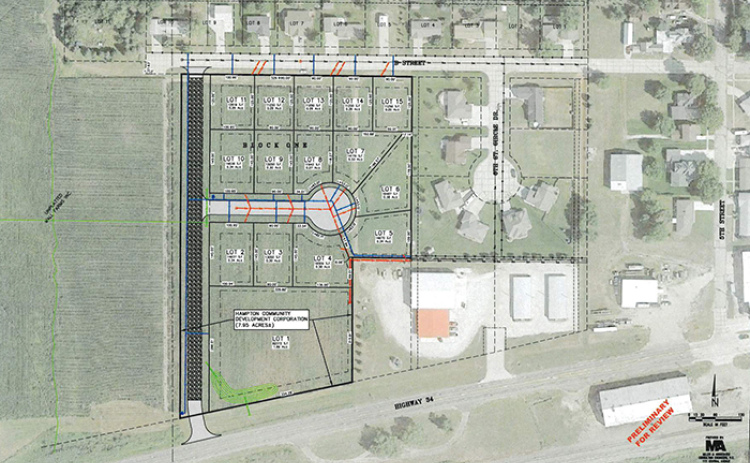
In yet another marathon meeting for the Hampton Village Board on Monday night, the body made significant progress on a joint project between the village and the Hampton Community Development Corporation (HCDC) to develop a new residential subdivision and industrial property on the town’s west side.
Four separate public hearings were held one after another shortly after the meeting was called to order to approve Ordinances 392 through 395. The first two hearings were for the purpose of rezoning a village-owned 6.- acre tract along Highway 34 from Transitional Agriculture (TA-1) to Residential (R2) and Industrial (I-1) zoning. The third hearing was for the preliminary plat subdivision of the property and the fourth hearing was for the purpose of approving the final plat. At each step along the way the hearing had to be opened and closed. Following the opening of the hearings the chairman called for public comment and, while there were no objections to the actions, Karen Bamesberger representing the HCDC called for approval of each step of the process.
Also at the conclusion of each hearing, the board was required to vote on a motion to waive the three readings of the ordinances on separate days called for by law, and then the ordinances themselves were voted on.
Hamilton County Administrative Manager Scott Stuhr was on hand to represent the county joint planning and zoning commission. He reported that the commission had given its nod of approval to the plans at a recent meeting.
After the adoption of the final plat of the property, board chairman James Parsley called on Bamesberger, who was next on the agenda, to address the board. She said once the plats were signed by Parsley they would be filed with the county and the process of selling the lots could begin soon.
Craig Bennett of the village’s engineering firm, Miller & Associates of Kearney, was also on hand to answer questions. He said with the approval of the plat, final design drawings for the development can now be made. He said he expected to come back to the board in a month and ask it to set a bid letting date to get bids for the infrastructure work to be done at the site.
“We would look at coming back in a month, probably talking about setting a bid letting date,” Bennett said, “and then that would put us into August. Probably the end of August, you could probably look at opening bids or somewhere around the first of September and then you would award bids probably at your September meeting.”
The subdivision plan calls for the construction of a new road called 8th Street, which will run north and south and link up B Street (currently a cul de sac) with the highway.
Other discussions during the meeting dealt with the village’s property insurance coverage, water rates, internet technology issues, water wells and delinquent utility bills.
Morgan Driewer and Jake Richardson of Cornerstone Insurance were back again to suggest raising the limits on various structures owned by the village so they are within 80 percent of co-insurance. As Driewer showed a chart of the current coverages and the suggested increases, board members noted that some coverages, such as for the town’s water tower and the well building on 3rd Street, were probably not enough to replace the structures if they were destroyed. Driewer stated that raising the village’s coverages by more than $800,000 would only increase premiums by $1,076.
Also making a presentation to the board was Kirby Steinke of 1to1 Technologies in Central City. Steinke discussed a recent security review of the town’s computer system which she said had revealed several potential issues. Among the major issues discovered in the audit was a lack of email security, the absence of a physical internet firewall within the village office and no file backup system. Regarding the firewall situation, Steinke said, “Village offices like yours are the main target of ransomware attacks.”
She said internet thieves are after information such as what is stored on the village’s servers and noted that sometimes town employees unwittingly hand over that information to hackers. Parsley asked 1to1 to present a proposal to the board at the next meeting to address the security issues.
Water rate review
Also at the meeting, retired engineer and Hampton resident Tom Williamson made a presentation regarding changing the town’s water rate structure. At a recent meeting Williamson volunteered to lend his expertise to the village to help with the ongoing water issues caused by the fact that Hampton has only one working well at this time. Williamson began by asking the board its reasoning for potentially raising rates, suggesting that could be done to raise revenues to cover the cost of providing the water or to discourage unnecessary overuse of water.
He said a survey of the village’s current water rate structure showed that every customer – whether residential, commercial or irrigation – paid the same basic rate of $25 per month. He said for those who use between 1,000 and 50,000 gallons of water per month, the rate goes up to $1.25 a gallon and those using over 50,000 gallons pay $1.50 per gallon. He went on to observe that in 2022, 73 percent of the town’s water customers used less than 10,000 gallons a month.
Williamson suggested that a new schedule might bump the cost per gallon to a quarter at the 10,000 mark. He also suggested having a different rate for commercial versus residential accounts and stated that, since the school district is one of the biggest users of water during the summer months to irrigate school grounds and athletic fields, a separate rate structure might be approved for those purposes.
At the conclusion of his presentation the board asked Williamson to pass along a proposed new rate structure to village attorney Drew Graham so he could draw up a resolution for the board to consider.
The board also discussed situations in which residents are behind on their utility bills. The board gave its approval to a plan by utility superintendent Chris Friesen to begin using disconnect notice door hangers in an effort to collect those payments. The hangers will serve as the final notice before utilities are shut off for nonpayment.