
Aurora native now speaks nationally on transgender issues
Ryan Sallans is known nationally as an inspirational speaker and author who utilizes storytelling to help federal magistrate judges and others willing to listen understand the differences between sex, gender orientation and expression. On Saturday afternoon as the keynote speaker at a Pride event in Aurora, Sallans shared his own personal story of how he realized at a young age that he was a male born with a female body, but rather than live with that reality transitioned from Kimberly Sallans to the person he is today.
The story began before he was born in 1979, Sallans shared with a group of approximately 50 people gathered at Refshauge Park, when his grandfather, a “water witch” in an era before ultrasound machines had been invented, declared to his parents that they were having a boy. By the age of 3 he said he began to have a sense that his gender was male, and at the age of 7 he had a revelation while looking in the mirror.
“Suddenly a voice just came in me and it just said to me, and we think in verbatim, ‘This really sucks,’” Sallans recalled. “I got dealt a bad deck of cards and I need to live with this the rest of my life and I don’t know if I can. At that age I started thinking about suicide and unfortunately that’s followed me ever since.”
Representatives with the American Foundation for Suicide Prevention set up one of several booths at the Pride festival in Aurora, sharing stats that confirmed Sallans’ story. Megan Langer, an AFSP board member from Aurora, reported that 45 percent of LGBTQ youth age 10 to 24 reported thoughts or attempts to take their own lives, making suicide the second leading cause of death in that age group.
Now 44, Sallans shared that his anxiety showed itself in the form of an eating disorder while he was a sophomore in college at the University of Nebraska-Lincoln. That may have been a blessing in disguise, he admitted, because while anorexia nervosa nearly killed him, he credited it for saving his life.
“It forced me into therapy and forced me to start exploring feelings and pushing myself to dive deep within the things that I was scared of,” he said of a process that led to joining the lesbian community. “When I did that I started walking straighter, the pain in my stomach started to dissipate and my disordered eating behaviors rapidly declined. It was an ah-ha moment in my early 20s of, ‘Wow, look at what happens when you do honor who you are, when you listen to your internal self and what it’s trying to tell you instead of running away from it or being fearful.’ It’s amazing. So just honor it, hold true and stay confident and if other people aren’t accepting you to give them their time to work on it or take care of yourself and exit from those relationships.”
Transition
In 2004, Sallans found a book of photos in Boston detailing the lives of individuals in the San Francisco Bay Area who transitioned from one gender to another and five months later began his own transition from Kimberly to Ryan. Now almost 20 years later, he described how he uses his own personal story, and those of others, to educate people on issues involving sex, gender, expression and orientation.
“I bring these pieces in to humanize it so that we’re not just looking at data, we’re not just looking at terminology,” he said. “We’re hearing the human stories to open up our hearts and minds and if I look at what’s presently happening in our country I still carry great hope. The reason why is because I’m the one working behind the scenes at some of the highest federal levels and I see the actual forms of acceptance that are taking place.”
Sallans, who now lives in Omaha, reported for example that he has worked in the fields of eating disorder recovery, sexual orientation and gender identity development. He spoke just last week with the Center for Disease Control on the issue of global migration and quarantine, talking specifically about the awkward things happening with trans people as they go through airport security.
“So people are open to this now, they’re listening,” he explained. “They are putting policies in place. What we’re seeing on the political level and state level is pushback out of fear. But fear will not win. Science will win and that will continue to push us all forward because you’re not to hide, but show your pride, to show our acceptance and to carry hope for all of us.
“It’s important not to get downtrodden,” Sallans continued, “not to think this is the end and that you do not have rights because you do. I transitioned when Nebraska didn’t really know what to do with us and I still found ways to navigate it in forms of acceptance. I can tell you what we have now today, that acceptance is stronger than ever from Omaha all the way to Scottsbluff. We have rural communities and urban communities where people love and support the LGBT community and we have to carry that with us because the more we carry love instead of fear, the more we’re going to be able to continue forward with our own hope and forms of optimism.”
Sallans ended his presentation by encouraging anyone seeking more information to go to ryansallans.com.
“This is one of the most important years so far for Pride visibility,” added Beaux Mason of Aurora. “With all of the anti-queer and gay laws and trans laws that are popping up across the country and state the best way to combat all of that is visibility and showing people that we are like everyone else, we’re just a little different. Our main message is wanting to show that queer people are in small towns. You know someone in your life that is gay, trans or bisexual and you love them the same as you love someone else.”
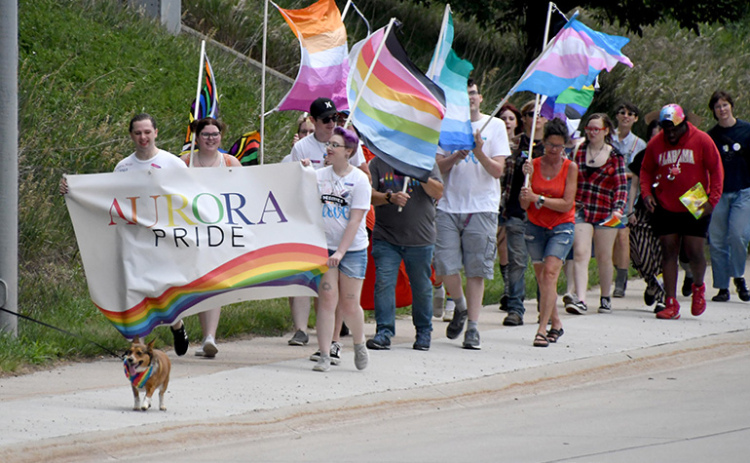
The day’s two-hour event, which included water balloon volleyball, dog therapy and a pie-in-the-face raffle, ended with a peaceful walk along Highway 14, concluding the third annual Aurora Pride march.