
Former owners, patrons share memories of old location
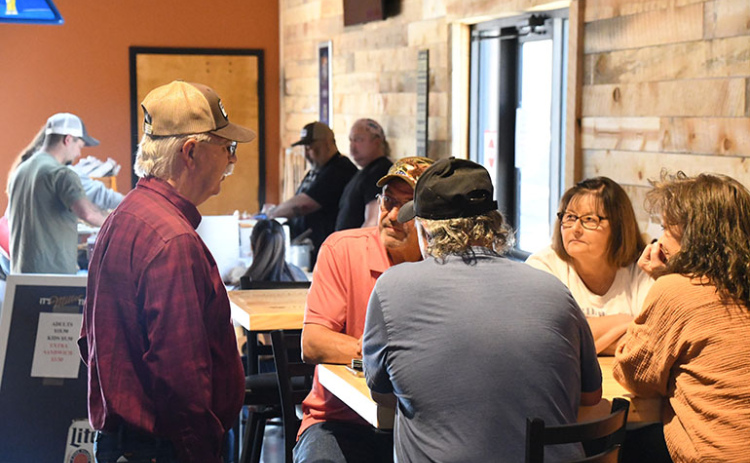
Among those excited for the opening of Winchesters Saloon in Phillips are those who grew up remembering the variety of restaurants that evolved into the final form of Winchester Restaurant that closed in 2004.
According to information collected by the Plainsman Museum, the original was across the street from the new saloon on West Street. The Phillips Grocery and Cafe, established in 1964 by Roscoe and Evelyn Heater, came from the same building as Phillips Hardware and Lumber Co. from 1953, itself having formerly been the S. A. Foster Lumber Co.
“I was in there when (I was) younger,” resident Dwayne Bergmark said. “I’d go after Cub Scouts and stuff. We’d walk up there for the pinball machine from time to time. You can see the cafe off to the left. They sold groceries off to the left, turn right and there were two pinball machines down a little hallway there.”
Don Watson became the proprietor of the location in 1965 and later opened a new restaurant and tavern in June 1969 called the Phillips Cafe.
Rodney Watson, Don’s son, worked in the store throughout high school. He recalled that his father originally shut it down with no plans to reopen.
“I graduated high school (in 1967), he shut the grocery store down because he lost all his help and he just didn’t see the future,” he recollected.
After going to factory work in New Holland and starting college, Rodney talked to his father about opening up the cafe on a summer break.
“The building was empty and my father wasn’t doing anything,” he remembered. “I told him, ‘Well, we’ve got the building, so why not just open up a little lunch counter.’ He would have something new. So, I spent the summer helping him remodel it and then we opened that up in ‘69 and then we actually built on to it and about that time I got drafted.”
By the time Rodney had spent his 15 months in Vietnam, the place had changed again with the addition of a 20x50 foot party room. The name became an unofficial synonym for the Phillips Cafe as well.
“That was my father’s (name for the cafe), you know, your company having a good time,” he recalled. “It’s kind of like going to a party, that was his reasoning.”
Rodney eventually took over operations, and was owner when a fire caused a “total loss,” on May 2, 1975, according to an article in the Aurora News-Register. Though no cause was listed in the paper, the then-owner had his own theory.
“I had a hired man that night and it was the first time he had closed up at night by himself,” he stated. “I had gone into Grand Island with some friends and when I came back, of course the restaurant was already closed. I’d done a quick run-through just to make sure he got everything done he was supposed to.
“The guy I had working for the first time (alone at closing) he went around and emptied the ash trays and instead of keeping them in a tin can, he dumped them in a cardboard box underneath the bar,” he continued. “That’s where the fire started, because that was the epicenter, as near as the fire department could tell. So it burned down.”
Over the summer of 1975 the cafe was rebuilt and opened for business. Bergmark recalled the new layout.
“The ones that built it separated the cafe from the bar,” Bergmark described. “(Customers) came in from the outside and either turn right, went (up a step) to the bar and they’d have a pool table. You can turn left and go into the restaurant part of it. It kept people separated, let’s put it that way. You could still see the bar, but it was definitely separate from our family atmosphere of the restaurant part of it.”
After Rodney transferred ownership, the building went through a variety of restaurant names and owners. The first new owners were “Catfish” Maylon and Joan Volf, who renamed the restaurant Catfish’s from December 1978 to February 1983.
“(The only thing that was different was) pretty much a name change,” Bergmark said. “Maylon would be up there from like 10 a.m. till the afternoon. At 2 o’clock he took off and Joan kind of looked after it. He just got out there to get away from the grind, then he’d come back for supper and start cooking again.”
Most people’s memories from that time center on “Catfish” Maylon, who was remembered for his cooking ability of steaks first introduced in Phillips Cafe.
“I remember Catfish Maylon, who did a great job of steaks and frequented the old Winchesters (building) all the time,” said Bill Kuehner, who grew up in Phillips and now lives in Aurora.
Another Phillips resident remembered an unusual patron one night.
“One night (someone) had been moving cattle and he rode his horse into the bar building right over here across the street,” Wendell Perry said. “Catfish (about) had a heart attack”
The ownership changed again when Mr. and Mrs. Heeg and their son Bruce renamed it The Harvester Restaurant and Louge in 1984, according to museum documents. In 1987, Don’s other son, Randy, gave the most enduring name of Winchester Restaurant with partner Tim Kolar.
Winchester repeats, again
Randy Watson said that going into the restaurant business in Phillips was a natural development based on his background and need to rise to the challenge.
“I liked the idea of being in business for myself and I grew up in the restaurant business, and in particular this one in this community,” Randy said. “I just looked at it as being a challenge and the opportunity came along and in 1987, when Heeg went out of business, so I took it over from there.”
Randy had grown up around the cafe, recalling taking out cardboard boxes to burn, taking out the trash and wiping tables before heading off to play with his friends during grade school.
“I’d rather be throwing a football or baseball, but it was instilling a work ethic,” he said.
Randy recalled his reasonings for choosing the name Winchester Restaurant.
“It had no significance whatsoever,” he said. “We (he and Tim) thought it was a cool name, easily remembered, kind of a western or small-town vibe to it.”
Randy worked with Kolar, who ran a car body shop in Grand Island, taking shifts in running the establishment.
“Although it was a lot of hours, it was a good experience,” he commented.
Randy tried to sell the place to a couple in the mid-to-late 1990s, though ownership was soon given back
“Basically, they went away from the philosophy that made it a successful business and tried to change it to fit their needs, I guess,” Randy said. “They definitely did not take care of their customers in a way that they were used to and unfortunately they failed.”
This time both Rodney and Randy Watson took control to try to straighten out the restaurant.
“(The new owner) made a monster mess,” Rodney said. “So my thinking was, I’ll come back and get it back and running again, and we enjoyed a good reputation always and good business.”
Ownership transferred to Dick and Marjorie Crawford in 1999. Dick’s sister-in-law Mary Crawford recalled their taking over.
“I was in Ohio for trapshooting,” she recalled.” And anyway I called (my husband) Jack (Crawford, who designed the wooden gun used in the restaurant’s decor), telling them we’re going to be on our way home and he told me that him and Dick, they’re going to buy the Winchesters. I was just like ‘Really?’ and he was like, ‘Yeah, don’t ask me.’ So they went and cleaned it up and everything to it get going. I don’t know, things didn’t go as well as the brothers.”
The Winchester Restaurant closed in September 2004 and remained so until the Winchesters Saloon reopened last month. The only exception, Rodney stated, was that he ran a smaller Winchester at the Wood River Country Club for a few years.
Many of those interviewed expressed what losing the restaurant meant to them and to the community. “We were open at 10 o’clock in the morning and by 10:15 (a.m.) there would be anywhere from five to 25 people in for coffee, most of all farmers. They would sit around for a couple hours and drink coffee and actually some would stay for lunch,” Rodney said. “They lost a social event because there wasn’t anything else; just absolutely nothing.”
Randy added on to his feelings at the time.
“(I) hoped that it (would) continue on through someone else,” he said. “That was a disappointment that nobody wanted to continue to run it. It’s a good place where people can get together and see each other on a social basis. You know, you’ve got church, you’ve got ballgames, but a restaurant and bar is another vehicle for that type of gathering.”
Bergmark expressed dissatisfaction at the closing of the old location almost 20 years ago.
“That was tough for a small community. What you had here -- that’s really all we had -- and it was nice. I drive a tractor and it’s nice to come home and drive three blocks and you can eat supper and have a good time with friends,” he stated.
However, those interviewed said that the new Winchesters Saloon is living up to the memory of the old restaurants.
“It’s nice to bring people back to town with something growing and the new housing area nearby,” Perry said.
“Oh, it’s a heck of an upgrade and all, the building I mean,” Randy said. “It’s much nicer than the metal building that we had, a lot more thought I think was put into it. It’s the nicer kitchen, just everything is nicer about it. It’s high quality.”
“The new Winchesters is great,” Kuehner said. “I love it, great atmosphere and good food here. I’ve been here a few times.”
Randy pointed out that there were still a couple of things that carried over to the new restaurant, including the wooden gun made by Jack Crawford (though Rodney disagreed that it was the same one) hanging above the bar, as well as the barbed wire sign above the swinging doors to the gaming area. New co-owner Jeff Reed said the physical decorations and name are not the only staples of the old Winchesters carried over.
“The same guys are still coming back,” Reed said. “I just met (some of) them, and asked who they were, and they were the same regulars at the one across the street.”