
Questions raised on agreement, street storage incident
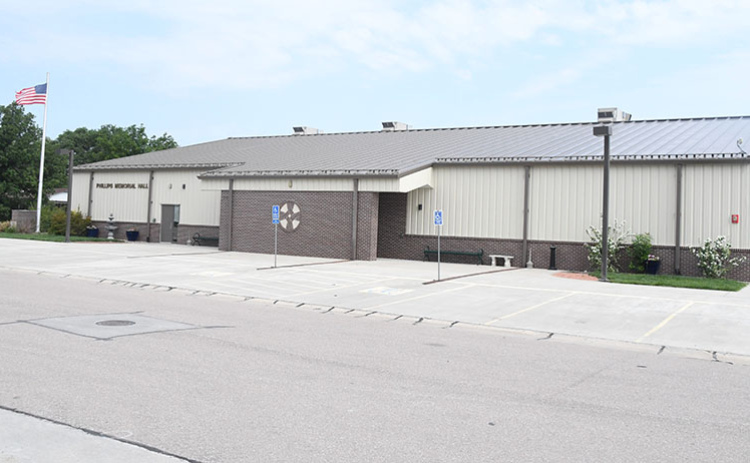
The selling of Phillips Memorial Hall and the storage of white rock and a dirt pile on and near 3rd Street drew lively discussion from the crowded assembly at the Phillips Village Board meeting on June 6.
The board made available the pre-purchase sales agreement of the hall from the Phillips Community Foundation to the community this week. Sale to the foundation had first been discussed in April. Chairman and member of the Phillips Community Foundation Les Dana made clear at the beginning of the meeting that this item would be presented to the public, but not voted on at this point.
“We said that we were going to let the people in the village look this over,” Dana said. “So the plan is not to vote on it tonight, but to put it out there. We’ll take any feedback. I think everything will be alright.”
The agreement is to sell the property for $14,000 to the foundation and split the land. A paper handed out at the meeting showed that the property on the east side of the white 24x50 foot utility building and a 40-foot easement for repair and maintenance of water, sewer and other utilities starting from the light pole to the north end of the property will remain with the village and rest to be sold to Phillips Community Foundation, including the Memorial Hall building.
“So the area directly north of the old Memorial Hall will stay village property and then when we clean that off, that’ll become one unit,” Dana added.
Copies of the proposed property map and legal descriptions were passed around, though village attorney Kent Raurt, with Svehla Law, said definitions were amended slightly.
“He did an initial survey that we had to tweak a little bit and it just took a little bit of extra time,” Rauert said. “I’m going to leave (this) with (village clerk) Cathie tonight, the proposed purchase agreement. She has a resolution which we’re going to need to change because the legal description has changed, but that will be available for anybody to come and take a look at.”
The question was raised by a member of the community if the village would retain use of the white 24x50 foot utility building for storage.
Dana answered that the village would be given access for storage in exchange for rent paid in the form of water, sewer and sanitation (trash removal) fees as had been paid for by village previously.
Under item 13, “Lease of Building” the draft agreement states: “As rent, Seller agrees to provide Buyer with the following utility services at no cost to Buyer, to wit: water, sewer, santitation (trash removal) and mowing of the easement area described in the preceding paragraph and adjacent area north of the main hall building.”
The building is to be leased to the foundation for a period of five years with an option for renewal.
The Phillips board had discussed at the April 5 meeting that the Phillips Community Foundation had requested assistance with the utilities, although Rauert expressed doubt that the city could remain involved with paying for those services.
“What we talked about was the village cannot directly support the hall, but the village can rent a building,” Dana said.
He further clarified that while the building will be privately owned by the foundation, both boards are dedicated to the village.
“I want everybody to understand that there is a Village of Phillips and that there’s also a Phillips Community Foundation,” he said. “Both have a board of directors and they’re both for the purpose of maintaining and upgrading the town. So this isn’t a individual that’s going to make money. Every dime that’s raised up for the hall goes back into the hall just as it has.”
When questioned if the foundation decides not to have the building serve as a community center, would the board purchase the building back in the future, Dana answered that the village board will have right of first refusal.
“The village can buy it back for the same amount or whatever the fair market value is,” he said.
When questioned if the sale to the foundation was already fair market value, Dana answered no before Rauert said it was.
“I would disagree with that, I know, I think, it is a fair market sale,” Rauert said. “It’s based on the assessment of the property maintained by the county assessor’s office.”
In response to some of the protests over aspects of what was explained, Rauert said that people should read the agreement made available with village clerk Cathie Walker at the village office for discussion at the next meeting, after paying two dollars or taking a picture of the document.
“Know what it actually says rather than what somebody tells you it might say,” he said. “I think that’s a good way to come about it. If you have complaints about it, or concerns, you should come to the next meeting or if you’re happy with it and simply think this was the greatest idea ever. But everybody ought to at least review it before they start making decisions about whether it’s a good idea or not.”
Board members said there were no plans for a special meeting between now and the planned July 11 meeting, when the motion to sell the hall will be discussed.
Board addresses social media critics on parking lot storage materials
Early in the meeting there was much discussion after Scott Hooley, head of maintenance, brought up complaints over a pile of white sheet rock on 3rd Street and a dirt pile in a nearby alleyway.
Hooley had given permission to Heins Lawn and Landscaping to park vehicles by the old burn pile location on 3rd Street and to use white sheet rock and dirt to maintain the area as well as the potential to have a dumpster on site.
“So Heins volunteered to (place) white sheet rock and maintain it and keep it free from weeds and stuff if they could park something there from time to time, I didn’t see a problem with that,” he explained.
Hooley listed that there had been parking at the end of 6th, 7th, 2nd and 3rd streets before with no issue. The contractor for placing the white rock was delayed, leaving the pile in the street to which there was much buzz on social media and the Hamilton County Sheriff’s Office was called who asked the homeowner to put orange cones around it.
“So the homeowner put out some orange cones on it for safety issues and I guess the orange cones was a safety issue because it was making everything too (tight),” he said. “Nobody could pass two vehicles. Well, it measured out from the cone to the curb on the other side was 25 feet. Semis could pass each other.”
Hooley then called out the social media talk over the project and suggested that was not the place for discussing community matters.
“It’s not being addressed where it should be addressed, which is in this room,” he said. “You know, people are calling people names and you’re doing stuff that I’m embarrassed (by). I’m really embarrassed with some of the crap that’s been going on in social media the last couple of weeks.”
He said the comments affected the town’s public image.
“I had somebody call me from another town, tell me they get a good chuckle reading the social media posts for the Village of Phillips,” he said. “And that’s nice, just what I want to get associated with.”
A man at the meeting claiming to be a neighbor near the pile stated that he had no complaints.
“(Hooley) is doing his best and I’m the neighbor,” he said. “I’d be the first one to complain if it was a hazard or anything like that, but it never was.”
Board member Jim Crawford stated that the affair had potentially driven volunteers away from the village.
“They wanted to maintain the restrooms at the park, they wanted to volunteer to paint, any leftover white rock was going to go to the church,” he said. “Any of you get your driveways cleaned out during the winter? That’s all volunteer time, that’s volunteer equipment, that’s all volunteer money on their side. So this year you might have to buy a shovel.”
Former attorney for Phillips Dorothy Benton stated that despite the negative comments on social media, the question that remained was if Hooley, or board member Jordan Watson on the maintenance committee, had the authority to allow piles of sheet rock in the street, dirt piles in the alleyway or parking on village property.
Dana affirmed that he did have the day-to-day authority to make those decisions.
“Scott is the maintenance man,” he said. “He is the one who’s here day-to-day,” he answered. “Everybody else up here at these tables has jobs and they’re out of town. So on a day-to-day basis, yes, Scott has permission.”
Outside of more comments that were directed at the others in the audience, regarding access to Facebook pages and why the outrage was happening, the discussion wound down before talk over Memorial Hall.
“There’s still a First Amendment right in the Constitution that the Village of Phillips doesn’t get to just ignore,” Benton said. “So when people say what they say, and if you don’t like it, don’t respond. But that’s a whole different ballgame that we’re talking about people being allow to do things within the village and who has the authority to grant that. I think that’s what we covered.”
In other action, the Phillips Village Board:
* discussed street and water project funding as talked about at the special meeting on May 30. Hooley voiced that a lot of people could not afford tax and water rate increase at the same time. New discussion was on whether to wait for government funding on water project which may decrease the water rate increase needed but which would require delay on the street project, which will likely be more expensive later on;
* also debated as part of the street discussion was on whether to add a truck weight limit to preserve the road. Benton stated that waste trucks could be exempt and Rauert said many have commercial business exemptions. Rauert said an issue with that is where to provide a truck parking lot or not which may upset drivers living in town;
* heard from Hamilton County planning and zoning administrator Melissa Barry and administrative manager Scott Stuhr regarding the Planning and Zoning committee recommendations after a request from Ramie Walling for amendments to the Village of Phillips zoning regulations. The changes included removing a provision that had businesses adjacent to residential districts having to put permanent six-foot-tall screens between businesses and residential districts, no storage open to front yards (definition of front yard is any building facing the street according to regulation definitions), and one that stated facilities have to have a buffer of 50 feet from the right of way, a 20-foot buffer to other property lines unless great setbacks are required, and 35 percent of all yards need to be landscaped. The council voted to pass all amendments as recommended by the Planning and Zoning committee;
* further heard Hooley report that the water tower is getting repainted next year and is getting powerwashed now and drained in the fall;
* learned from Hooley that stinking waste was left on 2nd Street, which he attempted to spray down but would have to get outside help to spray off. Crawford stated that a letter and cleanup fee could be given to the one responsible;
* shared information that the July 3 celebration at Memorial Hall will be at 5 p.m. Dana announced there will be a DJ, root beer floats, games for kids, hayrack rides, a car show and potentially a tractor parade;
* agreed with Kent Rauert’s assessment that the village board could not contribute $500 to the July 3 celebration, according to Nebraska state law;
* approved ranch-style home permits for Barconn at 501 7th St., 505 7th St., 509 7th Street, 509 7th St., 513 7th St., 517 7th St., 521 7th St. and 525 7th St. Also approved for Barconn were privacy fences for 602 7th St., 625 7th St. and 728 East St.