
Hampton graduate engineers road safety in Las Vegas

Subhead

Rickert describes traffic engineering career in Vegas
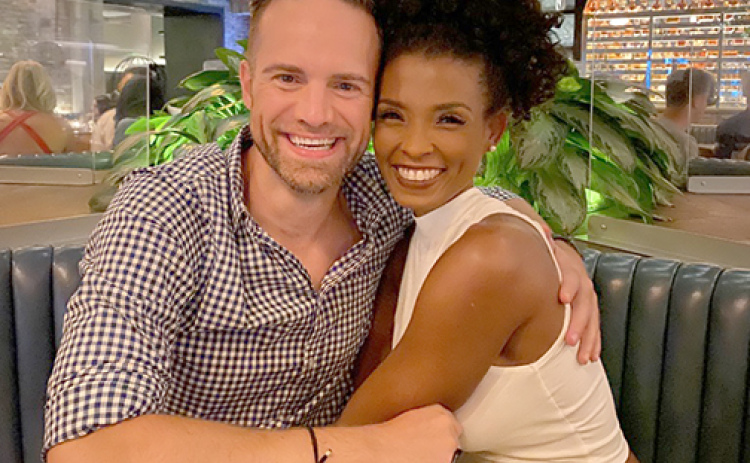
One locally-raised engineer is working to reduce the number of injuries and fatalities in car crashes across the state and nation, specifically in Las Vegas.
Scott Rickert is the national market director for transportation safety at Atkins Transportation, having moved to the bright lights of Las Vegas in an effort to make travellers safer on the road.
“I like to help people,” Rickert said. “I like to work in areas that are underprivileged. A lot of my work focuses around how can we make sure pedestrians, bicyclists and transit riders are safely getting to and from school or work. Because, unfortunately, a lot of people that need to walk or ride won’t have access to a vehicle.”
Rickert was raised near Hampton by Dwayne and Barbara Rickert and older sisters Dawn Ogden and Shelia Carpenter. He stated that Hampton was a good community to grow up in.
“When I was young, it was obviously really safe,” he described. “When I was in high school, the thing I really liked about a small town was that I was able to get involved in so many different sports. I was in football, basketball, track in high school, but I was also in Future Farmers of America and National Honor Society.”
Rickert stated that from a young age he wanted to be an engineer as he said he enjoyed working with numbers and loved a challenge.
“I was always a numbers guy and that was something I gravitated towards,” he said. “Then in college, my first years in physics, I was looking for a challenge.”
Rickert went to Nebraska Wesleyan, where he played football and later entered a dual degree program through Washington University in St. Louis. He got a bachelor’s in physics at Nebraska Wesleyan in 2001 and a bachelor’s of science and a master’s of science in civil engineering in 2003.
Though the classes were tough, seeing that everyone felt the challenge of the topic gave him the determination to carry on.
“At Washington University, there were definitely some difficult classes, but once you see that everyone’s having a tough time in this class, you just kind of push through,” Rickert explained. “It’s all about engineering -- problem solving.”
He also shifted his focus from structural engineering to traffic.
“I probably didn’t have the structural analysis teacher, which is the first step in structural engineering, but I had really good traffic engineering teachers or professors,” he said. “They kind of pushed me towards that and it was exciting to me.”
Rickert’s thesis project had him collect data on bicycle lane implementation in St. Louis which lead to a change in his thinking on traffic transportation.
“For me, that’s where I started to see there’s a lot of things that go into bicycles, too, that people don’t realize,” he said. “I know not everyone wants to see bicycles on the road, but technically they’re supposed to be by law… My first time out here (Las Vegas) you… try to get cars through as fast as you can. Then it kind of took a step back and it was more about complete streets. That’s looking at the multimodal aspects, looking out for all the transportation modes including -- not only -- the vehicles but the pedestrians and the (bicycle) riders, other types of users the includes scooters, (motorcyclists) and whatnot.”
Rickert worked as a construction manager intern in Houston, Texas, in the summer of 2002. After graduation in 2003, he helped a local electrician in Hampton before following one of his sisters to Las Vegas to get a job.

Fear and safety in Vegas
Rickert moved to Las Vegas in 2004 in the midst of a population boom of the desert city, one that has continues to this day and requires constant readjustments for traffic.
“Las Vegas, it’s always been one of the fastest growing (cities), “ he said. “We’re well over 2 million, you know, we’re going to be approaching 3 million in the near future. When I first moved out here we’re probably one and a half million for the metropolitan area... So it just shows you how much it’s blown up over the years.”
What he described upon moving to Las Vegas was a combination and diversity of humanity in the city of lights.
“It’s like a melting pot,” he said. “There’s any and every type of person here: race, religion and whatnot. Meeting so many different people and learning about so many different cultures I think it’s been really eye-opening.”
Within this city of constant change engeineers are needed to meet that challenge.
“One thing that I really like about here is because it is constantly changing,” he said. “I’ve never really been pigeon-holed into doing the same thing. The types of jobs I work on are always different.”
The city started with an established road system for hundred of years with a shorter, skinnier right of way. That had been replaced by wide right-of-ways which was not the greatest solution to Rickert.
“They threw out really wide right-of-ways and that’s not always a good thing,” he explained. “Especially since we have really long signal times because it take a long time for someone to walk across the street on a crosswalk. It also adds to speeding because the wider lanes, you know, there are not a ton of vehicles on that road so people feel comfortable in doing it. There are definitely positive and negatives on both sides.”
Rickert spent 12 years in a small office with Parsons Brinkerhoff, which is now WSP USA.
“When I first went there, we had as many as 11 people, combined traffic engineers and transportation planners,” he said. “I started in 2004, and in the 2007-2008 timeframe when the recession, the Great Recession, hit it kind of knocked us down to about two of us and then just me. I ran my entire department in my 20s. I think some of it was I was good at what I did. They were just saying, basically, just let him do it until he screws up and then we’ll get someone older, but I never really screwed up.”
He worked on a variety of projects including not only the highways but interior city road design to accompany the multimodal view with pedestrians, bicycles and transit. One study he did for buses and bus shelters turned him into a national expert.
“One of my first projects that I managed, I was to look at the safety of bus shelters throughout the metropolitan area because we had a major problem with bus shelters getting hit,” he explained. “There was a crash where some people died. It was national news because (the car) was airborne, killed six people waiting for the bus during the morning hours. I implemented and put together a report of countermeasures to help reduce the crashes at these locations, some of which were as easy as moving it 6 feet back from the roadway. At that point, you reduce crashes by 90 percent… I was the only person that has ever written about shelter safety in the entire US, so I was the leading expert in the field, which was kind of ridiculous because I was in my 20s.”
The second job was at a firm called Wood Rogers, which was originally a land development company before focusing on public works.
“They wanted to become more diversified,” he said. “They looked at a lot of research, proposals and qualification packages and made a list of people they wanted to go after. I was on that list and that list made it down to about six people. I was on that list as well. So they reached out to the public works people, asked them who they like to work with and who they recommended. My name came up quite a bit.”
Rickert went on to say that Wood Rodgers would become respected in the field through various projects including a statement of qualification.
“When I went to Wood Rogers, they weren’t ranked on any category, and I was able to get them ranked in a short amount of time in traffic roadway and water projects,” he elaborated. “Before I left we were ranked second in large traffic projects, out of all firms in the city of Las Vegas. We beat out all national firms, and we’re a small company. There were only two of them that are traffic engineers and transportation suppliers, and we beat out every other competition except for one (out of 20).”
He would get another feather in his cap when a project of his won the Institute of Transportation Engineers Project of the Year for Safety in 2022. This would lead to him helping Las Vegas develop a vision or action plan with Vision Zero.
“Vision Zero is eliminating all crashes resulting in fatality or serious injury,” he explained. “What I did was I wrote a scope and I delivered that project to them so they could go and get appropriate funding and they just received a large amount of funding for their first phase of that action plan. As a result of that, I started to really think about what I wanted to do. As time went on, I really wanted to focus on safety.”
Rickert started with Atkins Transportation in February of this year working on a national level to promote safety projects.
“I really like the fact that I have an opportunity not only work on safety projects locally, but I can work on safety projects throughout the United States and how all these different areas have different problems,” he explained. “I come up with countermeasures and solutions to help reduce these crashes that result in these horrible situations, such as fatality or death.”

Reaching zero
Car crashes are personal to Rickert. He cited that there was about 43,000 people who died in 2021 in car crashes, an impact he has felt in his life.
“I witnessed a lot of things locally, but growing up even in Nebraska, a lot of friends and family members were in a crash resulting in fatalities or in serious injury where it’s something that kind of goes with them their entire life,” he recalled.
He stated that he sees a lot more in his current job ranging from people getting hit while crossing the street in a residential area to infants trapped in car fires. Through Vision Zero, Rickert and other engineers believe the goal of preventing those incidents is possible.
“We want to make sure that people walk away safely from those crashes,” he explained. “We don’t want any fatalities and we don’t want any serious injuries. I know the goal is zero and some people will say, ‘Well, that’s not realistic,’ but who can you point out in your family that you’d say, ‘Okay, I’d be willing to let them die.’ It would be zero. So that’s for everyone.”
Rickert stated that there are several solutions that could drastically reduce fatalities in the United States across all roadways.
“I’m more specialized in traffic engineering, transportation planning roles,” he said. “You can look at things like reducing lane width to help people feel less comfortable speeding, that’s always a big one. There’s something as simple as putting retroreflective backplates on signals so people can see them easier, specifically at night. Sometimes you look at changing up the operations of signals so that people can get through them easier because if they’re afraid that you’re going to be sitting there for a long time, they might blow through.”
Other solutions include multiple driveways, making sure crosswalks are up to date and using roundabouts instead of intersections. While some may balk at a potential price, Rickert argues that it would be less expensive overall.
“(It’s) roughly $11 million for one fatality crash,” Rickert asserted. “I know that’s hard to comprehend, but what that comes down to is not just the crash itself. There are other factors that come into play such as auto insurance, that’s a big one, lawyer fees is another one and it just goes down the list.”
Though it might be a long journey, Rickert said he is convinced that the goal is achievable.
“My goal when I got into civil engineering was I wanted to make a difference,” he stated. “I wanted to do something that would withstand the test of time and that I could feel good about saving lives… It takes time to make changes, but we need to focus on making those changes. I know it’s hard and not everyone wants to do it, but I know that whoever you are, someone loves you and doesn’t want you to have to go to the hospital or mortuary.”
Rickert also has a partner of seven years in Sasha Gordon from Jamaica. As he starts a new phase of his career, he hopes to spend some time for himself.
“I really enjoy traveling and so the ultimate goal is to do that because I get so involved in work that we don’t take time to actually live,” he said. “I’m trying to make sure that I spend time living, enjoying time where I travel with my girlfriend.”