
State Board of Education, new commissioner visit local schools

Subhead

 Friday board meeting in Aurora part of communication strategy
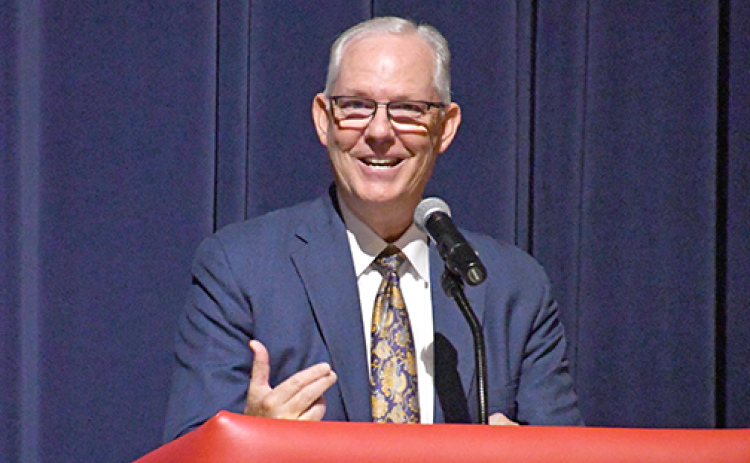
The Nebraska State Board of Education and staff spent three days in Aurora last week, culminating Friday with the first public board meeting to be conducted in outstate Nebraska under newly-hired commissioner Brian Maher.
The decision to move meetings throughout the state was made before Maher was hired, though the new commissioner said he thinks it is important for the board to see what’s happening in schools around the state first-hand, while also being more accessible to the public.
“It gives us a chance to be reminded why we do the work we do, which is all about kids, student achievement and how the kids in Nebraska are being developed for our future, and for their future,” Maher said during an ANR interview Thursday morning. “That’s a big piece of what we’re doing here.”
Maher and the board spent time touring schools in both Aurora and Hampton, which he said was a valuable learning experience.
“One of the things that being out and about does is help us accomplish one of our objectives, and that is to further develop relationships where relationships already exist, and also to develop relationships where maybe they don’t currently exist and that is with communities, community leaders, schools, members of the legislature and as is the case today with students as well,” he said. “So we have an opportunity to be out and be visible, making sure people know what we do is important in the educating of all of Nebraska’s youth.”

Teacher shortage
Asked what in his perspective are some of the top challenges facing the board and Nebraska Department of Education, Maher said he hears concerns consistently from superintendents about a growing teacher shortage.
“The fact of the matter is we do have far fewer educators today than we had just a few years ago, let alone decades ago,” he said. “How do we make sure that we have a pipeline that we need is part of that issue. Another part of that issue is making sure from the state board perspective that we’re not setting up barriers through the certification process.”
Maher cited a couple of local examples where  good people have been able to teach sooner than later.
“We need to make sure we can keep them in place going forward by looking at our certification and our rules and regulations,” he said. “We have a staff committed to that, we have a commissioner committed to that and maybe more importantly than those two things we have a board that is committed to addressing that issue. 
“I think the biggest thing I would say at this point in terms of traction, we not only have concluded some certification issues that I think will help school districts already, we’re looking at more ways to help in the very near future,” he continued. “If I put myself back in the role of a superintendent, I would say it’s time for the board to quit talking about doing things and taking some action. This board I believe is taking some action that will help school districts.”
Maher began his new position in June having spent years in education, first as a teacher, then as a principal, and eventually as superintendent for 16 years at Centennial and later in Kearney.
“I want to make sure I never forget what it was like to be in the classroom in front of students because that’s where the magic happens in education in Nebraska and everywhere, quite frankly,” he said. “But each of those roles is critically important to a quality education, so I’m glad I’ve had all of those experiences. 
“It does help when a superintendent talks to me, whether it’s about budget, or certification, or a personnel matter, I generally have some experience to fall back on to have some understanding of what they’re going through today,” he added. “And it also helps me sometimes give advice a little more paternal now than I would have been able to a few years ago, so I think I can help mentor some folks as well.”
Asked about the message he is hearing while out visiting schools and citizens, Maher said there are several key education issues on people’s minds.
“The issues that I’m hearing most about are the workforce, above all,” he said. “I’m hearing about assessment and accountability and how do we address that issue going forward? And then I would say other things, but they probably fall behind those two topics. 
“One of the messages that I’m trying to send everywhere I go is we need you when I talked to schools, when I talk to teachers, when I talk to principals, when I talk to superintendents,” he continued. “It’s important, I think, to let them know that we need them, not only from a workforce perspective, just from a humanistic perspective, and what I generally hear back after the speech is, ‘Hey, we need you too,’ so that’s affirming as well.”
Asked about his ability to communicate and work with a board that has widely differing views on many topics, Maher had this to say.
“I’m impressed with the eight individuals that we have as board members,” he said. “They certainly see some things differently, but they agree on a whole lot of things. That makes my job a position where I think I can work well with all of the board members. Mr. Penner is certainly no exception to that.”
Kirk Penner of Aurora, a member of the state board, said he was pleased to help host last week’s meeting.
“The board and Nebraska Department of Education appreciated the opportunity to visit Aurora and Hampton schools,” Penner said. “It is important that we visit schools west of Lincoln and they do recognize that what is happening in the smaller school districts is different than what they are used to seeing in the Lincoln and Omaha districts. Having the opportunity to have face-to-face conversations and hear successes and concerns with local staff administration is crucial.”
Penner went on to say that he has confidence in Maher’s ability to help improve statewide education.
“I support Commissioner Maher 100 percent and know that he will lead education down the path of success as he understands Nebraska schools being a former superintendent,” he said. “He is already making changes that were long overdue.”

Public input
Friday’s meeting included presentations by Hampton Public Schools administrators and students regarding the district’s Hawk Herd program, as well Lexington Public Schools teachers and students who described the school’s award-winning journalism/yearbook program.
After three hours of morning discussion, the board reconvened after lunch, beginning with a public input session. Three people spoke, including two from Aurora.
“I don’t know all the ins and outs of everything this board has discussed today, but I just want you to know some of the books that are in our schools and some of the indoctrination being taught, we care about that,” said Gregg Kremer, who then thanked specific members of the board for “standing in the gap” on those issues.
Greg Epp of Aurora also spoke briefly, comparing Commissioner Maher’s challenge to that of newly-hired Husker football coach Matt Rhule.
“His success will largely be determined by the staff around him and the players that he and his staff can recruit…” Epp said. “Your legacy will largely be dictated by the people you have on your bus. I don’t envy you because you have a very big job.”