Proposed Synergen ammonia plant hits roadblock

Subhead

Joint Planning Commission denies CUP application 
 

Only eight weeks after the proposed Synergen Green Energy ammonia plant first came to the attention of the general public in Hamilton County, the project has hit a regulatory snag. 
At the end of a nearly three hour meeting of the county’s Joint Planning and Zoning Commission held last Tuesday night, the commission voted 10-1 against recommending a conditional use permit (CUP) for the plant to be located along Highway 34 west of Aurora near the Mars Petcare factory. 
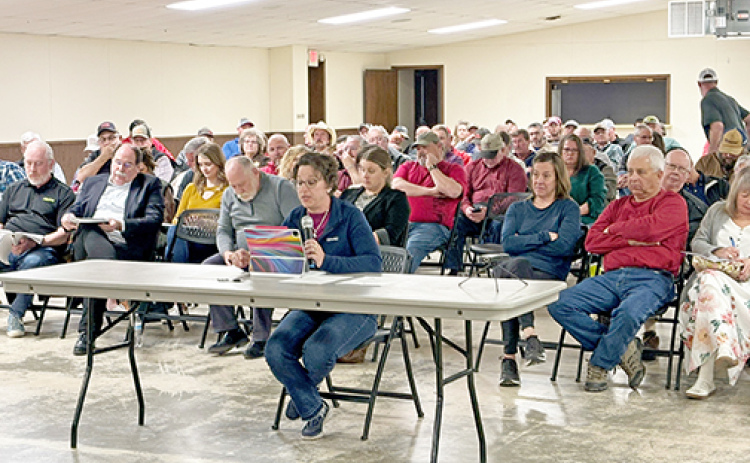
The dozens of cars surrounding the Ag Building at the Hamilton County Fairgrounds (where the meeting was relocated to in anticipation of the crowd) provided an early indication of the amount of interest in the main subject on the agenda that night. The vocal crowd of nearly 150 seated in folding chairs inside the facility gave an even greater indication of how the evening might go. 
After the meeting was called to order by the commission chair, Joan Fruit of Giltner, the roll of the 13 commission members from across the county was called. It showed two absentee members, Dale Bamesberger and Rich Archer. Seated at the tables spread across the front of the room along with the commission were County Attorney Douglas Dexter, County Business Manager Pat Shaw, who served as timekeeper for the testimony time, and John Shepard of David City, representing Marvin Planning Consultants. 
Several months ago, in anticipation of Synergen’s application for a CUP on the property, the county board of commissioners retained the services of Marvin Planning to help the county navigate the logistics of the project as it related to the county’s zoning ordinances and comprehensive plan. It was explained at the time that the company was familiar with the county’s regulations since company founder, Keith Marvin, had helped with the development of the ordinances several years ago. 
Prior to the beginning of the two hearings on the agenda that night, Fruit cautioned audience members against “booing, hissing or clapping” or otherwise responding to what was said during the hearings. 
After quickly dispensing with the first hearing, which consisted of the granting of a CUP for an addition to M.F. Construction of Aurora, the commission moved on to the next agenda item which was the Synergen question.

Public comments
The public hearing portion of the meeting, which began at 7:19 p.m. went on for more than an hour with testimony being presented by 15 persons who said they were either for, against or neutral about the proposal. 
After calling for testimony in favor of approving the application, the commission heard from six parties who supported the project, including Synergen attorney David Levy from Omaha; John Hewitt, Synergen vice president of projects; Engineer Jim Schneider of Olsson Associates who led the hydro-engineering study conducted on the project; Kelsey Bergen, executive director of the Aurora Development Corporation; Aurora Housing Development Corp. President Janelle Seim and Hamilton County Corn Growers Association President Mike Bergen. 
Hewitt, who has been at the forefront of Synergen’s introduction of itself to the community in hosting meetings and granting interviews, emphasized the benefits of the project to the county and stated the reasons why Aurora was chosen as the site for the facility. 
“Aurora checks so many boxes,” Hewitt said, listing the local market for anhydrous ammonia, the existing production and distribution network such as the NuStar ammonia pipeline which begins at the Gulf of Mexico and terminates near the proposed site, and enthusiastic local support. 
“We’re investing in ourselves and the community for the long term,” Hewitt stated.
ADC Director Bergen said the corporation had first learned about the proposed project in 2022 and has been holding discussions in all sectors of the community since the project was announced publicly in January.
Bergen said the ADC was in support of the project because of the additional jobs it would bring to the community and other economic benefits. 
Siem also spoke approvingly about the project, saying the community has spent the past four years preparing for it. She said she had had two meetings that day with investors looking at developing housing in Aurora and concluded by saying, “We are primed, we are pumped, we are ready for this!”
Mike Bergen started his testimony by saying “This initiative holds great promise for the ag community.” Noting that farmers currently rely heavily on ammonia imported from countries like Russia and Trinidad, Bergen said having a local source of the fertilizer would provide a greater stability in prices. He also said the plant would open the door to new industries in the area and would add to the tax base while taking some the burden off farmers and other property taxpayers.

Project opponents 
Speaking against the application were Ann Ashburn, Tina Oswald, Gale Ernst, Justin Elge and Marcellus Wall, all of Aurora, and Ruth Peters of Hampton. 
The concerns expressed in their testimonies centered mostly around the amount of water the plant would use, potential damage to the aquifer, what would happen with the wastewater from the facility as well as the loss of agricultural land for building the facility.   
Oswald and Elge both said they live near the proposed site and were concerned about the impact on their residential wells. 
“Are we being told everything about this project?” Oswald asked, adding that she doesn’t like the idea of taking prime farm ground out of production for building the plant. She also said she drives by the site on her way to work every day and would rather see crops than an industrial facility.
Peters echoed that sentiment, saying she was against “taking 160 acres of prime farm land out of production and covering it with concrete and asphalt.” 
Of the three speakers who said they were neutral about the project, only former state senator and Henderson area farmer Curt Friesen appeared to be the most impartial in his statements. 
Friesen, who said he had also previously served on the board of the Upper Big Blue Natural Resources District, stated that the NRD has the authority to regulate water usage and  historically has not been afraid to deny water permits when deemed necessary. 
Urging the commission to let the NRD take care of the water issues, Friesen emphasized the importance to the area of the new jobs that would be created by the plant. 
York County farmer Anthony Bohati, a current member of the NRD board, said he was not speaking on behalf of the board but stated, “We must be cautious not to over use groundwater.” 
Bohati said he was “very concerned” about the amount of groundwater the Synergen plant would use and stated that if aquifer levels get low enough, irrigators would be placed on restrictions long before the plant would have to cut back on its water usage. 
Representatives of Synergen countered concerns about the water usage by reiterating that the water use had already been studied by both their consultants and the NRD and that Upper Big Blue, which has the regulation authority, had already granted the company a water permit for the estimated daily usage amount, estimated at 3 million gallons per day.