
Meetings with Kenya leaders plant seeds for new business/workforce partnerships
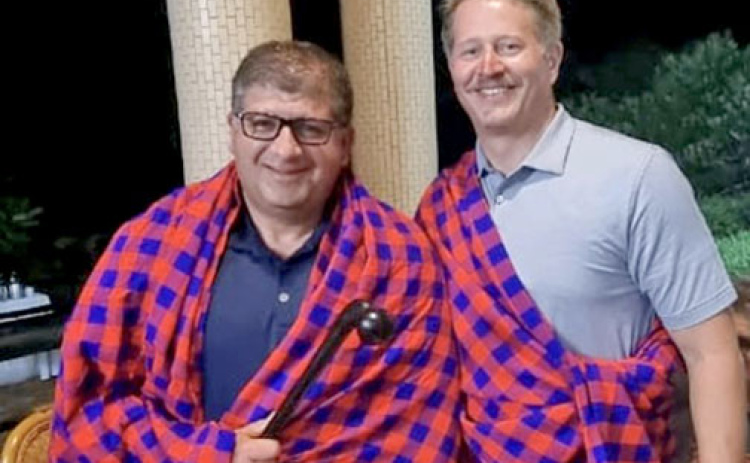
After returning from a trade and investment mission to Kenya last month two business owners from Aurora say relationships are forming which could create generational change on one end and a much-needed employee pipeline on the other of what they envision as a win-win global partnership.
Laban Njuguna, a native of Kenya who owns and operates Zabuni Coffee in Grand Island with his wife Cora, and International Workforce Services (IWS) co-owner Todd Vettel were part of a 10-day trade mission to Kenya Feb. 12-22 led by Nebraska Secretary of State Bob Evnen. The focus of that mission was to connect Kenya importers with corn growers and researchers in Nebraska, though Njuguna and Vettel agree it became clear during the trip that there are opportunities for mutual benefit far beyond the field of agriculture.
“I would say it was a heavily ag-based trade mission from what I gathered, but we just kind of tagged along,” Vettel said. “The Secretary of State had mentioned this bridge that they’re building between Nebraska and Kenya and it became very obvious to me after the 20th meeting there that a constant cultivation of this relationship has been in development for many years. As I see it, IWS is interested in all of those opportunities.”
Those opportunities could include helping what Njuguna described as talented, young, underemployed Kenyans fill jobs involving truck driving and other fields in Hamilton County, Nebraska and throughout the U.S. of A.
“I think the Secretary of State is looking at Africa and seeing a lot of opportunity for ag, seed technologies and manufacturing,” he observed. “I think the end goal here is to make Nebraska a serious jumping off and landing spot for Sub-Saharan African countries that want to trade with the United States, and especially in the Midwest. We want this to be ground zero for that and of course one of the most important industries is logistics.”
That’s where Vettel and IWS could come in and help fill the void, Njuguna said.
“There are something like 80,000 truckers needed in this country, so I don’t think they’re putting any guardrails to what can be done,” he said. “They are creating relationships and conducive environments for them to come in and do what they do best. The key ingredient is IWS doing what they are doing, because without that there is nothing.”
‘Unique’ mission
Njuguna, who helped organize the trip along with Evnen’s deputy for international trade, Cindi Allen, also credited Deen Albert of Grand Island for helping connect the dots. Albert is director of operations for Grand Island Express, a trucking company which has utilized IWS services to help recruit professional truck drivers from Africa and other foreign nations. Since debuting two years ago from a downtown location in Aurora, IWS has assisted nearly 220 drivers in completing the necessary training and paperwork to earn their American CDLs while also helping them adjust to living and working in the United States.
“What IWS and Deen are doing is really, really unique,” Njuguna said. “To me this is why trade missions matter so much is that we were together for 10 days and you get to know somebody real well. Despite the fact that I live a few steps away from IWS, after spending time with Todd I really got to understand what his motivations are and that of his family. They’re not doing this to just churn out another business and make money, they are seeing a need and knowing they can help.
“As an immigrant myself, that means a lot,” he continued. “If I would have been able to come to this country 24 years ago and have somebody hold my hand in that way and show me how to not only survive here but set me up for success, you’re talking about a whole different ballgame. If you come here without proper guidance, you’re going to wander around for a while.”
IWS growing
Vettel reported that IWS has grown in its mission as a trade school, working with drivers from 29 different nationalities over the past two years. Many of those individuals were from Africa, though none from Kenya.
“When you look at Kenya you have a very youthful and talented populace,” Vettel said. “We know we have the demand side of our workforce crisis in the United States so to me it’s a no-brainer that something should be done here.”
Describing the On-Demand CDL Academy as the company’s “bread and butter,” Vettel said IWS could be expanded to provide the same services targeted at other job sectors.
“We’re an academy that does the training and we want to do the human care to help people orientate and establish in Nebraska and America, but I think there are so many opportunities out there,” Vettel explained. “I could see someone purchasing a trucking company, staffing it with Kenyan management and Kenyan labor, patterning with wealthy businessmen and universities in Kenya. All these relationships are being developed, which is so important.”
Vettel said he and his family are also working to launch TruckerForce, which he described as a pool of trained drivers ready to get behind the wheel when and wherever needed here in central Nebraska.
“When you look at the state of farming, the farmers have difficulty finding people to haul their grain, just like large fleets do, including Grand Island Express or Sunrise Express,” he said. “They’re always searching for drivers, so we’ve talked to the community about developing and building out a ready fleet with lots of Kenyan drivers.”
Vettel reported that a web-based platform is currently being developed for TruckerForce, which he expects to go live later this year.
“We’re building a web-based platform where farmers will be able to request a contract driver and we’ll provide them,” he explained. “They will just kind of tell us when, where, how long, how many loads and then we will turn it into an app that the farmer can have on their phone.”
That, Vettel said, is just one of many opportunities he believes could flourish with relationships growing from the latest trade mission to Kenya.
“It isn’t just trucking,” he noted. “We discussed 20 different technical fields with the Kenyan State Department that are growing in the United States and we can’t find people for them. So taking the IWS model, the differentiator we have is that we’re not afraid of doing the human care. The cultural management is hard to do and I think we do it well. We find it’s a God-honoring thing that is necessary and we want to do that. When you merge that with the needs in this area, the truck driver needs, the diesel mechanics and a willingness to do it, I think it could be something that thrives. That’s what we have been working on since we’ve been back.”
Njuguna said he too is excited about the seeds that are being sown in his native country, where he said the average age of the population is between 20 and 25 years old.
“There are a lot of people looking for opportunity,” he said. “We have college graduates, kids with master’s degrees, that are still at home because a lot of them don’t have jobs. The fact of the matter is there is a need here (in America) and we’re not going to be able to fulfill that workforce need with Americans. We’re talking about legal immigration here and we need to start positioning ourselves and create the right relationships with the right people.
“I think one of the things that they saw with Kenya was number one, we already speak English,” he continued. “That’s a big deal. And number two, people are hungry for opportunity. Once you have people who are willing to put in the time and work hard I think that’s a recipe for success. That’s one of the reasons I feel confident about working with Todd and Deen.”