
Lippincott: ‘It will be an uphill battle’

Subhead

Dist. 34 senator predicts lively debate at special session
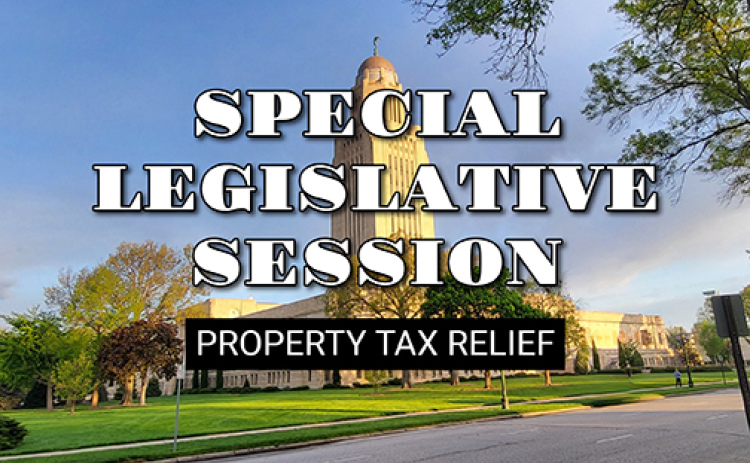
Dist. 34 Sen. Loren Lippincott says he was one of a number of legislators who received a personal visit from Gov. Jim Pillen in recent days during which the governor laid out his plan for shifting the tax burden away from property taxes. That is the lone goal of a special session called by the governor set to begin Thursday in Lincoln. 
Lippincott said Pillen, accompanied by two state troopers, spent about 45 minutes at his farmhouse near Central City visiting, explaining his tax plan and leaving him with a pamphlet which lays out many of the details of the proposal. 
“One thing Jim Pillen and his people are trying to do is they’re trying to broaden the base of those that are adding tax revenue to our state coffers,” Lippincott said. “For instance, right now, it’s a well known fact that 40 percent of Nebraskans do not pay income tax or property tax... But those that don’t pay property tax or income tax drive on our government-paid roads, send their kids to the government-paid schools and also enjoy protection from the police, sheriff’s departments, State Patrol and our military, but yet they’re not paying for it through taxes.”
Noting that agriculture is a vital component of Nebraska’s economy and that farmers disproportionately get hit by rising property taxes, Lippincott said the governor wants to shift the burden away from them.
One way Pillen hopes to do that, according to the senator, is by making public school teachers statewide, employees of the state. The governor believes that would shift 80 percent of the expense of running public schools away from the local property taxpayers. 
Lippincott said Pillen believes he has 37 or 38 votes in favor of his plan (out of a total of 49 senators), but he admits getting it passed will be an uphill battle.
“The reality is, his plan has been available to review only this past week, so it’s going to be tough to get this passed in a short amount of time,” Lippincott said. “When you work in the legislature, you become very accustomed to pushback for nearly anything that is change.”
The senator said he has been surprised over the last two years to see how much resistance there is in the legislature any time the status quo is challenged.  
“Obviously taxation is something that affects everybody, so there’s going to be a great deal of pushback toward the status quo in changing our taxing entities,” he said.  
An additional source of revenue being proposed by the governor, according to Lippincott, is to raise taxes on some items on which Nebraska has historically charged lower taxes than surrounding states. Those items would include such things as cigarettes, candy, pop, vaping, spirits, keno gambling and so on, but he warns they are special interests that won’t go away quietly. 
“All of those things have lobbyists that are paid in order to protect the interest of those items,” Lippincott said. “And you learn very quickly something that Warren Buffett likes to say in Omaha, and that is ‘successful people say no to almost everything.’ So when listening to special interests and lobbying groups that represent those special interests, you can feel free to listen to them, acknowledge what they have to say, but you do not need to feel obligated to vote in a way that will represent their interests instead of representing the interests of your neighbors and our fellow Nebraskans.” 
Lippincott said he expects the first three days of the special session to be taken up by legislators and the governor putting forth their favorite plans for revising the tax code, and he said he knows of at least one competing plan that will be entered by Sen. Steve Erdman from Dist. 47 in the Panhandle. 
“He said on day one, as soon as we get into session, he will drop his bill to propose the EPIC tax which is an acronym and stands for Eliminate Property Income and Corporate tax,” Lippincott said. “So he will be dropping that bill into the clerk’s office.” 
A petition drive seeking to put EPIC on the November election ballot recently failed to gather enough signatures by the deadline.  
Lippincott said there is no time limit on the length of the special session. 
“It could be three weeks in length; it could be six weeks in length,” the senator said. “There’s really no telling, and it will just be dependent on the amount of time that is spent on these different bills and the amount of bills. It should also be noted that as soon as these bills are submitted to the clerk, then they are made public for everyone to look at by way of the internet. Then there will be committee hearings and the people -- that is the second house of the state of Nebraska -- are welcome to come to Lincoln and testify before committees on these various bill proposals.” 
Reiterating that he believes coming to a consensus on the best way to ease the property tax burden will be an uphill battle, Lippincott said the governor appeared upbeat about his prospects for success. 
“It’s a sales job, and you have to believe in your product in order to sell your product,” Lippincott said. “So we’re making some movement in the right direction for sure.”
Editor’s note: The special session and the governor’s tax plan is the subject of Sen. Lippincott’s weekly column which can be found on Page B2.