
Andersons expand friendship with young family 8 years after hosting honeymooners
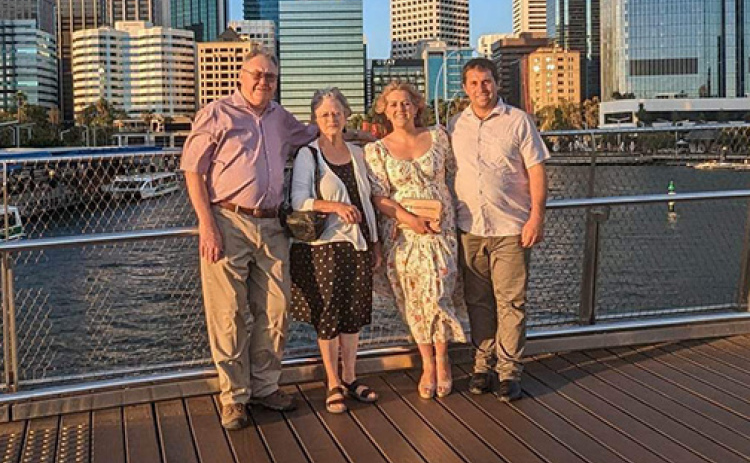
Six months after retiring on the same day, Alan and Dottie Anderson ventured down under earlier this year, where they experienced the trip of a lifetime to southwestern Australia.
The destination for their six-week adventure wasn’t the typical tourist attractions in Sydney or along the Barrier Reef. Instead, the Andersons found their way to a family farm “out in the middle of nowhere” near the tiny town of Dumbleyung, where they reconnected with a young couple they hosted back in 2015. Regan and Janelle Bairstow were on their honeymoon at that time (see related story on Page C7), when Alan responded to an email seeking hosts to help them experience America. Though separated in age by decades, the two couples bonded quickly and continued to communicate via Facebook and email over the years, leading up a reunion trip in January.
“I think we expanded our friendship,” Alan began. “We actually got to know each other. We weren’t talking to honeymooners who were really young and were only here for a few days, as we were able to see how they lived.”
The biggest change for the Bairstows since 2015 is the addition of four children. The Andersons had seen and visited via FaceTime with Phoebe, Denzel, Macey (whose middle name is Aurora, as in Nebraska) and Damian, who range in age from 1 to 6 years old, but virtually living with them for more than a month created a new and precious connection.
“We are like their (American) grandparents,” Dottie said with a smile. “We spent a lot of time with the four kids and their parents, and really had a great time with both their sets of parents. It was just the chance of a lifetime and there would be no way one could go on a tour and experience what we did. We just got to live right with the people where they are.”
The Andersons spent each day with the Bairstows from their arrival on Jan. 17 through their return home on Feb. 28, most of it on the family farm. Mixed in were trips south to the Southern Ocean coast, west to the Indian Ocean coast, and northwest to the city of Perth. Each of those destinations was two to three hours away, providing the Nebraska visitors an up close and personal view of a region they’re told few Americans ever see.
“We got to go to school with the kids and were almost kind of their show and tell, you know, because their friends are Americans,” she said. “All we’d have to do is say hello or good morning and they’d say, ‘You’re not from here. Are you those people from America?’ because Americans just don’t go there.”
Approximately 10 days were spent at giant “holiday parks,” which the Andersons described as elaborate camping grounds with all kinds of activities for children, as well as “chalets” for adults.
“Holiday time is very important and big to the Australians and Janelle planned lots of small trips,” Dottie explained. “We were at three different holiday parks while we were down there. We could go swim in the ocean, they had barbecues outside and kids were on bikes all over the place.”
“They have a lot of friends who go to these holiday parks, people they’ve grown up with, so it’s not like a bunch of strangers,” Alan added. “We were the strangers, for about 10 minutes.”
Out on the farm
Aside from trips to holiday parks, sightseeing at a wildlife refuge, a whale watching outing and other day-trip adventures, the Andersons spent a great deal of time on the Bairstow family farm near Dumbleyung. The community itself has a population of 199, part of a Dumbleyung Shire (similar to a county in the US of A), which has 650 people by census.
“There are not a lot of people, and most of them are agrarian, working with farms,” Alan said. “The Bairstows are sixth generation, so they’ve been there a long, long time.”
Having spent much of his career in the ag implement business, retiring last year as general manager at Grosshans International in Aurora, Alan was in his element talking to farmers about all aspects of their operations. He had a lot to learn from Regan, who runs a sizable farm with his father and brother in what he calls a broad-acre cropping operation. Alan was enthralled learning by watching on typically long days out on the farm, also joining them for unique experiences such as kangaroo hunting, designed to thin what there is known as an overpopulated, often hazardous animal.
“There are not a lot of people out there, so they’re just great big, huge farms,” he said. “I’m going to say they have close to 13,000 acres, okay, and their neighbors have 13,000 acres and their neighbors have 13,000 acres. “But their farming is hard. What they do is raise wheat, canola, oats and barley and then when that’s harvested they put their sheep on it and they graze it down to the ground. There isn’t anything left when they do that and the reason they do that is their ground is so rocky and so poor. They can’t till it, so they have to get the dry stuff off of it and then everything is done by a drill with tungsten point, hard, abusive equipment that can handle those rocks.”
Like most other farm region around the world, water is the most precious and unpredictable piece of the puzzle in Australia. While much of Nebraska is in the midst of a drought now, Alan said lack of water is a constant concern in that part of the world.
“What they said about rain is if they have seven inches of rain a year, they will maintain the farm,” he shared. “They can live with what they make. If they have nine inches of rain they will own the bank. It’s that close, but it’s boom or bust, boom or bust. It’s amazing what they do.”
The Bairstows reported two consecutive wet years with more than nine inches of rain, though it’s dry there now in July, which is their winter.
“They had bumper crops and they were able to really heal things up and make things profitable,” Alan reported. “They’re in a drought right now. It’s winter time and it’s dry.”
The Andersons had been to Australia before, on a brief work-related trip for Alan back in 1981, but this time they had the opportunity to take a deeper dive, learning about agricultural differences, as well as the local culture and way of life.
“I’m older now and I understand and appreciate things a little more,” Alan said. “I probably drove those poor people nuts because I asked a lot of questions about why they did what they did, what the outcome was going to be and for the most part when we asked a question, we got an answer. They are honest people and they told us things they didn’t have to, and I really appreciated that.”
‘Rebel with a cause’
While Regan is a native of southwest Australia, quiet by nature, Janelle is a “big-city girl” who grew up on the western coast in Bunbury. Dottie spent a lot of time with Janelle and the kids, observing her passion for family and community.
“She is a rebel with a cause,” said Dottie, who spent several years on city councils in both Aurora and Lexington. “She is a stay-at-home mom, but she doesn’t stay at home. She is very, very, very active in the community, and she wants to be involved in everything. Regan is very content to just stay on the farm, while Janelle wants to be at every meeting and every party.
“They are having a lot of racial issues in Australia at the moment and she’s right in the middle of the fight,” she continued. “I told her that if you’re going to complain that much you better get in and do something about it and I think at some point she will definitely try to get on the shire board, but I don’t know that.”
Being a stay-at-home mom is different in other ways down under, as young children are at home while they attend early elementary school, then by year six or seven of their education they go off to boarding school. The Bairstow kids are all still at home, though Dottie said she wouldn’t have been comfortable as a young mother sending her kids away at such a young age.
“So you’re 12 years old and you’re off to school, you don’t live at home anymore,” she said. “I could never have let my girls leave home at age 12.”