
KAAPA upgrading local ethanol plant

Subhead

CEO explains tech upgrades, planned CO2 partnership
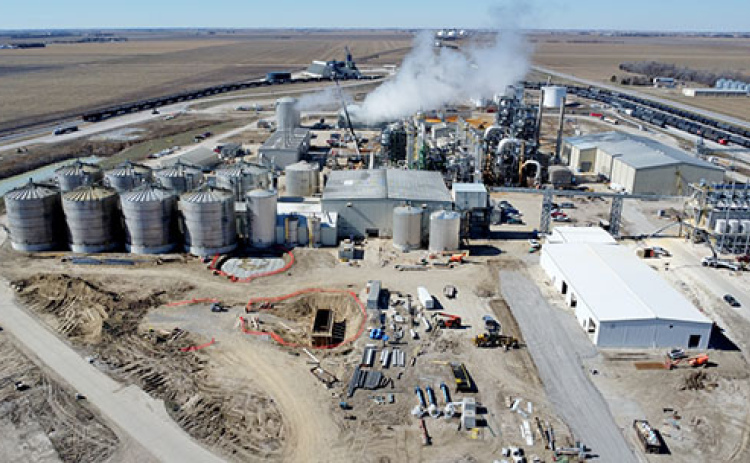
Tens of millions of dollars have been invested at the Aurora ethanol plant in the past year in what KAAPA Ethanol’s CEO reported this week is all part of a concerted effort to increase efficiencies and lower the carbon score on ethanol produced locally.
Chuck Woodside, chief executive officer of the Kearney-based LLC which purchased a majority interest in the ethanol plant from the Aurora Cooperative just over a year ago, provided a detailed update on changes being made at the plant on the west edge of town during a presentation to the Aurora Rotary Club March 20. The Aurora Coop remains a minority interest owner of the local facilities.
“We’ve had a history over the years of being involved in plants that needed technology improvements but have great infrastructure,” Woodside began. “We saw that in the Aurora plant and the opportunities there. Our goal, long term, is to take the Aurora plant from where it is today (producing approximately 110 million gallons of ethanol per year) up to 150 million gallons and we think we’ll be there by this fall.”
Reporting on what he called a capital-intensive process, Woodside said KAAPA will invest about $70 million into the plant with technology designed to make the facility more efficient. About half that total has already been spent on site with the planned changes to eventually include a new cooling tower, fermenter, hammer mills and centrifuges.
“There is a tremendous amount of technology that is advanced beyond even where our Minden plant is,” he said, comparing the Aurora plant to other KAPPA facilities in Minden and Ravenna. “I think the thing we’ve been so pleased with is the thermal efficiencies that we’ve introduced and that just makes us more efficient with the use of natural gas and with the use of heat. We think there’s a lot more to be captured there so we have a full year of 2024 ahead of us with things we’ve got to do to continue to work on those efficiencies.”
Other changes have been made on site as well, including routing utilized by local farmers delivering grain to the plant. The goal, Woodside said, is to get truck traffic all going the same way, again as part of an overall effort to improve efficiencies for everyone involved.
“Seven of the eight board members we have are farmers, so they understand the importance of getting in and out in a day,” he said of the routing evaluation effort. “Our Ravenna facility this last year received over 850,000 bushels in a day, so we try to get people in and out and I hope we’ve made some progress here. Hopefully there’s a lot more to come and you’ll see those as we go forward.”
As it stands today, Woodside said that all of the ethanol produced at the Aurora plant is shipped by rail to Texas, Phoenix or the Gulf Coast. Between its three plants, KAAPA provides 11 percent of all the ethanol used in the state of California.

CO2 project
Another key strategy to enhance the plant’s value involves KAAPA’s partnership with Tallgrass, which was explained in an ANR business story last month. The two companies are working together on a carbon sequestration project that involves capturing carbon dioxide created during the fermentation process, which is currently being vented into the atmosphere.
“There is a huge focus in the whole decarbonization effort in a lot of industries across the United States today and the ethanol industry has been at the forefront of decarbonizing the liquid fuel market,” said Woodside, who in addition to his role at KAAPA also serves as chairman of the board for the Renewable Fuels Association. “If we can deliver low-carbon ethanol, not only will it open up a lot more markets for us, but there will be a tremendous number of new uses for ethanol as other industries who can use ethanol as a feedstock try to make their product more environmentally friendly, less carbon intensive. That’s a big part of the importance of the pipeline that Tallgrass has been working on.”
Woodside reported that the Tallgrass venture, which proposes to capture CO2 from the Aurora plant and sequester it in the existing Trailblazer pipeline which runs east and west through Clay County, is one of three similar projects currently proposed in the Midwest.
“I think that if this gets completed, and I think there’s a high probability it will put Nebraska at a significant advantage over the balance of states across the Midwest,” he said, noting that Nebraska is the second largest ethanol producing state in the nation. “I really appreciate the approach Tallgrass has been taking in working with landowners. We will connect with them at some point. We’ve got to run south at some point to connect with the Trailblazer pipeline, but they’ve made great progress on the right-of-way parts of it and I hope that it’s embraced by the area and the community.
“This is a unique project because it’s already in the ground,” he continued on the Trailblazer project, noting that one of the other two CO2 projects has reportedly been abandoned. “The opportunity for Nebraska is tremendous because not only will they take CO2 and enter it into low-carbon fuel markets, but it will also open up products for replacement of petroleum products inside of other products. I think certainly sustainable aviation fuel is one you’ll hear a lot about. There is a lot to be done about that yet, but in order to compete you’ve got to have a low carbon score and that’s really what this will allow the Nebraska industry to do.”
Woodside said from a Renewable Fuels Association perspective, ethanol as an industry has made a commitment to have a carbon score of net zero by 2035, which makes opportunities like the Trailblazer project significant.
“Corn is one of those things that I don’t believe gets fair value with respect to the carbon intensity of it,” he said. “I think we’ll continue to develop and continue to tell that story.”
For example, he said during a Q&A following his presentation, companies like Microsoft are exploring ways to lower their carbon scores by looking at direct-air capturing equipment which pulls CO2 out of the air and then has to be sequestered.
“What’s disappointing to me is that we have our very own direct-air capture in the corn plant and we’ve been doing it for hundreds of years,” he said. “What they’re paying $900 a ton to do, our corn plants do every day. We’ve got to tell people that message and make sure they understand that our corn plant is really a direct-air capture function, which is harvested in the ethanol and then sequestered, so I think there is some great opportunity and we have just got to keep telling the story.
“We’re excited about the opportunities ahead in the next two years,” Woodside concluded. “Not only will we be making sure the plant is efficient, runs well and runs fast, but there are opportunities long-term with respect to low-carbon fuels and the low-carbon market.”