
New well dug at ball fields shows high nitrate levels
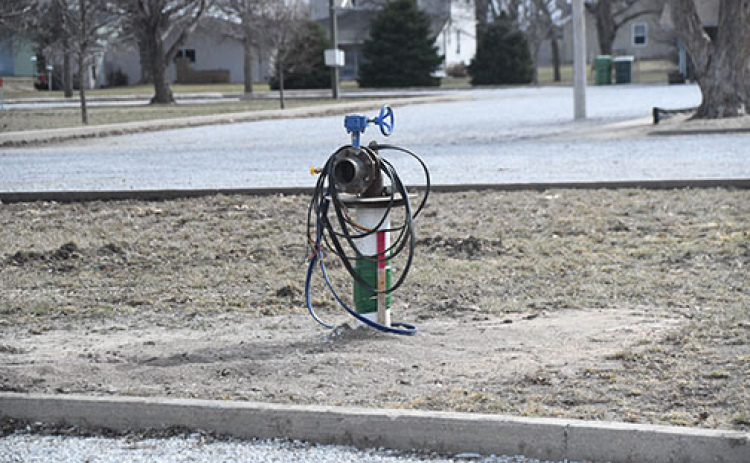
High hopes for a timely and relatively cost-effective solution to Hampton’s ongoing water problems were dashed Monday night when it was announced that water test results from the recently-drilled test well came back showing high levels of nitrates. Chris Miller of the village’s engineering firm, Miller and Associates reported to the monthly village board meeting that water samples from the well dug by the ball fields on the west side of town came back showing nitrate level of 15.8. Miller stated that a level of 10 or higher in a municipal water supply would trigger a situation in which the village would have to supply purified water to infants and the elderly at homes on the system.
Miller did say, however, the well water could be used for irrigation and the possibility of allowing the school to use the well for irrigation of its athletic fields was discussed.
Miller also said that in its search for alternative water sources, the village could possibly look at drilling a well several miles to the north near a creek bottom, however, he said that would be about the same cost as running a pipeline to Aurora and buying treated water from that community.
“If you do a consolidation of your water system with Aurora the USDA will give you money for laying the pipe,” Miller said.
He said if the village wanted to go that route, his company could finish its feasibility study within a month and the project could move forward. Noting that money was available from three sources including the USDA, Miller said the entire process could take 2-3 years but he seemed to suggest that was the village’s most viable option at this point, given the ongoing problem with high nitrate levels.
There was a nearly capacity crowd in the Hampton City Hall for the first part of the meeting as the board discussed a conditional use permit (CUP) for the new Central Valley Ag (CVA) white corn cleaning plant to be constructed on the south side of Highway 34 in Hampton. The public hearing on the permit was first on the agenda and County Planning and Zoning Director Hillary Betka and three CVA representatives were on hand to discuss the plans for the $15.5 million project that would bring two full-time jobs to the community.
“We are very excited and hope that Hampton will grant us this conditional use permit,” said Wes Obannon, vice president of operations for CVA in York. “This will kind of repurpose an old elevator and give it life and a purpose for the next 50 years.”
Obannon said the project was important to the area as this is one of the top white corn-producing regions of the country.
“We need more options for our products and a corn cleaning plant is important to our strategy,” he said.
Betka said the CUP had come before the county’s Joint Planning and Zoning Committee and it had been approved. Following a brief discussion, the permit was approved by the board.
The next agenda item involved a discussion of the tax increment financing (TIF) being sought for the project. A representative of CVA said before construction can begin some power lines will need to be moved underground and other infrastructure work will have to be done at a cost of about $270,000. He said the company wants the TIF from the village to offset those costs which are above and beyond the cost of construction.
A TIF is a financial tool used by local governments to fund economic development, in which property taxes on a project are deferred for a period of years to provide funding for some aspect of the project. The representative explained that the village would not have to borrow the money or tax its citizens.
Village Attorney Drew Graham said after the TIF expires the property “all goes onto the tax roles at once, so it’s an investment in the future.”
No official action was taken on the TIF at Monday’s meeting, however, the board had previously indicated its interest in the proposal and the matter will come back for a public hearing at a future meeting.
The board also took action at the meeting to approve Resolution 2024-3 which authorizes the village to reimburse itself from bond proceeds for expenses it has already incurred on the Hampton West Subdivision project for installing infrastructure such as roads, electrical, water and sewer.
Austin Partridge of Northland Securities was on hand to brief the board about the upcoming bond sale to pay for the project. He said everything is ready to go for the sale of bonds which will raise $860,000 for the project.
Partridge said the bonds could get in the market as early as this week and the sale could close by April 10, locking in an interest rate at about 4 percent. Board chair James Parsley said he would be available later in the week to sign the bond purchase agreement so the sale can move forward.
Construction on the infrastructure needs for the new subdivision is expected to begin in April with completion set for September or October.