Pipeline deemed most cost-effective solution to situation
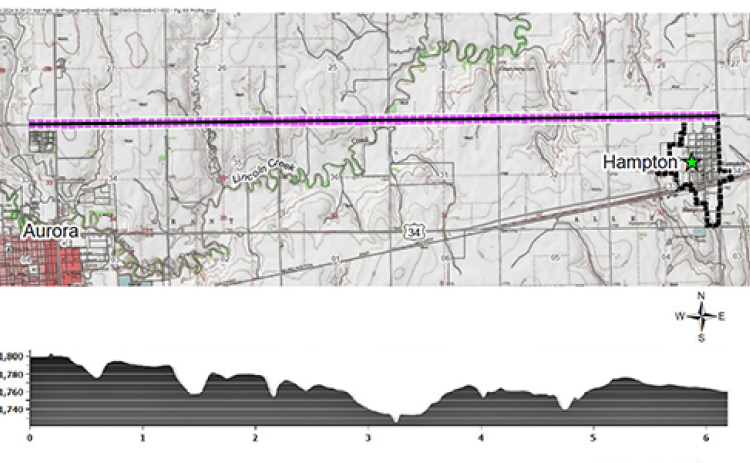
After being presented by its engineer with several possible scenarios for solving its ongoing water issues, the Village of Hampton is investigating the installation of a pipeline and purchasing its municipal water supply from Aurora, six miles to the west. The informal decision came at the conclusion of a presentation at the monthly meeting of the Village Board on April 8 during which Chris Miller of Miller and Associates Consulting Engineers made a presentation to the board outlining several possible solutions to the situation.
Hampton has been dealing with water issues for some time after one of the town’s two working water wells showed high levels of nitrates and had to be shut down. The well Hampton is currently using also has nitrates, but they are within the safe level for drinking (Under 10 milligrams per liter). It was hoped a test well recently drilled in the village’s park might provide a viable solution to the situation, however, that well tested high for nitrates as well. It may be used for irrigation purposes.
In a detailed presentation accompanied by a slide show, Miller laid out four possible options for the village to pursue to find a reliable source of potable water. Those options included attempting to find a solution in town, looking for a new source of water several miles out of town, building a treatment plant (using either the reverse osmosis or ion exchange methods) or piping water from Aurora.
Miller said the attempt to find an in-town solution had been tried and failed in the drilling of the test well. He said in sampling several wells within a several mile radius of the town, including irrigation and domestic wells, had also yielded little hope for finding a well with lower nitrates.
At one point Miller indicated a spot on the map about five miles north of town that he said might be a potential site for a viable well, saying the advantage of such a well would be that the village would not be buying its water. However, he said if nitrate levels rise in the future the village might have to build a treatment plant anyway and in addition there is the cost of building a pipeline from the well field to the water tower on the northeast side of town.
“The issue that I see with that is if you’re going to build five miles of pipeline you want to really look at just hooking into Aurora,” Miller said.
Treatment plant costs
Building a treatment plant would be the most foolproof of the solutions, according to Miller, but he said that also has its issues. He estimated the cost of building the plant at nearly $6 million, but he said the ongoing cost of maintenance with either type of system is high plus up to 40 percent of the water is lost in the process. Miller said the ongoing cost of filter replacement for a reverse osmosis system could be as much as $80,000 to $100,000 every two years.
Miller said a treatment plant would involve connecting the two existing wells which are located several blocks apart, but noted the water from the wells could be blended at first to stay within acceptable nitrate levels. He said the communities of Polk and Benedict both currently use this method.
“I can get grant money for the capital costs,” Miller told the board. “What I don’t get grant money for is the operation and maintenance for the rest of your life. That I can’t get money for. So that’s why treatment is always last... because you’ll spend $100,000 to $200,000 easy in treatment O and M—the pumps, the motors, the media, the lagoon—all that costs a ton of money.”
In the end, Miller said the most viable and cost-effective solution would be to build a pipeline along County Road 14 that would connect Hampton with the Aurora well field which is located east of the cemetery and along the same road. Miller said Hampton sits at a lower elevation than Aurora so there would be no need for installing pumps since gravity flow would work. And he also suggested using a 12 inch pipe which would provide 638 gallons per minute (gpm) water flow which would be important in case there was a major fire in Hampton.
Miller estimated the cost of building the pipeline at $5.1 million, which he said could be funded through grants from the state, and he noted that option was less expensive than other solutions. He estimated the user rate per month at $99.95, but said that was also less than other options and said the village could possibly negotiate a lower bulk water rate with Aurora.
“I’m assuming they’re gonna charge you the out of town rate,” Miller said, which is two times the rate charged to Aurora’s in-town customers.
However, Miller reiterated that Hampton could possibly negotiate a lower bulk rate.
Miller acknowledged that the viability of the plan was contingent on getting grant money to build the pipeline but said, even with the ongoing cost of buying water, he believes it is the most cost-effective solution.
“This is where the rubber meets the road,” he said noting that the his report would also be submitted to the Nebraska Department of Environment and Energy (NDEE) for review and oversight.
‘Recommended solution’
“I think your connection to Aurora is your best bet, so we’re going to write the report as ‘this is the recommended solution,’” Miller concluded. “We’ll lay all these out and this is what we’ll probably submit... I think it’s a no brainer.”
While there was no formal vote on the matter, several board members expressed their agreement with Miller’s proposal and the board discussed setting up a meeting with Aurora water officials prior to the May meeting to discuss next steps. Miller said he would be glad to attend that meeting.