
Hamilton hits fiber-to-the-home project milestone

Subhead

Nelson, Molliconi reflect on impact of high-tech initiative
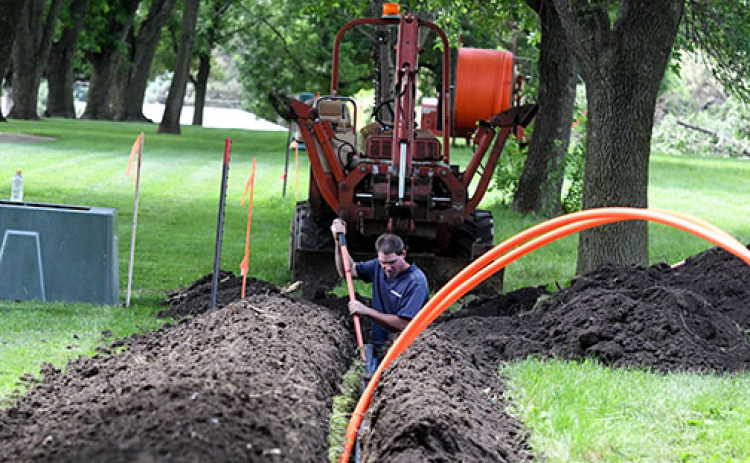
Seven years after beginning the process of burying fiber to extend high-speed internet access to customers throughout its local exchange territory Hamilton Telecommunications has reached a milestone. Company officials announced this week that a multi-year, multi-million dollar project to provide direct fiber access throughout its local territory is now complete, with approximately 1,187 miles of fiber laid throughout Hamilton County and parts of Clay and Adams counties.
“We are thrilled to have achieved this very important milestone,” said John Nelson, Hamilton’s CEO. “To be able to say that anybody in our exchange area can access internet speeds up to 1 gigabite, even if they live in the country miles away from the next house, is monumental. We know that many people, even in the largest of cities, do not have access to these speeds. These connections are big for our customers and they are critical for our communities to continue to grow and thrive well into the future.”
The Aurora-based company began the construction project in the spring of 2017 by building out fiber to a home in Hampton, connecting the very first residential fiber customer on July 26, 2017. The process was delayed some by COVID and supply chain issues, but today Hamilton has fiber available to more than 3,700 locations, including 454 businesses. Nelson said it was a total team effort involving installers, troubleshooters, Wide Area Network (WAN) crews, accounting and “almost everyone in this building.”
“This is definitely a milestone and I think it’s one that is going to hold,” Nelson commented, comparing the copper-to-fiber transition to the decision made by his grandfather decades ago to convert to a dial system allowing customers to place their own phone calls. “We will still have more milestones before we retire, but this part of the network is going to outlast us by a long ways.”
The decision to bury the fiber cable was based on another company milestone, Nelson recalled, referring to a 1976 ice storm which brought down a majority of the aerial lines used to provide service. Burying cable is more expensive and takes more time and resources, he said, but after a successful pilot project in 2017 burying fiber was determined to be a more reliable, cost-effective strategy in the long-run.
“We were not the first, but we’re definitely ahead of the curve,” Nelson said when asked how Hamilton’s strategy compares to others in the industry. “There are a few companies that were earlier and maybe had to spend more to get it done right, but there’s a recognition now that there is an unprecedented need for this service, particularly in rural Nebraska.”
On that note, Hamilton COO Dan Molliconi said the company has been more aggressive than some in terms of its commitment to provide fiber to rural residents, which in some cases means burying cable five to 10 miles to reach a single customer.
“One of the areas I think we’ve been at the very front all the way back to when we rolled out DSL service and through fiber today is that in a lot of areas the town got served, but not the person 15 or 20 miles out,” he said. “All the way back to when we started doing DSL, we made a commitment to provide DSL to every subscriber, regardless of their location. 
“It’s very expensive, and very hard, to plow fiber five or eight miles to somebody that’s sitting out there by themselves,” he continued. “That upfront commitment is really where we were very different in that we recognize that we’re part of this community. Farmers, businesses out in the country and residents out in the country have a need just as much as anybody else to have it, and we want to make sure they had it.”
Asked to estimate the investment required to reach this fiber-to-the-home milestone, Nelson said the total in Hamilton County alone stands at approximately $30 million.
“We are committed to the success of Hamilton County,” Molliconi said. “All of our assets are in the ground and we can’t go without saying that the owners and directors of this company believe in this area and are willing to really devote a large amount of cash to building this out. That’s pretty amazing.
“There is a lot of fiber that is being installed aerial in different parts of the country,” Molliconi continued. “It is tremendously less expensive, the first time, but it is much less reliable. When you have the degradation of fiber that’s swinging in the wind, under the sun and all those types of things, that goes even further to this being a very long-term investment that we’ve made. We really did kind of the Cadillac solution here to make sure it’s here and available for all of our customers for decades.”

Future proof
While technology continues to advance at a rapid pace, Nelson said the fiber-based infrastructure now available throughout Hamilton’s trade territory is in a sense future proof.
“We’re already starting to see faster electronics out in the field, but there are no shovels involved,” he explained. “It’s just like upgrading your DSL modem, so it’s really that simple. You don’t have to go out and plow, and you don’t have to be working in the roads and the right-of-ways. On the horizon, we’re seeing network updates on the existing fiber that gets you up to terabyte speed, so we’re talking thousands of times as fast as we’ve got today.”
Molliconi noted that the company still has a large amount of copper-based infrastructure in service, which will eventually be decommissioned. Those service lines can be identified by the light green pedastals on site, which were installed throughout the territory years ago.
“When you put copper in the ground, it’s subject to corrosion and subject to moisture, electrical inputs, those kinds of things,” Molliconi said. “With fiber, because it’s glass it doesn’t corrode and it’s not subject to electrical impulses or anything like that. You can dig up a bottle that was buried 100 years ago and it’s still a glass bottle, so the fiber really is future proof, not only from the ability to upgrade, but also its durability.
“There will be a point in time where we have to decommission the copper and we want to get all of these subscribers moved over so we can do that,” he added. “We need them to contact us to help us  get over the hump so we can move on to the next generation completely.”

Stable pricing
In addition to reaching a major milestone, Nelson said he is proud of the fact that providing fiber availability has allowed the company to increase the speeds delivered to every customer without increasing prices, while adding new data plans and bundles to the company’s service offerings. 
“One of the things we are most pleased about is that we have been able to build out and deliver fiber service, which is far superior and increased speeds, and keep prices for internet the same as they have been since October 2001, even in the face of more than 20 years of cumulative inflation,” Nelson said, recalling the company’s $49.95 monthly price for 256K DSL service. “During that time we’ve added one more plan across the top that was more expensive, but otherwise our prices in each of those tiers have remained constant for 20 or more years. I’m not sure what else you could buy today that was practically the same price it was 20 years ago and is 100 times bigger.”
The next steps to fully complete the infrastructure upgrade is for the company to begin the process of retiring and de-commissioning its copper plant. 
“While we have tried to reach every customer, we still have some customers we have not been able to get in touch with to get them connected,” Nelson said. “Any customer in the Hamilton exchange that has not been connected to fiber can contact us now to get converted and connected. We will make every possible attempt to reach and convert customers before retiring the copper hut and service in their area.”