
Group envisions inclusive playground project for county

Subhead

Designed for kids of all abilities to play together in one place
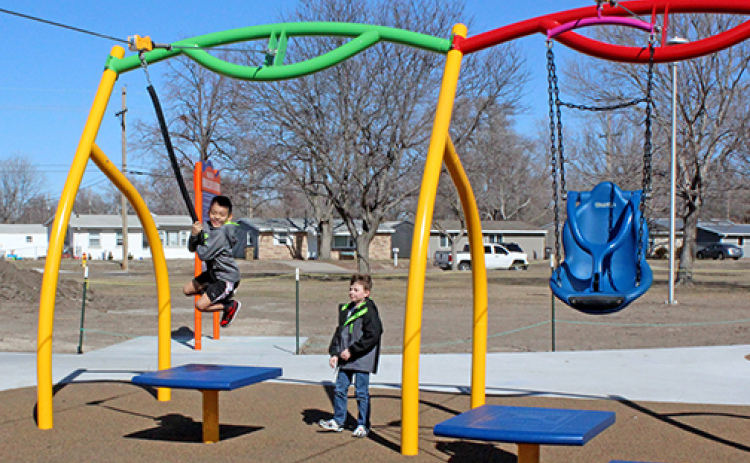
Beginning with a vision to create a play area in Hamilton County where kids with disabilities can play together safely with able-bodied kids, a group in Aurora is starting to see its project take wings. 
The vision shared by the group is to construct an inclusive playground similar to ones built recently in York and at the new Pirnie Playground at Ryder Park in Grand Island. Inclusive playgrounds have equipment that is accessible to children in wheel chairs or who have limited mobility and it’s often paired alongside equipment that can be used by kids without disabilities so that the two can play together in the same space, hence the title “inclusive.” 
The inspiration for locating such a playground in Aurora first came to Pediatric Physical Therapist Cami Knust, who works for the Aurora School District. 
“I work with kids with disabilities and so it’s always kind of been a thought in my mind,” Knust explained. “But just in working with some of the parents and talking to a couple of them, I just felt like it was the right time, and so I decided to just contact some people and see if others would be interested too. There was a lot of interest and so here we are.”
Among those early recruits was Mariah Sorensen, who is the school psychologist at Aurora and works directly with Knust. She said the idea caught her attention partly because her daughter, Aven, has cerebral palsy. 
“We had just gone on vacation to an inclusive playground and our daughter loved it,” Sorensen said. “And just looking around the parks here in town, for her there’s not a whole lot that she could access right now, so I kind of came to Cami and said I think this would be something that at some point we could do. And then it just kind of went from there.”
Another early adopter of the playground plan was Jennifer Heiden, who also has a child with a disability. Her son has down syndrome and both Knust and Kim Eberly, a fourth member of the group behind the project, have worked with him since he was two months old. 
“I’ve known these ladies very well, and they’ve been so good to him, so I personally just stay in contact,” Heiden said. “And so when we were going to inclusive playgrounds I was — probably annoyingly — sending Cami these messages of (my son) doing all of these things and how excited I was for his abilities and how much he’s grown, specifically since they started with him.”
She said when Knust approached her with the idea of working toward bringing an inclusive playground to Aurora she “absolutely jumped on that.”
“I love the idea and so I’m so excited to be a part of this group,” she said. 
Sorensen explained from the standpoint of her child why something like an inclusive playground can be such a breakthrough for a special needs child. 
“With cerebral palsy, it’s essentially a movement disorder caused by an injury to the brain,” she explained. “She was born at 30 weeks and she had a brain injury at the time of birth. Ever since she was born, motor skills have been the last things that have come along. She’s turning 3 next month and, for example, she right now mostly army crawls around the room. We’re working on getting her to crawl on all fours. She requires mobility equipment like AFL braces in order to stand and has a stander and a gait trainer which is like a medical walker. And then we’ve just gotten her a power wheelchair, too.”
Sorensen said at most playgrounds Aven needs help with standing and needs somebody to carry her around to the various pieces of equipment. 
“Putting her up on a slide requires somebody to hold on to her as she is going down because she doesn’t have the core strength to hold herself up,” Sorensen said. “She’s not walking around the playground and climbing on the equipment herself.”
Noting that her daughter is extremely social, Sorensen said an inclusive playground would give her the opportunity to play with other kids who are doing the same activities.

Specialized play equipment 
“It’s all ramps within the playground structure itself,” Knust said, explaining that the extra features make the equipment accessible by wheelchair. “Now we will have a variety of climbers and challenging equipment for kids that are able to use that on the outside, but the idea is to have at each access point — every slide or every piece of the playground — maybe an interactive activity on there, so a kid who can climb from the outside and a kid with a mobility difference can get to the same spot from the inside using the ramp.”
Other items specially tailored for special needs children might include roller slides, swings with chairs designed to hold children in and merry-go-rounds that are situated close to ground. Instead of mulch, the walkways between the equipment are typically made of rubber so they provide cushion but can still be crossed in a wheelchair. 
Another piece of equipment specifically mentioned by the group and which is also part of the Pirnie Playground in Grand Island is a pair of ziplines placed side by side. One has the usual disc hanging down for a child to sit on while traveling from one end to the other, but the other has a seat designed to securely hold a disabled child. That way, the group explained, children of all abilities can play side by side. 
Stressing the truly inclusive nature of the project, the group members talked about various ideas that would benefit children with varying disabilities. One idea has to do with equipment designed not to interfere with the cochlear implants used by some children with hearing loss. Another idea is to provide a shaded area for children who easily become overheated in the hot sun and still another idea is for a quiet zone for children on the autism spectrum who may get overstimulated. 
Heiden said because her son has a tendency to run off at playgrounds, a priority for her is to have the area fenced so that he can be free to run and play but still kept within a somewhat confined area.

The vision moves forward
After meeting over the course of several weeks for envisioning and planning, the group recently approached the Aurora City Council with the idea and received a tentative nod of approval on the project, although the council did not actually vote on the proposal. Group members say the next step is to find a location for the project. While they have some locations in mind they have not finalized anything yet and are not yet ready to talk about possible locations. 
They also noted that the playground should not be located in an existing city park. 
“There’s been several questions such as ‘Why can’t you just put this in an existing park next to an existing playground?’” Knust said. “Part of that is the ‘fully inclusive’ component. If you have two kids playing at a park, and one’s in a wheelchair and one’s not and the one that isn’t runs off to the other playground set, the kid in the wheelchair can’t go and access it. So then it’s no longer inclusive. And so we’d really like to have our own space; a new space to provide just a nice play area for everybody.”
The group hopes to finance the project through grants and by holding fundraisers within the community, emphasizing that the project is intended for the entire county. Toward that end, the group members said the interest county-wide in the project has been extremely positive. 
“I think there’s been a lot of openness to bringing more inclusion to Hamilton County and so I’m definitely excited to see that,” Heiden said. “It’s not just a park for individuals with disabilities. We also want to share that it’s so important for typical kiddos as well to just be around others who may be viewed as different and how much better that can bring their view of the world and just kind of change things a little at a time.”