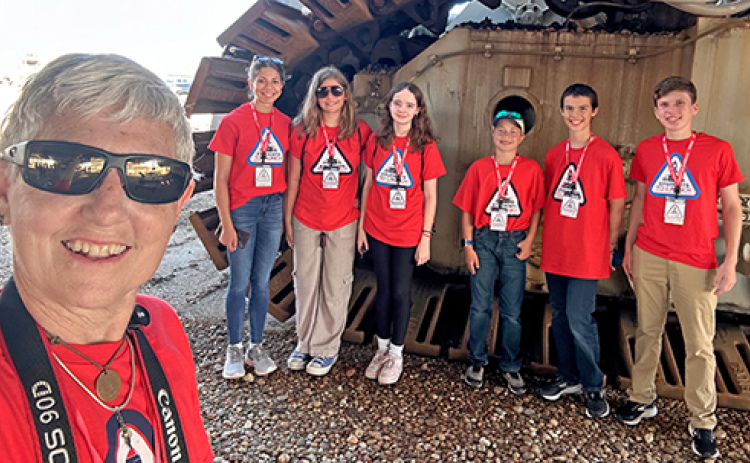
Aurora students join Students to Launch program
The sky’s the limit to what can be learned from space. At the launch of the GOES-U satellite on June 25, two students from Aurora were able to be a part of NASA’s latest step towards new discoveries.
Incoming freshmen Joey Ballas and Shawn Morris have been highly-involved students in several programs provided by the Edgerton Explorit Center.
“I’ve been involved in other Edgerton camps for awhile,” Ballas said. “I did the after-school program since first grade, then Seriously Science and more advanced stuff.”
“I attended the Wednesday afternoon program for six years, then volunteered weekly for three years in middle school,” Morris added.
Having also participated in Aurora Middle School’s robotics team, Ballas and Morris shared that through encouragement by Edgerton educator and executive director Mary Molliconi, they joined the camp conducted by the Edgerton and the Students To Launch (S2L) program.
Launching into action
Edgerton educator Deb Miller explained that S2L had invited the Edgerton to be one of several science centers throughout the country to host a camp or hub. The Edgerton hosted the camp for 50 students, including Ballas and Morris, to partake in NASA mission-inspired activities.
“We had a little intro in the theater where we got to talk to someone associated with this space program and he talked and answered questions,” Miller explained.
Among the activities the students worked together in was creating astro socks used by astronauts to protect their feet in the station.
“Their job was to use certain materials, measure the pressure on the foot and then try to disperse that pressure across the top of their foot so they don’t get a pressure sore,” she added. “Certain people were assigned the mission like one was documenting and one was the actual engineer person. It was kind of like NASA where you have all your certain people when you come together to create your product.”
Another activity involved students writing postcards to astronauts currently working at the International Space Station with the hopes of receiving postcards back in the future.
Miller shared that students were asked to write essay about their thoughts on NASA. Not only did this essay invite students to reflect on what they learned about the space program, but also to launch themselves into a bigger opportunity.
“We were to choose six that we thought represented an idea of what NASA is and what it would mean to them,” she explained. “We picked the six people, (S2L) contacted (Ballas and Morris) and said, ‘Hey, you want to come on this mission?’”
The mission, to join fellow campers Bridget Kavan (York), Ryan McCaslun (Broken Bow), Annika Spielberg (Minden) and Alex Taylor (Auburn), to fly down with over 80 students to tour the facilities of the Kennedy Space Center Visitor Complex at Cape Canaveral.
Exploring the history of space
Ballas, Morris, Miller and four other students travelled with students and educators June 24 to see the facilities of the Kennedy Space Center first-hand.
“We got to go see the Vehicle Assembly Building, which is where the rockets are assembled and then rolled out on the launchpad,” Miller said.
The tour of the Assembly Building was a highlight for Morris.
“My favorite part was when we got to go under the “crawler, which is the vehicle that carries the rockets,” Morris commented.
Miller shared it had been an eye-opening experience for the students when they discovered that the rockets were not built at the Kennedy Space Center.
“They’re made in all sorts of assembly places throughout the whole country,” Miller said. “Then they are brought there and that’s where they put them together.”
Ballas shared that other students in their group were amazed to see where all of NASA’s greatest engineers come join together to build the rockets and spacecraft.
“I like how everything comes together, all the people that work on it and how the pieces are assembled different places, but they’re all working together towards one big goal,” Ballas said.
Along with touring the Kennedy Center, the group traveled to another facility that featured the history of the Apollo space missions.
“They had spacesuits, they had rockets, they had the lunar module and you could see of the history behind the Apollo,” Miller said. “At that one place they talked about all the Apollo missions as it went up to Apollo 17.”
Building up to the main event the following day, the students learned about the GOES-U satellite, the last of the Geostationary Operational Environmental Satellites -- R series.
“It’s going to be over the United States regulating water temperatures, fires, not just weather,” Miller said. “It’s going to encompass a lot of infra-red stuff.”
In addition to witnessing the launch in-person, they were able to see the landing of the rockets that brought GOES-U into space.
“Watching rockets through the Apollo and the Shuttle, you (normally) would send up a rocket and the boosters are just dumped into the ocean because they were non-returnable and just junk,” Miller said. “Now the rocket boosters, technology has them that we watch the rocket go up and then they’re just saying wait. About six or seven minutes later those rocket boosters fall back down and they land so their reusable.”
While providing the opportunity for students to see the launch as well as NASA’s facilities, Miller commented positively on S2L for providing for the students during their time Florida.
“It was funded through that program,” she said. “They didn’t pay anything to do the program here either. They sent us all the materials, so that coordination on top of that, I think it was pretty cool to offer this to get kids any type of idea that maybe they would be interested in.”
Both Ballas and Morris shared joy in being able to meet with other students throughout the states and share their passion for science and robotics.
Morris, who is now a student worker at the Edgerton, expressed gratitude to S2L as well as Miller and Molliconi for making event possible for his group.
“It was an amazing trip,” he said. “We did a lot in a short period of time. I’d like to thank Deb Miller, she made the trip really fun and she got us home when our flight was delayed. She’s the best and thanks to Mary Molliconi for making this program possible in our small town.”
Miller expressed pride for the work the students put in both the camp and during their trip to Florida.
“These kids did a spectacular job of writing their essays and conducting themselves when they were there,” Miller said. “For the parents and the teachers of the students that I had, I was very proud of them the way they acted on the trip. Hopefully they took a little bit of coolness and knowledge back with them.”
Both Ballas and Morris will be continuing robotics in high school.