
Monday’s face-to-face meeting with architect is productive
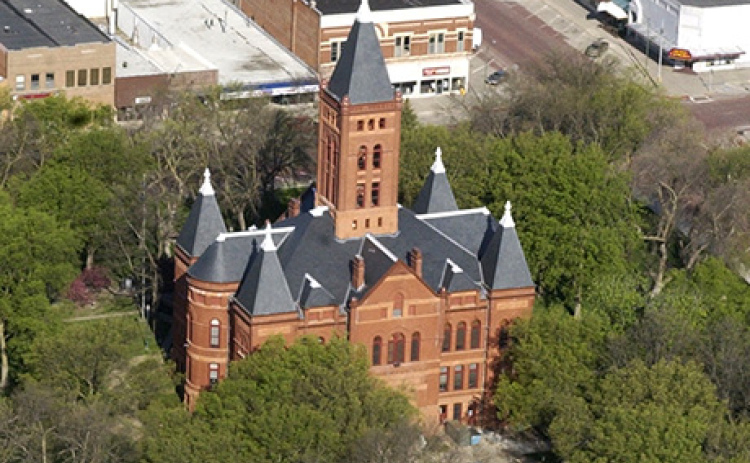
The $2 million renovation and preservation of Hamilton County’s 150-year-old courthouse was front and center at Monday’s regular meeting of the county Board of Commissioners.
Jerry Berggren, owner of Berggren Architects of Lincoln, was on hand to talk with the commission regarding concerns about work the firm had done previously on the Wayne County Courthouse. After talking to Wayne County commissioner Terry Sievers and visiting and taking pictures of the Wayne County facility, commissioner Francis McDonald had brought questions and concerns to the county at a meeting several weeks ago and it was suggested Berggren be asked to come to Aurora for the face-to-face meeting.
In a wide-ranging discussion that lasted more than an hour, Berggren took questions from the board and especially from McDonald about his previous restoration work and especially the preservation of the Wayne County Courthouse.
The county had previously signed an agreement with Berggren’s company to oversee the restoration, including tuckpointing, on the courthouse to address issues related to aging and moisture damage done over the years. Berggren does not do the actual construction but works with contractors and suggests materials and techniques to preserve the building, maintaining both its structural and historic integrity. McDonald and fellow commissioner Nicole SaBell came on the board in January of this year and were not on the board when the contract was signed.
Following an introduction by board chairman Rich Nelson, explaining the reason for the meeting, Berggren spoke about the survey of the courthouse that had been done by his company in order to come up with the recommendations for repair.
“We’ve been doing this for a very long time,” Berggren said. “I think it’s safe to say that we probably have more experience with county courthouses in Nebraska than any other firm and all types of structures because they range in age, the oldest one being 1864 in Nebraska City. What we found in your building is not terribly unusual to what we found in the buildings in other counties across the state.”
Berggren went on to say that in recent years he has been working with a consultant from England who specializes in restoring buildings that are hundreds of years old, noting that the way they need to be repaired is different from more modern buildings.
“Literally they’re finding in their restoration attempts from 25 to 30 years ago, there’s a better way to do it,” Berggren said, “and they’re undoing some of the restoration they did in those days.”
“The way we know is the best today and where they were a very common thing in the early 1980s and late 1970s, was don’t use hard mortar because it’s stronger than the bricks or stone around it and causes this fault,” Berggren said. “Yes, that’s true, but that’s not the only thing,” he added. “The hard mortar also impedes the amount of moisture being able to get out of the wall, and that’s that’s where we’re getting more accurate leadership from England than what we can find in the U.S. in terms of the mortar mixes that are appropriate for the buildings.”
Berggren emphasized that trapped moisture causes damage to older stone and brick buildings and said changes and repairs made to the building and grounds over the years have contributed to the problem.
“All of these decisions were made with the best of intentions,” Berggren said. “I firmly believe that, but we need to kind of undo some of it to get back to where the building can breathe and live the way it was designed to live.”
Q&A
At the conclusion of Berggren’s opening remarks, McDonald, armed with photos he had taken of the Wayne County Courthouse printed out on copy paper, began a line of pointed questions.
“I was pretty disappointed in the workmanship you did in Wayne County,” McDonald said pointing to a mortar joint in one of the photos.
The commissioner’s questions dealt with the color of motor used in tuckpointing, issues of mortar appearing to have fallen out of joints, problems with change orders and frustrations expressed by Sievers about long waits for materials leading to construction delays by the contractors.
After several minutes of a back-and-forth discussion between Berggren and members of the board, Berggren said he was glad to have the issues brought to his attention and noted he had not had any such feedback from the Wayne County clerk or commission.
Asked by Commissioner John Thomas whether $2 million was enough to do the work on the courthouse, Berggen replied, “You’re gonna need to tell me what you want to accomplish.”
He said the foundation and the steps need to be addressed most of all and the rest of the repairs could be delayed “almost indefinitely.” He listed the highest priorities as addressing problems with the first and second courses of stones at the base of the building, installing a drainage system to move water away from the foundation and to get rid of plantings around the building that are contributing to the moisture situation. He said a budget of $2 million would accomplish the most essential things.
Berggren said he would like to have some time to investigate and address the concerns raised in Wayne County and come back and meet with the board again to discuss the project. No action was taken by the board.
In other business at Monday’s meeting, new County Planning and Zoning director Melissa Barry, who was sitting in for County Administrator Scott Stuhr, announced she is moving back to dispatch after just two months on the job. She also presented a request that the county move its payroll from once to twice a month to make it easier for employees to budget their money. Currently the highway department gets paid every two weeks, and Thomas said he would like the payroll schedule to be consistent countywide. All the commissioners expressed general agreement with the change but decided to table the recommendation in order to give county clerk Jill DeMers time to investigate.
Budget review
One of the first items on Monday’s agenda was to hear a budget entity review from the Aurora Airport. John Wilcox of the Airport Authority led a delegation of three airport officials, which included treasurer Brett Mitchell and airport manager Terry Ott in bringing the report. Wilcox focused mostly on the ongoing taxiway construction taking place at the facility.
Wilcox reported that the project was a continuation of the replacing of the runway which was completed four years ago. He said the taxiway had to be moved 75 feet because it was too close to the runway. The change was necessitated by new GPS guidance technology, which is now in use at the airport.
Wilcox said the six inches of crushed gravel and rebar were in place on the new apron and he anticipated pouring of the six inches of concrete might start as early as that day. He stated that while the runway would probably not be long enough, it would be strong enough to land a Boeing 737 airliner at Aurora.
Another ongoing project at the airport is replacing more than a dozen hangar doors with stronger bi-fold doors at a cost of $45,000 each.
Wilcox noted that in spite of the construction the runway remains open. He said between crop dusters, pilot training flights, National Guard Chinook helicopters (some of the pilots live in Aurora) that regularly land here and corporate planes that come and go, the airport is a busy place.
“We’re excited where there airport is going to be a year from now when this is complete,” said Mitchell.
Commissioner Nancy Salmon told the airport officials, “I think you’re a great asset to the community.”