
City audit notes declining cash reserves

Subhead

AMGL suggests sales tax as means of ‘solving problems’
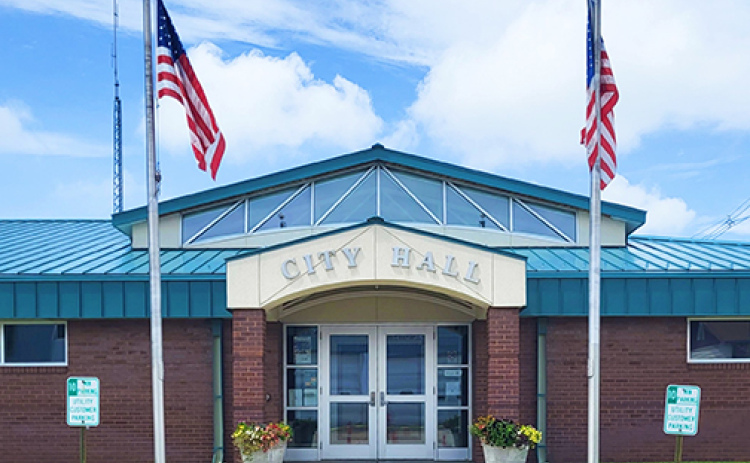
The city’s auditor reviewed a 2023 fiscal year summary with the Aurora City Council last week, pointing out a significant rise in EMS/fire and police department expenses which have resulted in an $850,000 decrease in general fund cash reserves over the past four years.
Michael Hoback of AMGL, P.C., the city’s auditing firm, spent approximately 15 minutes reviewing the summary findings at the March 23 council meeting, offering a comparison of Aurora’s 2023 totals as compared to 32 other Nebraska cities of mostly similar size for which AMGL prepares similar audits. 
While reviewing the city’s governmental expenses, which excludes capital outlay, Hoback noted that Aurora’s fire/EMS budget cost taxpayers $329 per capita last year, which is nearly five times the $70 per capita group average. The city’s fire/EMS budget was at $76 per capita in 2019 and has risen each year since the city took over the ambulance service, going from $191 per capita in 2020 to $221 in 2021, $277 in 2022 and $329 in 2023.
“You guys are definitely a little bit different in the way you operate your EMS,” Hoback told city leaders, noting that the total listed reflects operating expenses only. “Most of these cities don’t have the whole paid staff that you guys have. If we figure in the county’s contribution to this of $250,000 and then the actual revenue that we get from the (ambulance transfer) charges, we’re still at about a $432,000 loss in operations after you consider all the different contributions, so that’s a pretty big hit to our general fund.”
Hoback also noted that police department expenses went up this year from $251 per capita to $270, compared to the group’s $225 per capita average. He noted that police departments across the state are having to increase wages and benefits in order to be competitive, suggesting that Aurora has felt that impact as well.
Other line items in the governmental expenses report showed Aurora’s city administration at $65 per capita, compared to the group’s average of $90 per capita; Aurora pool and parks are at $90 per capita, compared to the group’s $60 average; the library is at $55 per capita, compared to the group’s $60 average; and cemetery expenses are at $22 per capita, compared to the group’s $25 per capita average.
One major item of concern in the report, according to Hoback, is the city’s general fund cash reserves, which have dipped from $1.53 million in 2019 to $681,677 this year. He said that is approximately half of the $1.3 million cash reserve levels suggested for a city of Aurora’s size.
A notable factor that impacts the budget in various ways, Hoback began, is the city’s valuation, which at $501 million is considerably more than the $396 million average of the comparison group. The city’s total tax levy, which is 31.1 cents per $100 valuation for the general fund and 41.4 cents overall, is lower than the comparison group’s average of 44 cents.
“We’ve done a good job of keeping our property taxes low,” he said. “You can see that the (general fund) levy has always been around 31 or 32 cents. We’ve never really increased our levy. The increase in taxes have just been the valuation, but when you look at the general fund reserves, we haven’t been generating the revenue to cover expenses.”
The most likely three options for increasing the city’s cash reserves, Hoback suggested, would be to raise property taxes, cut department expenses or implement a sales tax.
“It’s pretty shocking to me that we don’t have a sales tax,” he said. “The sales tax is probably, in my opinion, the best way to go in collecting revenue from everybody around the communities, rather than just putting the burden of all those departments and services that we have on citizens of Aurora. All kinds of people from out of town come into town and they use all our services. They use the library, the parks, the ball fields, the pool, they drive on our streets, so they should be paying for some of that use. The sales tax solves a lot of the problems.”
Hoback also included in his review comparisons of the top sources of revenue for cities. Number one for Aurora is property taxes, at $406 per capita, compared to $307 for the group’s average. The city receives $180 per capita in various state allocations, compared to the group’s average of $188 per capita. Aurora receives $63 per capita in grants and contributions, compared to the group’s $235 per capita average. Franchise tax revenue is listed at $49 per capita for last year, compared to the group’s $105 per capita average.
The largest revenue source for other communities in the comparison group was sales tax, Hoback pointed out. The group’s average was listed at $425 per capita, compared to zero for Aurora.