
Retiring Aurora physician says medicine is all about relationships
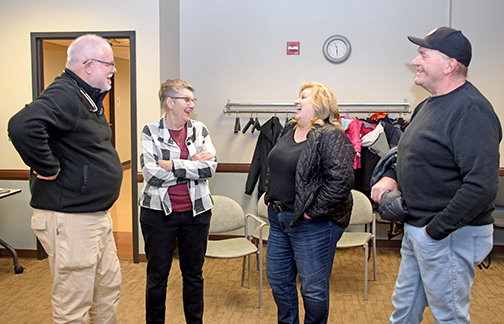
Growing up as a preacher’s kid who was fascinated by nature and science, Dr. Jeff Muilenburg absorbed life lessons early on in a way that would eventually lead him to a career as a small-town family doctor in Aurora. He will turn the page as of Friday, ending that 30-year chapter of his life story, one that he says combined his faith and natural instincts for the scientific realm.
“You are the sum of your experiences,” Muilenburg shared in the week leading up to his retirement. “In my heart, I’m an engineer, but instead of working with metal, steel, glass and wood, I work with biology. I work with the blood that’s moving through your body, with tendons and muscles and physiology.”
In his first two years of medical school at the University of Kansas in Kansas City, Mo, Muilenburg learned the words, concepts and physiology of medicine, discovering that he’d found his life’s calling.
“For me everything from biology, chemistry, physics at the cellular level up through pathophysiology is in my wheelhouse,” he said. “I loved every minute of it.”
As much as he enjoyed the science aspect of his studies, Muilenburg said he realized that to be successful as a doctor he needed to look through a larger lens, and to be a become a better communicator.
“I was an introvert who lived on the edges of groups,” he confided of his youth. “I’d rather read a book than talk to you. The book ‘Dune’ made me think that there was such a thing as interpersonal relationships and I started watching the interactions with people because I knew I had to figure that out. In medicine, you get thrown into relationships because you absolutely have to communicate with your patients.
Future doctors learn the science of medicine in med school, Muilenburg noted, then have to start learning the art of medicine and how science is applied to the individual patient.
“Now, I realize it’s all about relationships,” he noted in the final week of his tenure. “It’s interacting with people, discovering who they are, trying to educate them, trying to teach them and help them.”
Muilenburg said he discovered over time that he thoroughly enjoys trying to get people to understand what’s going on with their bodies and how to adapt.
“The holy grail of medicine is to change somebody’s behavior,” he said. “How can I tell them enough information that they’re motivated to change their behavior? A cold is a cold, so you just give them an antibiotic. Those are the easy, simple things. It’s the lifestyle things and the chronic illness (that are challenging). How do you help somebody manage diabetes. I’ll miss that stuff.”
Foundation of faith
Confiding that his belief in God has been instrumental in shaping his views on life and medicine, Muilenburg reflected on his faith journey. He gained a strong foundation in faith from his father, an Army chaplain, and took it to another level while listening intently to religious radio broadcasts as he conducted water studies for the Air Force shortly before he enrolled in medical school.
“I listened to ‘Focus on the Family’ for two straight years,” he recalled. “I wasn’t married and I didn’t have kids, so I absorbed the interpersonal dynamics information from ‘Focus on the Family.’ That helped train me toward being able to do medicine. Over time I learned that I was getting to see how God created the universe and that the deliberate order of things and how it all fits and works together is phenomenal. It’s just so much fun to do that.”
Background
As the middle child of three siblings, Muilenburg was born in Alaska and lived all over the country, including a three-year stint in Germany during his elementary years. He graduated from high school in Salina, Kan., and then joined the Air Force, spending four years conducting contamination and water studies in south Texas. Having always been fascinated by medicine, the future doctor earned a spot at the University of Kansas medical school in Kansas City before leaving the military.
Muilenburg completed his residency in Wichita, which is where he met his future wife, Cindi, who was working at that time in college administration. Cindi was a Nebraska native who grew up in Loomis, and when Muilenburg learned that there was a full family practice opening in Aurora, the young couple moved here in 1996.
“I started at the east clinic,” he recalled, referencing a facility located in what is now Dr. Kirk Reichardt’s dental practice. “When I came we had an active OB department, we ran the ER, we did the hospital and the clinic, so you were constantly busy.”
Muilenburg eventually moved his office when Memorial Hospital was expanded to include the clinic. (The same facility where he was greeted by colleagues, former patients, family members and friends Friday during a retirement reception in his honor.) He admitted that the COVID era and the growing influence of government and insurance regulations convinced him it was time to hang up his stethoscope.
“There is a stress associated with the government telling you not to treat somebody and not to do what you think is the right treatment until they’re in the ER going to the hospital,” he said. “Even if ivermectin was a bad drug, it worked on a third or half of the people everywhere else in the world. It’s just that we were led by Dr. Fauci. He should be in jail for killing people, and you can quote me on that.”
“I’m feeling old,” he continued. “I get irritated with the stupidity of the government and the computer a lot faster. The insurance industry has gotten out of control.”
What’s next?
Now ready to shift gears into what he is calling a sabbatical, Muilenburg said he and his wife have some plans over the next year or so. On that to-do list are a few house projects and trips to visit family, as well as a 200-mile bicycle trek on the Katy Trail — an old railroad trail between Kansas City and St. Louis, Mo. The Muilenburgs have two grown children: Katie, who now is a postdoctoral fellow at the National Cancer Institute Center for Cancer Research (NCI) in Bethesda, Md., and Nathan, who lives in Lincoln and works in the UNMC blood lab.
Eventually, Muilenburg would like to start teaching technical courses at the college level, perhaps at a nursing college or the University of Nebraska Medical Center. He also plans to continue leading Bible study groups at Monroe Evangelical Free Church north of Aurora where he and Cindi have been active for the past 28 years.
While he will not miss the administrative aspect of medicine, Muilenburg said he will miss the connection with patients, and the challenge of helping them feel better.
“The two big things is that God designed it all — not just the body, but the soul and the spirit,” he said. “I remember going and seeing my brother’s daughter and looking up the reflexes that babies have. I watched how all those things change, how all that accelerates, and that is all by design.”
“So you see with babies growing up, how they look, interact … it’s just fascinating watching all those details of how God designed the world,” he concluded. “I got to be part of that design, so that goes back to me being a PK (preacher’s kid). I’m a servant of God. That’s the core of who I am.”