
Melcher, Smith share detailed insight on existing staffing levels, year-to-date revenue/expenses, concern with loss of paramedics
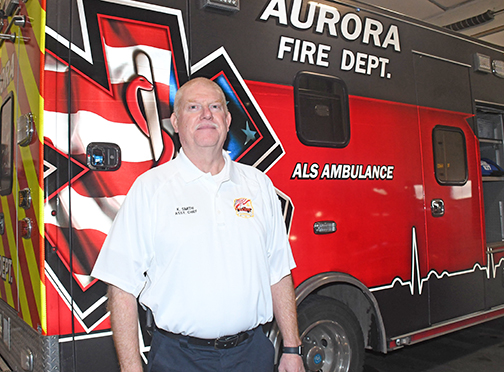
Two months after an auditor’s report raised concerns about a growing ambulance service budget which is dwindling cash reserves, city officials shared this week that a citizens advisory committee has been formed as part of a focused effort to improve the financial efficiency of local EMS operations.
City Administrator Rick Melcher said the advisory committee has met just once so far, though he is welcoming the group’s input to help determine how the city can provide the best EMS service possible within the budget of available resources.
“We formed a committee of citizens to see what we can find out in the numbers for improving our financial efficiency within the EMS service,” Melcher began in an ANR interview that included Mayor Marlin Seeman and EMS Captain Kirt Smith. “We don’t know if that means paring it down or if that means that the service is running the best it can right now with the revenues that they’re bringing in. We gave some of the committee members some homework to bring back to the table for the next meeting.
“I think the focus of the committee, first of all, is what we’re spending all the money on and what we’re getting revenue from,” he continued. “With the information we gather through the committee, that will hopefully affect our budget in a positive way. If we find something out that we are not doing or that we can do, then it would help out in a positive way.”
Though city leaders haven’t had time to digest, therefore aren’t ready to share the latest report regarding income from 911 services, Melcher said considerable time has been spent analyzing the existing level of staffing and services. As it stands, the EMS staff includes five employees per shift times three shifts for a total of 15 FTEs, all working to provide 24/7 advanced life support as well as transfer services.
“Basically, how it’s set up is our full staff is five per shift, with a minimum manpower of four,” explained Smith, who stepped in to lead the city’s ambulance department in November. “So if somebody calls in sick or somebody is on vacation, we can run with four, no matter what kind of service we provide as far as inter-facility transfers. If we were just doing 911s, we would still have to have a minimum manning of four people per shift.
“If you call an ambulance, an ambulance shows up and multiple times we have multiple ambulances out on separate calls because that’s just the nature of the business,” Smith continued. “It’s a lot busier now than it’s ever been. We’re an aging population with more and more health problems and with modern science people are staying home longer with more serious cases of illnesses. People are staying home longer, so we have calls that maybe just involve a lift assist for some people. That happens more and more now than it ever did 20 years ago or 10 years ago.”
With five employees assigned per shift, Smith said that helps meet the minimum staff level of four, which helps the city avoid paying overtime. The standard for EMS departments, he explained, is that overtime is not paid until after 53 hours worked, based on a long history of labor laws involving firefighters and EMS personnel who work 24 hour shifts. Typically, he said, paid EMS employees work 48 hours one week, then 72 the next week on a rotating basis.
“It’s a different formula than most businesses,” Smith noted. “That’s one of the things that’s different. When we were at the county, we didn’t have that because they weren’t firefighters.”
Smith and Aurora Fire Chief Tom Cox explained in a previous ANR report the No. 1 job for EMS employees is to man the ambulance, but they are also trained as firefighters so that in case of a structural fire call they have air packs and can be ready to assist volunteer firefighters when they show up with the fire trucks.
“They’re just as much firefighters as EMS,” Smith said. “They really supplement, especially with the shortage of volunteers we have.”
Getting back to the staffing level explanation, Smith said that with five people available on a given shift — meaning that nobody is on vacation, sick leave or in training — the EMS could be able to do two inter-facility transfers at one time, while still leaving staff and equipment available for a 911 call.
“That would help us with our revenue building up because we’re able to send more out and still have two ambulances in service here to handle 911 calls,” he said. “So when we’re fully staffed with the five, which doesn’t happen all that often, we’re able to handle more inter-facility transfers. That’s kind of where the optimal spot is five per shift, which alleviates backfill and overtime when people are gone. If we’re fully staffed, we are able to better cover doing the revenue side that we have to do to help offset the expenses of the department.”
EMT/Paramedics
Of the existing EMS staff, seven are now qualified as paramedics, with several others in various stages of training to reach that goal. Smith said turning an EMT into a paramedic requires time and extensive training, with 600 hours of clinical training spent in a hospital setting, plus a 200-hour internship involving ride time in an ambulance.
The short-term goal is to have three paramedics per shift, Smith said, in order to maximize both the level of service and revenue potential for taking transfer calls.
“A paramedic does all the advanced procedures,” he explained when asked what a paramedic can do that an EMT cannot. “They can put the tube down your throat. They can give you all the medicines that you need, like your cardiac drugs. They can defibrillate a rhythm. A lay person and EMTs can do that with those AED’s (Automated External Defibrillator), but a paramedic can actually read the rhythm, determine if it’s a shockable rhythm and shock a person. Basically, a paramedic is more advanced, so a lot of our inter-facility transfers are called ALS (advanced life support) so you have to have a paramedic in the back of that ambulance. Some are BLS (basic life support) and an EMT can take those, but the majority of our’s are ALS.”
Impact of reducing staff level
Asked what the impact would be on the level of service and operational costs if the basic staffing level was reduced from five per shift to four, Smith said one of the important variables is how many of those are paramedics, versus EMTs.
“The big thing is it shortens us on is having that person there to not have to call in overtime and alleviate burnout, because that’s what happens,” he said. “So today let’s say I have four people working. If somebody would have called in sick that would have put us down to three. We would have to backfill that person, so somebody from yesterday’s shift that was here for 24 hours, if nobody calls in to volunteer to take that overtime, would have to stay for what we call mandatory overtime, so they’d be working 48 hours straight. Then they would have 24 hours off to go home, do whatever, then they’d come back that next day to their normal shift. That’s okay once in a while, people do that, but the problem is when it’s repetitive and it happens a lot, which I think was some of the problems we’ve had prior. When they’re running short-staffed you burn them out and they go find jobs elsewhere because this isn’t for them.”
For reasons that weren’t disclosed, Smith said one paramedic resigned recently and another is scheduled to leave in June, causing disruption to both the schedule and the budget process.
“That’s a constant struggle, trying to keep the staff together and trying not to overwork or burn them out for their shift so that we can handle for sure the 911 calls and especially the transfers for the Aurora hospital,” Melcher confirmed.
“We’re behind the eight ball when we’re short-staffed and it just snowballs into more and more and more,” Smith added. “We’re struggling to make sure we can cover the 911 calls, plus it’s vacation season.”
Continuing the probe into the impact of reducing the level further still to three employees per shift, Smith said that would change the operation considerably.
“We would be running a bare minimum 911 service that you wouldn’t even be able to get the second ambulance out the door,” he said. “I mean, you’d have one ambulance to cover everything and you wouldn’t be able to do any transfers.”
Smith emphasized the point that EMS services in general are not designed or intended to make money, though there is revenue to be made through inter-facility transfers.
“That’s why the private businesses are in business, to do inter-facility transfers, because that’s the only place they make money,” he said. “They don’t make money on 911 per se, because you don’t go and ask somebody for insurance on 911 calls. You take care of everybody. Inter-facility transfers is a little more about do they have insurance. That’s probably how private companies operate the most.”
Another factor that can boost transfer revenue totals is the mileage fee, Smith explained.
“We charge base rate for our calls,” he said. “There’s an ALS rate and a BLS rate. Then there’s a mileage rate, which is down to the 10th of a mile. That’s how they have to bill it, so on a transfer from Memorial Hospital to Lincoln you make up that mileage quite a bit. Loaded miles is where it really makes up the difference.”
On budget this year
Having completed the seventh month of the fiscal year April 30, Melcher said the city is on budget with its EMS services. Though the auditor indicated that the budget as prepared could lead to another pink postcard hearing in September, due to projected spending and the lack of cash reserves, Melcher said it’s too soon to know if that hearing will be necessary.
“I don’t know that I can answer that yet, but we’ll know more towards the end of the fiscal year,” he said. “We’ve got a spreadsheet that we use on a monthly basis. Tom (Cox) gives me the number of runs that we go on and what the runs are for, then Barb (Mikkelsen, city clerk) gives me the numbers that we receive for medical services.”
So far during seven months of the fiscal year, Melcher reported 386 911 calls and 209 transfers, which averages 55 and 30 calls per month, respectively. Combined with a few stand-by and intercept calls, the seven-month call total stands at 599.
“In that seven-month period, through all those runs and the work that the staff does, we averaged $74,255 per month, so our projection for the end of the year right now is $890,710 of total revenue,” he said. “That’s if we maintain the revenue as it’s going today, which nobody can predict, but we have to have paramedics because they give us the ALS service which we can charge more for.”
While reporting on the total revenue projection of the EMS department, Melcher commented on what he believes was a false comparison regarding the auditor’s red-flag warning in March. At the March 25 council meeting, Michael Hoback of AMGL listed the city’s fire/EMS department at $388 per capita, compared to the recommended average of $70 per capita for like-size cities in Nebraska.
“The way we look at that number, that $388 per capita number included the fire department, which is $168,300,” Melcher said. “The auditor just simply added that to that $388 number, which should be pulled away. That’s what our committee is going to go through and work out. Obviously the other thing that the auditor doesn’t do, and I’m not a CPA but they are, and I trust the numbers that they have for us, but they don’t include the numbers for revenue.”
Using the projected revenue estimates, Melcher said he believes $148 per capita should be reduced from the $388 total.
“By comparison, the closest city to the revenue we get is Nebraska City, at $102 per capita revenue, but they have 7,222 people in their population, so they are almost twice as big as we are,” he said. “I think all of that plays a part in how hard these guys are working and what revenue we make, and how hard it is to get.”
One other point Melcher shared from the latest research is the number of calls the EMS crew responds to in Aurora as compared to throughout the county.
“The city of Aurora has 64 percent of the calls and the county has 36 percent, so we’re going to try to put a little bit of light on how much would be a fair amount for the county to pay,” he said. “We need to have a conversation with the county again when we get that number.”
The next step in this on-going process, Melcher said, will be to share the latest information regarding third-party 911 billing revenues with the citizen’s advisory committee, which he anticipates will meet again in the next few weeks.
Mayor Seeman mostly listened during this interview, asking detailed questions for clarification. Having heard the latest update, he concluded by saying the city remains committed to providing the best ambulance service possible.
“We are so committed to making EMS service work at such a high level, because I go back to when we took it over around five years ago,” he said. “The community was agitated about the lack of service at the level that they wanted, because they wanted the paramedic level of service. We are still committed to that and that’s why I want the staff to know, and I want the community to know, that we’re committed to it. It can be taken away by whatever the community might formulate, but we’re not the ones that are going to in any way harm the superior service that we have. If there is somebody that needs to be transferred, we need to be there. It would be just an offense on the typical Aurora if we didn’t do everything we can for life and safety of the people. That’s our goal.”