
Aurora grad helps kids succeed through hard times
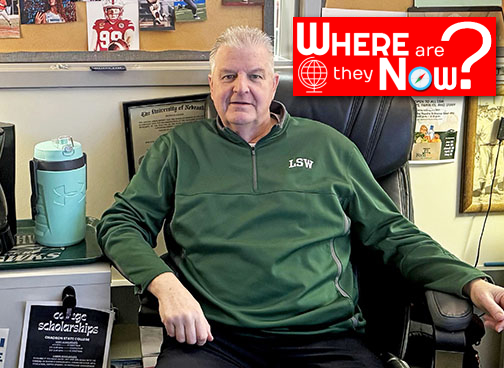
When students arrive at Lincoln Southwest High School, they are assured that guidance counselors like Tim Ernst will be there to be there for them when they need a helping hand.
While growing up in Aurora, Ernst said the thought of becoming a guidance counselor didn’t cross his mind.
“I didn’t set out to be a school counselor,” Ernst said. “I set out to teach and coach and then just fell into it.”
Ernst graduated from Aurora High School in 1978 and proceeded to earn his teaching degree at Kearney State College.
For 11 years, Ernst taught at Kearney and then Hebron high schools as an industrial tech teacher and also coached basketball for both schools. It was during his time at Hebron that Ernst found his calling.
“I started helping kids do things that a school counselor would and my wife encouraged me. She said, ‘Well, instead of having them come over here at night, why don’t you get your degree and be a school counselor?’ so I listened,” Erst said.
Ernst continued his journey as a guidance counselor at Heartland Community School for seven years before moving to Lincoln where he worked as a counselor at the University of Nebraska-Lincoln for four years.
“There are great people, hard working people in every building,” he said. “I loved my time there and it was just time for me to move on and do the next thing from those schools, but I still have many friends and connections to my former schools.”
Ernst joined the guidance counselors at Lincoln Southwest (LSW) High School in 2009, where currently 2,200 students are enrolled.
Like his work at previous schools, Ernst and fellow guidance counselors are determined to help students reach the next step in their education.
“The kids graduate, that’s number one,” he said. “We let them out the door and then number two is make sure they can do what they want to do when they leave here... A small percentage goes directly into the workforce, a small percentage goes into the military and pretty much the rest of them go either to a trade school, community college for academic transfer or directly into a four-year college.”
Ernst noted commented on the variety of challenges he has helped students to face while working in that environment.
“You never know from day to day what was happening,” he said. “We have our microcosm of society where we deal with probably a lot more than people in smaller schools and smaller towns.”
Often these problems include assisting students through traumatic events.
“I’ve had kids that had their parents murdered, we have dealt with sexual assaults, those kind of negative things that are part of life unfortunately,” Ernst said. “Then we deal with all kinds of things kids are struggling with -- personal social issues, family issues, parents losing jobs and deportation. Pretty much things that are going on in society filter their way into our buildings here in Lincoln.”
Ernst said the struggles his students faced had made it more challenging for them to graduate as compared to students in smaller schools.
“A lot of our kids with anxiety don’t come because of that and then that gets them behind the eight ball and at risk of not meeting graduation (requirements),” he said. “We work quite closely with the county attorneys and for truancy cases as well, but we have a lot fantastic, great kids, too. I love what I do, love the people I work with and the kids are appreciative.”
“The one thing I was surprised about when I came to a Class A school after I’ve been at a B and C schools before, kids at smaller schools like Aurora and Henderson, they will graduate,” he said. “When I came here, that’s not the case always and there’s a lot of reasons why my kids don’t graduate from this size of school.”
Despite these struggles, Ernst has forged strong relationships with his students and has helped several to overcome their struggles.
“I was surprised to find out I probably developed closer relationships with kids here than I did at some of my smaller schools, even though I have coached and still have great relationships with many, many of my former students and players,” he said. “But they didn’t need me like these kids need me. They had other avenues, too. They had help. They had supportive families and that kind of thing where we don’t have that here. There’s a lot of kids that are doing it on their own and I think that’s surprised me. You grow pretty close with these kids when you see them struggle.”
“Sometimes I see them in what I hope is the worst moment of their life and hopefully they don’t have to suffer anything like some of the things they’re going through and things get better, improve and so forth,” he added.
What Ernst has cherished the most is seeing students receive their diplomas and be able to chase their dreams.
“The ‘thank yous’ we get as counselors at graduation from kids when they look at you and they thank you, it’s something that helped them,” Ernst said. “You got them through something and showed them how to deal with things so they can go on to be productive members of society. The ‘thank yous’ we get at graduation are amazing. I think that’s why we keep coming back to do what we do.”
In 2018, Ernst was inducted into Southwest’s Hall of Honor, which he considers to be one of his proudest accomplishments.
“I got that honor because I was selected to be on the NCAA Advisory Board, so most of my role for my time here was working with our college-bound athletes, making sure they were eligible to move to the next level,” he said.
During his time with the National NCAA Advisory Board, Ernst worked with the academic side in “making sure we were equitable with kids that were trying to become eligible.”
“The one thing I did learn from that system was the NCAA, if there were ever an issue, they would rule in favor of the kid when they could,” he said. “A lot of times they can’t, because the student, parent, coach or somebody did something wrong, but when they could, they ruled for the student as far as eligibility.”
After originally retiring in 2023, Ernst came back to LSW to fill in for another guidance counselor and ended up returning to work full time.
“I still feel I have a sense of purpose to help young people,” he said. “I can stay as long as I still feel a sense of purpose.
Outside of school, Ernst enjoys spending time with his wife Tammy, their two daughters and their seven grandchildren. He said he loves attending his grandchildren’s activities.
During the summer, Ernst works at a golf course and enjoys golfing in his free time.
Ernst is the son of Bob and Carol Ernst.