
Project pending results of grant app to help fund study
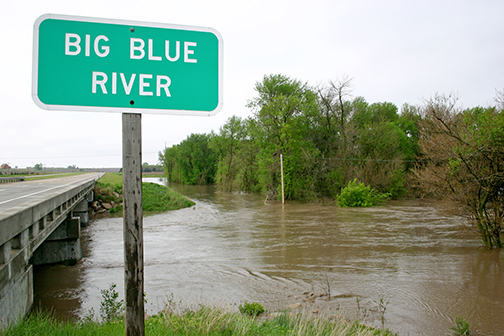
City leaders approved an interlocal agreement last week, agreeing to partner with the Upper Big Blue Natural Resources District and Hamilton County Board of Commissioners to participate in a groundwater sustainability study.
The proposal came about after a large water use permit was requested by Synergen Green Energy, which is proposing to build an ammonia production facility on a 160-acre site just south of Highway 34 near the CF Industries and Koch Fertilizer plants. A hydrological evaluation was conducted, and based on its results the Upper Big Blue NRD board voted in December to approve the large water use permit.
Not to be confused with the hydrologic evaluation already completed for the Synergen proposal, this newly proposed groundwater sustainability model will involve the city, county and NRD. The interlocal agreement has now been approved by all three of those parties, though the study itself will not begin until the results of a grant application are known. The application for that grant, which would be used to help cover the estimated $50,000-$100,000 cost of the study, is due at the end of March, with the results not expected to be announced until September.
The county board voted to approve the interlocal agreement Feb. 12 and the Aurora City Council followed suit at its Feb. 13 meeting, confirming that a separate study is being proposed by the NRD to look toward the future in terms of evaluating the area’s groundwater use.
Marie Krausnick, assistant general manager with the Upper Big Blue NRD based in York, explained to the council the reason for conducting the sustainability study.
“We are presenting an opportunity to partner with Hamilton County to look at groundwater sustainability and development with the newest industry coming into Hamilton County,” Krausnick began. “We did a hydrological evaluation internally at the NRD office and began asking ourselves, if this (Synergen) can come in with this impact, how many of these size industries should Hamilton County support before it turns from a sustainable maintenance of a natural resource to more of a mining situation?”
Krausnick went on to explain that the NRD recently completed a Regional Blue Basin groundwater computer model, which is now being used to evaluate possible water use impacts in the Upper Big Blue District. Given the drought conditions in much of the district in the last growing season, NRD officials say this resource is especially timely as it will help the NRD board to protect the water supply for all beneficial purposes, cited as one of the 12 areas of responsibility shared by all NRDs, and dictated by state statute.
“Visiting with our modeling consultants that worked on that project with us, they said we had a great springboard product that we can use to dial into Hamilton County and refine and build a tool that not only the city can use, but the county as well as the (Aurora) development corporation,” Krausnick told the council. “When they (the ADC) are engaging in conversations with new industries, how long do you court an industry before you decide this is a good place for you or it’s not? This would be a tool that I see could help.”
Council members made no comments and asked no questions before voting unanimously to participate in the interlocal agreement.
As for the Synergen large water use evaluation, the proposed use was simulated at a continuous pumping rate of 2,300 gallons per minute for 25 years. The impact analysis showed that Synergen’s water use would have a minimal impact on existing wells in the area. More specifically, water level reductions at the proposed site were reported at 10-14.5 feet, with reductions at the edge of the three-mile radius being no more than one to three feet.