
Air Force veteran David Feddern talks about Veterans Day, his time as a ‘missileer’
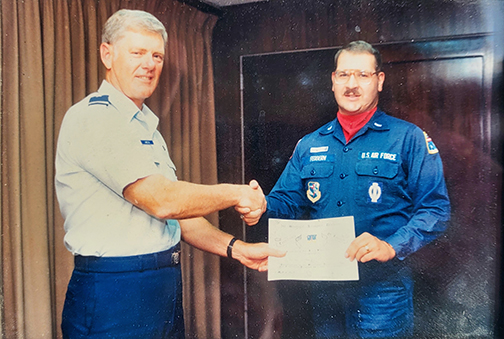
For Rev. David Feddern, Nov. 11 is a day that brings out deep emotion rooted in a profound respect and admiration for his fellow veterans.
That attitude was forged in his early years of growing up on a farm near Pierce, surrounded by relatives who had served their country on various battlefields. During his own service in the U.S. Air Force that appreciation for those who have served their country was deepened by opportunities to talk to other veterans who shared their amazing stories and experiences with him.
A veteran of the Cold War, Feddern thankfully never had to fire his weapon in battle, for that would have meant the years-long standoff between the U.S. and Soviet Union had become a hot war and of the nuclear variety.
For most of the years he served, he was what is sometimes called a “missileer” working in a launch control center deep underground somewhere on the western prairies of Wyoming or Nebraska as either a combat missile crew commander or the deputy. During those hours on alert he was always ready to launch Minuteman III nuclear missiles at a moment’s notice if given the command by the President of the United States.
Feddern, who for the past seven years has served as pastor of Zion Lutheran Church near Hampton, said his desire to serve his country in the military began during his growing up years.
“I just always had a desire to serve in the military from a very young age,” Feddern said. “I can distinctly remember growing up as a child watching older relatives, like some of my mom and dad’s first cousins, get drafted and leave and go to Vietnam and fortunately they all came back safe and sound.
“Some of them did receive wounds,” he continued. “Some of them were highly decorated for their military service. And there was just something about growing up in that time era, where, even though I know that those men and women were treated very poorly at times by the public when they came back home and came back to civilian life, there was just something about seeing them and their uniforms and their military decorations and just kind of the respect that people would give them for their military service. There was just something about it that really appealed to me. It’s kind of hard to describe at times unless actually you are a military veteran yourself... but that’s what my desire was to do from a very young age.”
That desire led him to join the Air Force ROTC while attending UNL. From early on in that experience he knew his service would take him to the missile fields.
“The following spring when two scholarships became available for our detachment, they both had the stipulation that if whoever accepted those scholarships would know already at that time that they would be working with intercontinental ballistic missiles somewhere within the continental United States,” Feddern said.
When Feddern graduated in May of 1986 with a bachelor’s degree, he received his commission as a second lieutenant in the U.S. Air Force the same day.
“The university, even yet today, requires all ROTC cadets, regardless of which branch of the military that you’re going to enter into, to go through a formal commissioning ceremony,” Feddern said. “Usually it’s held in the afternoon after graduation in the morning. In our case, we had that public commissioning exercise at the Student Union there on campus. So, if I remember correctly, all nine of us that came out of the Air Force ROTC detachment that year, all were commissioned the night before privately so we went to graduation in the morning, wearing our Air Force uniforms, already commissioned officers in the United States Air Force. Then we had to take our rank off to go through another second public commissioning exercise in the afternoon. We kind of always joked about that, that we got demoted and then got promoted back to second lieutenant within a 24 hour period of time.”
The journey begins
Feddern was initially scheduled to report for active duty in November, but after suffering an injury in a softball game that required knee surgery, that date was pushed back to February of 1987.
Less than 48 hours before reporting for active duty, Feddern married his wife, Deanna. The couple decided to get married at that time so that Deanna would be taken care of by the Air Force while they were separated by his service. They were married on Feb. 14, 1987 and Feddern says that first year they were only together about four months, and because of his service and her student teaching and finishing her teaching degree at Concordia University in Seward, the couple would often be many miles apart for the next several years.
Following four months of training at Vandenberg Air Force Base in California, Feddern was assigned to his first duty station, F.E. Warren Air Force Base near Cheyenne, Wyo.,where he was assigned to the 319th Strategic Missile Squadron.
While there he worked in the missile fields in launch control centers and also spent nearly a year working in the instructor detachment.
“And then after my crew time was finished at Warren, which is usually a four year assignment, I transitioned into the Wing Command Post as an emergency actions officer,” Feddern said. “So there we worked directly underneath the wing commander, who was a brigadier general. That was a very interesting part of my Air Force career because there we were in constant contact with, for example, 15th Air Force Command out at March Air Force Base in California. We could speak to people directly at the Pentagon if necessary — all over the world, really.”
Cold War secrets
While Feddern didn’t face the kind of physical dangers experienced by many military personnel, there were many stresses to the work, many of them caused by the secrecy that surrounded his duty.
It was, after all, near the end of the Cold War (it ended during his time of service) and America’s nuclear weapons program contained many closely-guarded secrets.
“You know, we used to joke... The running joke always was ‘I can tell you exactly what I do every day that I go on active duty, but then I’d have to kill you!’” Feddern recalled. “And I know that’s a morbid joke... but that was just the nature of that business. You couldn’t tell anybody. You couldn’t go home and talk to your spouse about it. You couldn’t talk to anybody on the street about it. You couldn’t sit in a restaurant or a public area with another person who was doing the same thing you did every day on active duty, because someone could overhear you and then there would have been a security breach and an investigation. So it was like one of those things that you did, but you didn’t ever talk about it.”
Feddern said that inability to talk freely about one’s daily job was only one of the sacrifices made by those who worked in the missile fields.
“They didn’t get all the fame; they didn’t get all the glory,” he said. “And we didn’t do it that for that reason to begin with. Please don’t misunderstand me, but it was hard. We all know that the Air Force is made for fighter pilots and pilots in general. I mean, that’s what the mission of the Air Force is. When you have a missile badge on your uniform and you work with nuclear intercontinental ballistic missiles for a living, most people look at you like you you’re not wired the right way, if you know what I mean.”
Although Feddern notes that serving in the missile fields was not glamorous work, he maintains it was vital to helping the U.S. win the cold war and hold off Soviet aggression. He also notes that the missiles already deployed across the west during the time of the Cuban Missile Crisis in 1962 had a profound impact on the outcome of that standoff with Soviet leader Nikita Khrushchev.
“If you can ever get an opportunity to watch some of the briefings, the press conferences that President Kennedy had during the Cuban Missile Crisis, at least two or three times as he talked to the American people that night, he used the phrase ‘ace in the hole.’” Feddern said. “‘My ace in the hole,’ I think is exactly what he said. And most people, to this day, have no idea what that means, and most people who heard it that night had absolutely no idea what that was about. The reason he said it, though, is because it was in reference to the first operational flight of Minuteman I nuclear intercontinental ballistic missiles that were on alert at Malmstrom Air Force Base in Montana. And when Khrushchev heard that and all his intelligence officers heard that, they knew exactly what he was referencing. What he was basically saying out loud to them in a speech made to the American public and to the world is ‘I have an ace in my hand’... My ace in the hole is those 10 Minuteman I missiles up there. So therefore, you really should remove your nuclear ICBMs from Cuba and take them back to the Soviet Union where they belong, or else!”
Feddern said he is honored to have been a part of that mission that continues even today.
“As we sit here right now,” Feddern said, “there are men and women at those same launch control centers that I used to pull alerts at, doing the same exact thing now with a little bit different weapon system than what I was familiar with, what I was trained to do, but they’re still doing it every day, every hour of every day, every day of the year, and it’s been going on in some cases since the early 1960s.”
Launching a Minuteman
The highlight of Feddern’s service with the missile squadron came during the summer of 1989 when, after all those years of training and readiness, he actually got to turn keys to launch a Minuteman III missile in a test launch at Vandenberg.
Every year during that time the Air Force would select one missile from F.E. Warren to be removed from its silo, have its nuclear warhead removed and stored away, and then transported by train to California to be launched as a test out over the Pacific Ocean. From there it would make its 6,000-mile journey to its target, the Kwajalein Atoll in the southwest Pacific.
Feddern said the distance of the flight approximates the flight of an armed missile launched out of a silo in Nebraska crossing over the North Pole on its way to its target in the Soviet Union or China.
Only three launch crews were selected from Feddern’s wing to accompany the missile to the West Coast and he was part of one of those crews. Initially the plan was for the missile to be launched by an aerial command center that exists to launch nuclear missiles in case all the ground crews become incapacitated, but Feddern says there was a technical problem that foiled that plan. After it was decided that the missile was to be launched by Feddern’s crew there were other delays.
Russian fishing trawlers off the coast of California (believed by the Air Force to actually be Soviet spy ships) had to be moved out of the path of the missile in case of a misfire and then there were thunderstorms over the island that was to be the missile’s target. Finally the launch was timed so that the missile would impact between the rolling storms and Feddern launched the missile.
“So I can honestly say — not to be bragging or anything like that and not putting all the glory on myself because it certainly didn’t have much to do with me, just what I was trained to do by the Air Force — but I can honestly say that I am one of the few people you’ll probably ever meet in your lifetime that can honestly say that they launched a Minuteman III intercontinental ballistic missile. So that’s probably, obviously the high point of my Air Force career!”
Following that event Feddern continued to work in missiles another four years until, due to a service related illness he was granted a medical retirement in 1993.
Ten years later Feddern entered the Lutheran Church-Missouri Synod seminary in St. Louis and moved back home to Nebraska in 2005. After serving churches in Cambridge and north central Nebraska for several years, Feddern accepted a call from Zion Lutheran Church near Hampton and has been the pastor there for nearly seven years.
The Fedderns have two children, Miranda who was born while he was serving on active duty, and son Kelby, who was born shortly after Feddern’s retirement.
Reflecting on sacrifices
As Veterans Day nears Feddern reflects on the sacrifices made by so many in service of their country.
“Now that I’ve been retired for 20 years I just can’t say enough about our veterans here in the United States,” he said. “Even though I am one myself, I just have just such a tremendous respect and admiration for everybody who’s ever served on active duty and those people who are still active... I mean they all have a mission, a vital role in the national defense. They get deployed all over the globe in harm’s way. I was fortunate I was deployed five times in almost 6-1/2 years, but all five of my deployments were right here in the continental United States. I was still physically separated from my family. Oftentimes I’d be on one side of the United States or the other and my wife would be in Wyoming. We were still separated, but it wasn’t the same as being in the Middle East or being on the other side of the world.”
“When I when I first retired from the Air Force back in the early 90s I joined an American Legion post at the invitation of someone who had served in Vietnam,” Feddern recalled. “I talked to men who were at D-Day on June 6 1944. I’ve talked to men who flew over Hiroshima, Japan and took the reconnaissance pictures the day after we dropped the atomic bomb. I’ve talked to men and women who have served in so many amazing roles when they were in the military. And they don’t do it for the fame and they don’t do it for the glory. They do it because of their love and their honor and their respect for their fellow men, and for this nation that we’re so blessed to live in. So it really pains me to see people today who don’t understand that and take everything that they have for granted... If it wasn’t for people who served in the military, who shed their blood — just like our Savior shed his blood to free us from our sin — well, they shed their blood so that you’re free to go down the street, travel anywhere you want to. You can go to church and worship without fear of death or persecution or imprisonment. You know, it’s sad when people don’t realize that and just take it for granted.”
Feddern said it was those experiences, many of which occurred during his own Air Force service, that make holidays like Veterans Day special for him.
“I don’t look at myself as being a hero by any means,” Feddern said. “Did I make sacrifices? Sure, we all do. Did I suffer as a result of it? Absolutely. I carry wounds and scars because of my military service that I always will, but it doesn’t change a thing. I would go back and do it in a heartbeat if I was asked.”