
Vettel spotlights military mindset in business
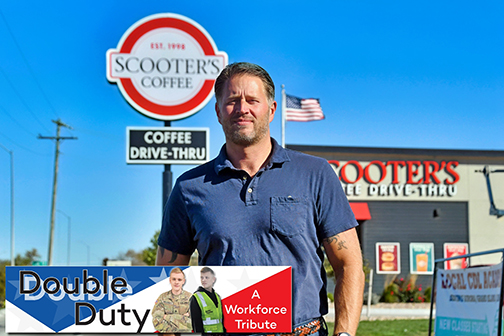
Todd Vettel wears plenty of hats. A barista at Scooters isn’t one he gets to wear very often, but it may be his favorite.
How could that be? Vettel has his hands in everything from managing Scooters to International Workforce Services.
In a round-a-bout sort of way, serving drinks in the early-morning hours reminds Vettel of his military background. In fact, he smiled right away when asked about slinging coffee at Aurora’s Highway 34 location.
“It puts me right back to being in the trenches,” Vettel said. “It’s like trench warfare in there. When you’re at peak and it’s very busy, it’s a very stressful job being a super barista.
“I’ve had people work here making it look effortless. I’ll be in there and I’m sweating, I mean a pool of sweat under my feet.”
For Vettel, a United States Marine Corps veteran and multi-business owner in Aurora, it’s important for him to do things like make coffee in his own franchise.
No job is too big, or too small for that matter.
“It’s important to show that you can go in there and work in the trenches,” Vettel said. “That’s sort of a military idiom, but it’s important to show your employees you can do the work, too.”
Vettel is a United States Marines veteran, an active duty member from 2000-04 and inactive from 2004-08. He was a sergeant when he finished.
He nearly stayed in for another term, set to join drone instructor school, but that suddenly went by the wayside and he committed to college.
While attending a community college in Illinois, Vettel joined a large agricultural company, working as a grain elevator superintendent.
Life after Marines
Vettel snagged what he thought was his career job out of the military, working for a global security company alongside mostly other veterans and law enforcement folks.
As he began transitioning back to civilian life, he absolutely agreed to several setbacks and challenges, switching gears from the military to life as a civilian.
“That definitely happens,” he said. “Our unit came back from Iraq and it was just sort of like, ‘Welcome back.’ There was no transition, you were just there. You are back walking the streets with everyone else.
“You go from the maximum adrenaline of people trying to kill you, assimilating back into the world.”
Vettel tried to put it into perspective even further, adding that the saying goes for every year someone is enlisted in the Marine Corps, it takes about four years to normalize back to civilian life.
“The Marine Corps is sort of a cult and very intense,” Vettel said. “So, if you’re in for four (years) it takes 20, so I’ve finally moved past that threshold.”
Trying to adjust back to a routine life was difficult for Vettel at times. He was used to things like tanks blowing up and being shot at. Trying to settle into what he called “mundane” activities was a struggle.
Over time, Vettel felt the nudge to become an entrepreneur. It certainly wasn’t a quick decision, either.
He mentioned an entire shoe box full of business ideas he’d written down every time he thought of something.
“One day, I sat down to go through those ideas and I had noticed a bunch of workout and fitness ideas,” Vettel recalled.
Over time with he and his brothers, Vettel bought a franchise, 9Round, eventually owning up to five gyms.
That led to Vettel branching out into the Scooters realm, opening up the Highway 34 location in Aurora while also starting International Workforce Services.
Vettel’s initial interest in the military came from his grandfather, serving in the Army Air Corps in World War II.
From his earliest memories, Vettel had hoped to be a pilot. However, his vision would hold him back.
But, a comment made by his optometrist when he was 12 years old really stuck with him.
“I don’t think he knew how big of a deal this was to me, but he said I would never be a pilot,” Vettel recalled. “Your vision is inadequate, he said. It just crushed me.”
Vettel shifted his focus to what he considered to be the next best thing, or something that would bring the most intensity, which was the Marines.
But he didn’t want to just join the Marines and be a supplier or anything. He swung for the fences.
Business initiative
While having his hands in multiple different business avenues, Vettel’s process for keeping things moving forward are all ideas and qualities he picked up from his time in the Marines.
Initiative is far and away the biggest of those attributes, thinking quickly while making confident decisions.
“The Marines would say improvise, adapt and overcome,” Vettel explained. “Making no decision is the worst possible thing you can do.”
Vettel shared an event from basic training called the crucible, the capstone of decision-making.
It included small unit, low leadership and initiative in decision making while also not being afraid to take risks.
All of those characteristics Vettel mentioned are cornerstones of how he’s run his ventures, from the gym to Scooters, and IWS.
“You have to be conservative, cautious and think things through, but you can’t do that forever,” Vettel continued. “You have to take action.”
Vettel said he knows quite a few small business owners like himself who have come from the Marine Corps and there’s no mistaking why. It’s those qualities mentioned.
As far as how he manages and works with employees, Vettel doesn’t beat around the bush. There’s no time for that.
“I take action very quickly,” he said. “I move fast and break things. It’s not that we want to be reckless, but it’s that initiative.”
Vettel also mentioned that those who work for him need to move at that speed, again qualities he picked up from the Marine Corps.
During his time in the Marines, he mentioned a wide sample of demographics and how that relates to leadership.
“When leadership is the theme every single day, you see a lot of great things, a lot of good things and a lot of things not to do,” Vettel said. “You get a really good sample of leadership from a lot of different people. Not only are you learning excellent leadership traits, you can also see some things that maybe didn’t work.”
As far as Vettel’s leadership style, he reflected it to be quite different than most. As he explained, he tried to take the best from the Marine Corps and adapt those attributes to a civilian workplace.
“The Marine Corps is very intense and rigid,” Vettel said. “A lot of this stuff doesn’t work in the civilian workplace. Your mission is completely different in the Marines, it’s life or death.”
While Vettel leads his businesses with many of those Marine principles, they’re softened quite a bit.
He doesn’t go around barking at people and while there can be some confrontations from time to time, the intensity level is pulled way back.
What’s interesting for Vettel is when he’s had the opportunity to manage fellow veterans. He mentioned that there can be a tendency to lock back into that old Marine style, but even that is a bit different, too.
“We won’t be yelling at each other, but I actually try to make a distinction that we are a small business and running things in the civilian sector,” Vettel explained. “I don’t want to run things like I’m in the military sector. Those things just don’t work in the civilian sector.”
Community relationships
Something Vettel takes very seriously is his ever-growing relationship binder within Aurora.
“I think it’s very important to be out front and interacting with the community,” Vettel pointed out. “You can’t not do that when you’re involved with a public sort of business like Scooters or IWS.”
One of Vettel’s goals and missions through his Aurora businesses is to raise awareness, giving the community a peek behind the curtain.
The last thing he wants is for anyone to come up with their own answers to anything he’s doing. Vettel wants the community to hear it from him.
“We’re trying to be as proactive as possible,” Vettel said. “It’s smart business. It’s part of our marketing effort as far as Scooters goes. Being as connected with the community as we can be has a lot of win-wins involved.”
IWS is a completely different animal to Scooters in terms of the work being done and the people he’s working with. Vettel credits a lot of his success with IWS, a workforce shortage solution aimed to get workers in the field, to his military background.
He’s traveled to more than 30 different countries and seeing those different types of people and cultures has helped him interact with anyone.
“I have met a lot of people and had interactions with different cultures,” Vettel mentioned. “That makes sense for us at IWS. If we didn’t have that international experience, IWS may not exist. It’s been profound for us.”
Vettel has always been goal-minded in everything he does, including goal maps with his current business ventures, which use measurable metrics.
Despite all of that, he’s tried to simplify those goals over time both professionally and personally.
“Less is more,” Vettel noted. “We’re trying to double down on what makes sense. We don’t want to try and be everything or have too many irons in the fire.”
Vettel is a visual person, writing things down, just like his business ideas in a shoebox all those years ago. He doesn’t want to stop his creative juices. What he may do less of is trying everything that comes to mind.
“I think that comes with maturity,” he added. “ I’m realizing some of those things are fools errands and wisening up to how we focus our time.”
Vettel enjoys the quote from former heavyweight champ Mike Tyson that goes, “Everyone has a plan until you get punched in the face.”
He pointed out he’s had plenty of those experiences as a small business owner and many of those traits -- adapt, overcome, initiative -- all help, including mental, physical and spiritual endurance.
“Just keep going when things are great,” Vettel finished. “Don’t get too optimistic and when it’s really bad, don’t stay down there. Just keep going. The Marine Corps really summarizes that.
“It doesn’t stop you from having a plan. Planning is imperative, but you have to be able to think on your feet and move quickly.”