
Where Are They Now follow-up ...
Editor’s note: Aurora native Lauren (Paschke) Weasel shared her life’s story in a Where Are They now feature published in April. Her husband, Dr. Jacob Weasel, was just about to embark on a trip toward the top of Mount Everest. Here is a follow-up story on his journey, republished with permission from the Rapid City Journal.
by Darsha Dodge
Yells of “rock, rock, rock” echoed down the Lhotse Face. Jacob Weasel managed to look up seconds before a racquetball-sized rock struck him in the chest.
A temporary setback for the determined 36-year-old, who took a minute to collect himself before continuing his grueling ascent. Every time rock calls rang out, his bruised ribs throbbed in pain.
Any climber bound for the summit of Everest must traverse the nearly 4,000 ft. tall wall of glacial blue ice which rises with 50-plus-degree pitches. Weasel and his team rested at Camp III for a day and began their push towards the “death zone” — the altitude beyond which the human body can survive unassisted by oxygen tanks.
Weasel, an Indigenous trauma surgeon at Rapid City’s Monument Health, would spend 63 hours in the death zone.
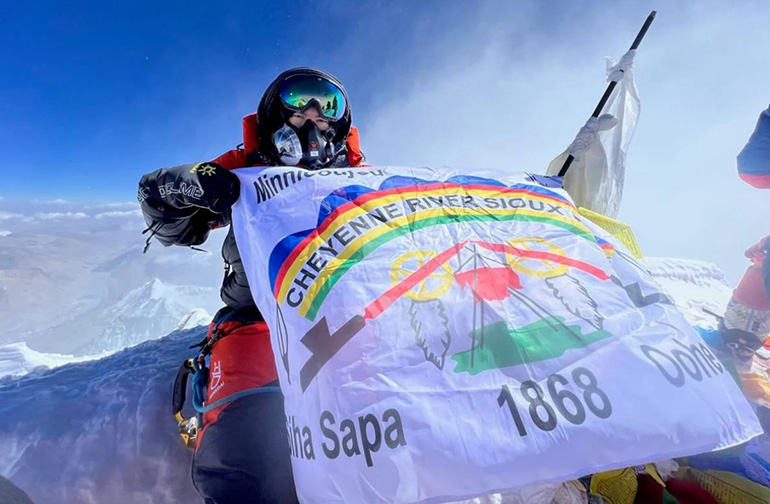
And on May 17, 2023, at 8:34 a.m., he unfurled the flag of the Cheyenne River Sioux Tribe — his tribe — at the highest point on earth.
A pair of yellow crampons kept Jacob Weasel alive one step at a time.
Following his guide — Lakpa Dendi, a Guinness World Record-holding Sherpa — tested his mental, physical and emotional limits.
“I began to play this game, and I imagined that his crampons are birthday candles, and the entire way up the mountain, I’m trying to blow out his imaginary birthday candle crampons,” Weasel said.
As he recalled the adventure, having been back in Rapid City not even a week, the exhaustion evident behind his dark eyes. The months of training in preparation for the trip helped some, but he said he was quickly humbled on the mountain.
Five steps forward. Out of breath.
“My mantra...was three words. It was ‘DFS’: discipline, focus, strength,” he said. “I said those three words to myself probably thousands of times on the way up the mountain.”
That was the priority — and in that order.
Going for the summit requires discipline to the extreme — discipline to take in adequate electrolytes, calories and sleep. Discipline in safety.
Focusing on every step.
And strength.
“It is what it is,” Weasel said. “It’s important, but it’s not nearly as important as the amount of discipline you have and the focus that you have and the mental fortitude that you have, because the mountain just keeps going.”
High hopes
After weeks of acclimatizing ascents and descents, Weasel found himself in a maelstrom just below Camp IV.
Winds in excess of 60 miles-per-hour churned up out of nowhere, sending climbers scrambling to protect themselves; some resorted to laying face down on the frigid ground.
Arriving on the South Col at Camp IV around 5 p.m., Weasel and Lakpa Dendi slumped into their tent and exchanged a knowing glance — there would be no summit bid in this weather.
Confusion with tent assignments left a fellow climber huddling in the cold. Ultimately five people shared a tiny tent, trying fruitlessly to rest as the relentless wind ripped against their cramped shelter.
Just before midnight, the tent flap opened, and in poked the face of expedition leader Nirmal “Nims” Purja. Purja served 16 years in the military before becoming a world-record-breaking climber, achievements which included being the fastest to summit all fourteen of the world’s 8,000-meter peaks.
“He says, ‘Get up, we’re going for the summit,’ and it’s still like 60 mile-per-hour winds,” Weasel said. “And I looked at him and I was just like, ‘No dude. This is not smart. Conditions are terrible.”
Weasel decided to take an extra day of rest — much to Purja’s chagrin — the only member of the 14-person expedition to stay behind; all 13 climbers reached the summit.
Out of all the teams attempting a summit that night, two people needed rescue.
Returning to Camp IV, Purja said he shouldn’t let Weasel summit, but decided to let him try anyway.
“He tells Lakpa, ‘I’m going to let you guys go up, but Jacob is your responsibility,’” Weasel said.
The realization hit they would be alone on the mountain. Dendi and Weasel spent the day eating and resting, and when they poked their heads out of the tent that night, the sky was clear — a brilliant tapestry of stars glittering above their heads.
29,032 feet
Climbing in darkness, all Weasel could do was pray for the sun to rise.
And when the first glimpse of light struck the horizon, the breathtaking landscape focused into view.
“I look to my right over China, and the sun is rising over this amazing valley. And then to my left, the perfect pyramid of Everest is projected onto the Khumbu Valley. It’s just beautiful beyond words, to the point where you can do nothing but cry, and then the tears freeze to your face,” he said.
The climbing continued, one bottled-oxygen-breath at a time, until suddenly there was nowhere left to go.
29,032 feet — the highest point on earth.
Weasel pulled an eagle feather, blessed by Rick Two Dogs, from his pack and tied it to the pole among the prayer flags.
“I just felt a deep sense of privilege and honor of being able to do that,” he said.
They all took photos. Dendi touted his new book, took Instagram photos and held up a flag commemorating the 70th anniversary of the first summit. It wasn’t long before Weasel was ready to come down. He took a seat on an ice bench, watching the high-altitude fervor.
Soon, screams disrupted the merriment.
A South African climber, flanked by her boyfriend and two Sherpas, was out of oxygen. The valve between the tank and regulator was frozen, preventing a new bottle from being connected.
The summit of Mount Everest juts into the upper troposphere, which contains about a third the oxygen present at sea-level. Weasel and the two Sherpas spent minutes banging and blowing on the valve, trying to thaw it enough to connect — all while the woman screamed she was dying and cried for oxygen.
“In my mind, I’m like, this is crazy. Like, if this doesn’t connect, she’s dead within 10 to 15 minutes,” he said.
They managed to reconnect the bottle, flooding her oxygen-starved system and bringing an end to the terror.
“I remember sitting there after we got it fixed and just thinking, ‘We aren’t supposed to be here,’” Weasel said. “Humans should not be up here.”
The ‘Death Zone’
Weasel waited in line to descend the Hillary Step, his eyes focused not on the brightly colored band of climbers but on a single man in a gray suit.
The man wasn’t climbing.
His body had been there for years, frozen to the rock, with a view of the valley below.
Around 200 bodies remain on Mount Everest, according to current estimates. Seventeen climbers are dead or presumed dead from the spring season — making 2023 the deadliest on record.
In mid-May, three Sherpas ferrying ropes across the treacherous Khumbu Icefall were swept away when a section collapsed. On May 1, American doctor Jonathan Sugarman died at Camp II. Phurba Sherpa, a member of the Nepali Army helping with the country’s mountain clean-up campaign, died near Camp IV.
Tragedy did not escape Weasel’s time on the mountain either.
Shrinivas Sainis Dattatraya, 39, an Indian-Singaporean climber, went missing during his descent from the summit on May 19. Dattatraya texted his wife saying he developed high-altitude cerebral edema and couldn’t make it down. His body still hasn’t been located.
Dattatraya and Weasel spent 20 days climbing together on Denali. They texted during their concurrent Everest expeditions, never able to cross paths.
A great man and an extraordinary person, Weasel said; the world is at a loss.
“There’s so much loss and so much suffering...so much death on that mountain. And as much as there is loss and death and suffering, there is an equal if not greater amount of beauty and joy,” he said. “For me, it has always been that the beauty and the love and the joy has to outweigh the evil and the anger and the hatred and the pain.”
A French climber Weasel met during his first rotation, Orianne Aymard, was hit in the head by a falling serac and had to be life-flighted to Kathmandu. After 14 days on antibiotics, she and Weasel passed each other on a hike up neighboring Pumori, where he recalled she looked recovered.
They passed again as he descended from the summit.
Aymard had broken her foot and couldn’t descend, telling Weasel she didn’t know how she was going to get down.
“I just stood there next to her and I just said, ‘I’m so sorry,’” he remembered. “There’s nothing for me to do. Like, I’m so sorry. And then you keep going down...the helplessness...and for somebody who has trained for years and decided to pursue a profession dedicated to helping people, for me to see a friend and have no ability to help them whatsoever was just heartbreaking.”
Aymard survived, her energetic demeanor filling the halls of the Marriott in Kathmandu following the climb. She had two frostbitten fingers on her right hand, one or two on the left and a broken foot, but none of that appeared to slow her down.
Weasel himself nearly became a fatal headline on more than one occasion. He experienced auditory and visual hallucinations during parts of his climb, a classic sign of a possible hypoxic brain injury.
During the final descent through the icefall, he and another Sherpa were caught in two massive avalanches.
Looking up, a plume of ice, rock and snow barreled towards them.
“Three thoughts come to mind,” Weasel said. “One, don’t pee yourself. That is the first inclination; that is your natural, physiological response. I remember thinking, ‘If you pee yourself, it’s not the embarrassment, it’s the fact that you’re going to get your undergarments wet and they’re going to freeze.’ Number two, you have to get behind something...and the third thing was I so badly wanted to grab my phone and take a video of this thing.”
They split up — each taking shelter behind a rock, crouching and putting their hands over their faces to create an air pocket. Seconds later, the unrelenting power of Mother Nature rained down upon them. Rocks threatened their extremities, while their crampons dug into the ice, trying to hold back from sliding into a crevasse.
And as suddenly as it began, it ended. Screaming for each other, Weasel and the Sherpa reunited, continuing their descent until another broke off and sent them back into flight mode.
Distress
When Jacob Weasel opened his eyes, all he could see was white.
Instantly, the fear of being buried in an avalanche kicked him into survival mode, and he jumped up and began thrashing around.
A pause and a glance around brought the situation into focus — he was in his hotel room at the Marriott in Kathmandu. Safe, surrounded simply by white sheets and blankets.
Being caught in avalanches and hit in the chest with a falling rock left a lingering effect on the surgeon, who spent his first night post-trip in Kathmandu wondering if he was experiencing renal failure.
He did the math — he‘d only relieved himself once in eight days. The fear of needing dialysis in Kathmandu hit hard. Hours of trying and failing left him standing in a warm shower at 4 a.m. and eventually trapped in the bathroom, losing water his body was unable to absorb due to the lack of oxygen in the bloodstream at altitude.
Weasel slept maybe two hours the first night.
Having lunch by himself that second day brought with it a flood of emotions.
”I’m just trying not to cry sitting there having lunch by myself at the Marriott because of everything. I thought there was the possibility that my kidneys had died, and then I wake up thinking I’m buried in snow…I’m sure there’s some form of PTSD from the avalanches probably — whether it’s that or just the other things you experience on the mountain.”
The Wopila Project
As far as anyone knows, Weasel became the first member of the Cheyenne River Sioux Tribe to summit Everest, and among the first Indigenous people ever.
The Journal previously reported he was the first Indigenous person to reach the summit, but other Indigenous climbers, reportedly from Standing Rock and the Navajo Nation, have also summitted but were not publicized.
“My goal wasn’t to do anything other than inspire young Native kids to show them that they‘re capable and [to] dream big dreams. That was the point of it,” he said.
His trip aimed to raise funds for his nonprofit, The Wopila Project, based in Rapid City. Weasel intends to build a playground for the residents of Lakota Homes and build three women’s healthcare clinics in rural Nepal.
Fundraising, he said, is going slowly. One of his goals post-Everest is to do speaking engagements — the cost being only a donation to the project. He’ll be working with a grant writer to secure some funding, and hopes to have solidified the funding for both projects within 18 months.
Carrying the eagle feather to the summit and standing at the top of the world wasn’t about fame or glory, Weasel said, it was about proving anything is possible with enough determination, focus and strength.
“I hope that young Native people will see that and dream dreams of their own, and I don’t care what it is — but hopefully they will see that they aren’t victims and they aren’t disadvantaged and they’re equally capable,” he said. ”If nobody else believes in you, I believe in you. Believe in yourself. Chase after what it is that you want with grit, perseverance, and an undying will to never give up.”
Just the beginning
Weasel intended to complete two summits during his time in the Himalayas — Everest, and Lhotse, a neighboring peak at 27,940 ft. A radio call from Camp II dashed his hopes of a Lhotse summit during their descent from the top of Everest.
He was very unhappy, looking up at the clear blue sky surrounding Lhotse and wondering why the decision to keep him from his goal was made.
Later in Kathmandu, Purja told Weasel he hadn’t made that call, but would accept responsibility as the expedition‘s leader — and said he would’ve made the same call. Purja recounted to him the story of a young, fit Australian climber who pushed for the summit, returned to her tent and just simply laid down and died.
Being in the death zone so long takes its toll on even the healthiest of climbers. Weasel did the math — twice. He spent 63.5 hours in the death zone.
”Two things would’ve happened,” he said. “There’s a very strong possibility — upwards of 99 percent — that we would’ve summited [Lhotse]. The other possibility is that I would have died; my body would have given out and I would have just collapsed and died.”
He said that’s probably why his family is thankful someone made the decision to keep him from attempting Lhotse, because he would’ve either summited or not come back.
”I would be content to never be there again,” Weasel said. “Because I understand what it means being there and how close you are to death. I’ve come to peace with it.”
But not even a week after being home, Weasel‘s passionate spirit was already calling him to the next adventure.
Next January he plans to climb Aconcagua in Argentina or the Vinson Massif in Antarctica — a trip that would also see him skiing to the South Pole. He intends to be the first known Indigenous person to bag all seven summits — the highest point on each continent — and complete an explorer’s grand slam, which involves visiting both poles.
The trials and tribulations of climbing the world’s highest mountain didn’t change his outlook or goals.
He’s finding his way, getting back into a routine and settling in to everyday life. Being home was surreal at first, but he spent the first month home spending more time with family.
The feeling of having done what he’s done can be summed up in a single word, he said — grateful.
“I walk away from all of that and coming back home, [I have] a deep sense of joy for being alive, because of what you experience up there,” Weasel said. “I’m happy to have breath in my lungs and blood circulating around my body and to have the opportunity to continue on in this adventure of life.”