
Aurora youth learn to build robot, strategize all remotely

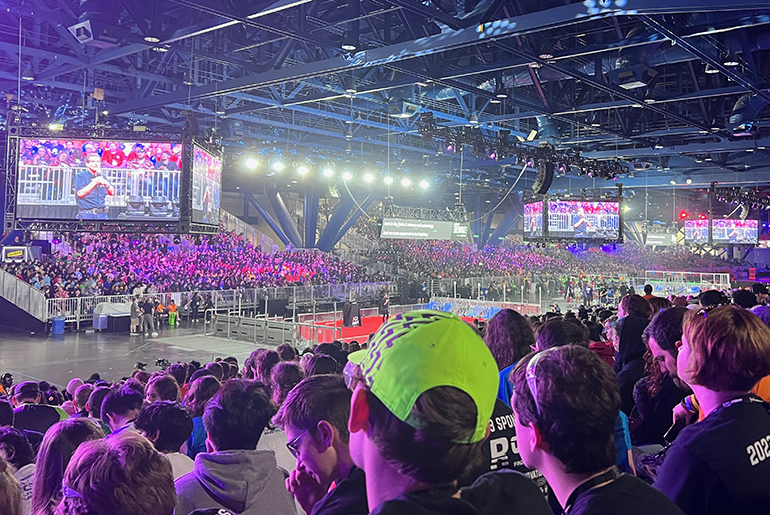
Competing in front of a crowd of 50,000 people, the Aurora robotics team showed off its skills recently at the world’s competition in Houston.
The road to get there was a unique one given that the locals joined forces with a team out of Arkansas in order to have a full roster.
“We had met Apophis six or seven years ago at one of our first or second events,” coach Tami Brandl explained. “So I had known their coach a little bit.”
The Aurora team struggled to find enough kids for a full team, thus opened the door to a cross-country partnership.
“When we tried to get kids on the team, we couldn’t,” she said. “It’s hard to get the word out.”
Brandl suggested to the Arkansas coach, Rudy, that they put their heads together to make a combined competition team.
“I talked to Rudy and said, ‘Okay, here’s the deal. I don’t have enough kids, so we can do a host of things,’” she voiced. “‘If you would even let us do strategy (with you) and come to Iowa and watch you compete, I think that would be great.’ That was my low end.’”
That was merely the beginning of the two teams’ options.
“My top end was, ‘Could we just join forces with you and help you with your robot?’”
From that moment on, the two teams became one and began the process of building a robot, strategizing and meeting completely virtually.
“We met with them every day for the first two weeks,” Brandl said. “We’d strategize and work on stuff and then we worked on the robot using Fusion 360.”
Fusion 360 is an online database that allowed the teams to build its robot together -- remotely.
“So, all of our models are online,” she said. “We can access them and we can work together. There were several times that we had our (programs) open, they had their’s open and we had a video call going.”
After several weeks of working from separate locations, the two groups of students were finally able to come together to display their work in Oklahoma. Competing at an event in Tulsa, the combined team punched its ticket to world’s.
“How we made it was a wildcard,” Brandl explained. “Once a team is qualified for worlds, if they compete in another event and qualify for world’s a second time, that generates a wildcard. Then, someone else gets invited on that wildcard.”
This is exactly what happened for the Aurora-Arkansas alliance.
“We got invited on the second wildcard,” Brandl said. “We came in second in Tulsa and that was a cool experience because we weren’t even planning on going to Tulsa.”
After their success in Oklahoma, the team made its way to worlds. Drawing in crowds of 50,000 people and highly experienced teams from around the globe, Apophis had its work cut out for it.
“There were 974 teams,” the coach stated. “There are some really big teams. NASA even mentors a team and so does the Johnson Space center.”
At world’s, the team ended up going 5-5 in its matches, losing most of them by only one or two points.
Coach Brandl expressed the importance of getting kids to do this activity.
“FIRST is an umbrella organization that we work with,” she explained. “FIRST stands for For the Recognition of Science and Technology.
“As you notice, there isn’t robotics in that name,” she continued. “Their motto is: ‘more than a robot’ and it truly is more than just a robot.”
With a multitude of different opportunities for kids from kindergarten to senior year, Brandl explained the numerous different things they are able to do.
“What you see is a robot,” she noted. “We also have to have a business plan, we write essays, we do videos for awards. For example, we need kids that want to be elementary school teachers because we do outreach with a lot of elementary schools. If you want to learn about designing curriculum, we’ll pull you in and find somebody to help you learn.”
She also explained the business side of things.
“We have a base business plan,” she said. “We’ve worked with different business leaders to create that. We get lots of mentors that come for a day or two to help us out, so we need kids who are interested in business, too.”
The coach also explained the more creative side of robotics.
“We also need somebody that does graphic arts,” Brandl continued. “The Arkansas team’s logo is a snake wrapped around the sun and they put that on their robot. You’ll find a lot of graphic arts sort of things.”
And of course, there is the engineering that goes into programming and building the robots.
“I am an engineering professor,” Brandl stated, “and I wish all of my engineering students had gone through this program because, while they don’t understand all the math that goes into it, they get the hands-on experience that’s so critical.”
If parents or students would like to contact Brandl about joining robotics she can be reached at Tami.Brown-Brandl@unl.edu or 402-631-7618.