
Aurora-based OT Potential podcast examines health risks with field expert, seeking clarity on key question of association vs cause

Ever since a friend of Sarah Lyon’s was diagnosed with cancer back in elementary school, she remembers worrying that farm chemicals in area drinking water were related to the high rates of pediatric cancer in Hamilton County. Thirty years later, now a licensed occupational therapist who hosts a podcast from Aurora exploring a wide range of health issues, Lyon tackled the issue head on by interviewing a researcher known as an expert on the impact nitrates can have on human health.
“I remember being in fifth grade and I had a classmate who had to stop coming to school because he had leukemia,” Lyon recalled while introducing her guest in an hour-long OT Potential podcast posted last fall. “At the time, even as a fifth grader, I was aware that they were worried it was the farm chemicals. This paper (written by Jesse E. Bell in 2022) shows that association between nitrates and pediatric cancers. While the results of the study do not necessarily prove a causal relationship, they do suggest that the use of agrochemicals such as Atrazine and nitrates could pose a significant threat to pediatric health through higher than average rates of brain and other central nervous system cancers, leukemia and lymphoma.”
Bell, a professor of water, climate and health in the University of Nebraska Medical Center’s Department of Environment, Agriculture and Occupational Health, published his findings in a report hoping to document the connection between nitrates and multiple health conditions. That report is titled “The Geospatial Distribution of Age-Adjusted Incidence of the Three Major Types of Pediatric Cancers in Waterborne Agrochemicals in Nebraska.”
About the report
According to Bell, the authors set out to perform a county-by-county analysis of the relationship between cancer rates and nitrate and Atrazine levels in Nebraska to see if there was an association. They conducted an ecological study analyzing county level data from 1987 to 2016, also considering pediatric cancer data from the Nebraska Cancer Registry focusing on ages zero to 19.
According to the report, Nebraska reported 2,559 pediatric cancer cases between 1987 and 2016, with the age-adjusted incidence of brain and central nervous system cancers shown to be higher than the national average in 63 percent of Nebraska counties (though data was only available in 83 of the state’s 93 counties).
Statistically, Nebraska consistently ranks among the top five states with the highest incidents of pediatric cancer, according to data from Surveillance, Epidemiology and End Results (SEER).
Bell, a native of Nebraska who worked outside the state for many years before returning in 2018, explained how he got involved with this particular study.
“So this story actually kind of starts with him (Dr. Don Coulter) being interested in trying to understand why he was seeing small communities like Aurora, Nebraska, where there were multiple cancer cases with children popping up,” Bell began with a reference to one of many colleagues involved in the study. “There were potential underlying causes for this and that’s where some of these research projects started to come about.”
Being from rural Nebraska himself, Bell said he became intrigued with the associations between nitrate contamination, especially in groundwater, and higher rates of certain adverse human health outcomes.
“For me, this became a point of passion because this is some of the areas that I’m from,” he said in the podcast interview. “How do we better communicate and engage with wider audiences to make sure that people understand some of these threats because in places like Nebraska this is probably one of our biggest environmental issues that we face. But sometimes it kind of falls on the back burner. People don’t really pay attention to it the way that we do, so that’s part of the reason I became interested in this.”
In 2020, Bell said a water climate and health program was initiated at the University of Nebraska and one of the primary reasons was to look at water quality issues, trying to understand some of the linkages between nitrate levels and health issues, while also seeking ways to do a better job of education, outreach and engagement around water quality issues statewide.
“That’s really been one of my core focuses since 2020, and even a little before that, to try and understand these relationships,” he said. “How do we engage with the community more broadly and how do we actually take this science and translate it into something that’s actually usable in the state of Nebraska and other states as well?”
Nebraska is not the only place looking at this issue, he added, citing similar studies in Europe.
Association vs cause
Lyon asked Bell to further explain the possible links between high nitrate levels in drinking water and health issues, including pediatric cancer.
“It feels to me like there’s so many possible associations with these high nitrates, but across all that literature there isn’t that certainty of cause,” she said. “It’s all association, if I’m understanding correctly. I’m wondering, from your vantage point, what are the big unanswered questions still? Is it cause? What’s the safe level (of nitrates in drinking water), and what do you think are the next questions that are on the horizon?”
“Science builds upon science,” Bell responded. “That’s one of the things that I love about the field that I’m in is that we never look at a question, answer it, and then we’re done. We always continue to move forward to try to continue to better understand many of these things.
“So for me, that correlation versus causation, it’s a tricky one,” he continued. “I’m getting to that point where we move on from just looking at what is the correlation between things and what is the actual causation. It’s difficult but important, and one of the ways that we move towards that is, one, better understanding the mechanism, but also continuing to do studies. Because if the amount of literature and the amount of research we do keeps pointing in the same direction, that helps us form better understanding of the potential causes behind some of this as well.”
‘The mechanism’
Diving deeper into the scientific breakdown of the issue, Bell noted that nitrates ingested through water would mix with oral bacteria, turning that nitrate into a nitrite in the stomach, which can then be converted into an N-nitroso compound (NOC). Numerous studies, he explained, have found that compound can be cancer causing, and/or cause adverse health and birth outcomes as well.
“So that’s the mechanism,” he said. “It’s not that we don’t see a potential mechanism. I think that’s the first component of this is where you’re understanding those mechanisms. We’re doing more research to try to understand what’s going on.”
The professor added that other studies are being conducted in Nebraska, other states and around the world, looking at combinations of exposures with, for example, nitrates as well as pesticides, uranium and other chemicals.
“And what is the mixture of these chemicals and how does that impact your health,” he asked, comparing exposure to nitrates in water to smoking. “If you smoke it increases your risk of lung cancer and it also increases your risk of a variety of other adverse health outcomes. It doesn’t necessarily just stack on top of each other. It’s also like compounding on each other, and that’s the same thing when we’re talking about nitrate and combinations of pesticides and other things that might be in our water… Looking at these mixtures is definitely one area to move forward around.”
Reducing exposure
Noting that 90-95 percent of what the United States spends on health care is for treatment, Bell said he thinks it is important to try and solve the problem through prevention.
“If we can reduce exposure, that might be preventing some child from developing cancer; it might be preventing some adverse human health outcome,” he said. “That’s incredibly important for me, that we’re not just looking at what are those end-of-life solutions, but what are we trying to do to make sure that the water is cleaner, and the people have good sources of water so that these chronic health issues don’t arise. That’s incredibly important, just from a baseline of trying to protect our communities.”
Lyon then questioned Bell about ways to reduce the risk of high nitrate levels in water.
“The best way of reducing risk is if people at least understand that there is a potential risk,” he answered. “If they don’t understand there’s a risk, they’re never going to be able to mitigate against it. And that first step is just getting people to test their well, especially if you’re on a private well.”
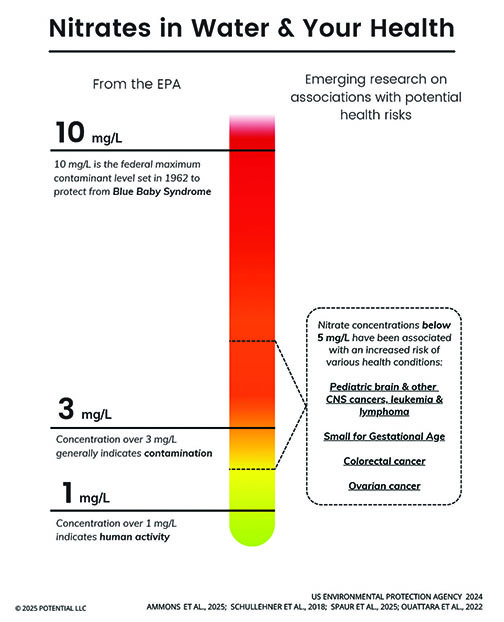
If high nitrate levels are detected, which according to federal standards established by the Environmental Protection Agency in 1962 is anything above 10 milligrams per liter, Bell said one of the best known solutions is to install a reverse osmosis (RO) system.
“That little RO system (designed to treat water piped to the kitchen sink) maybe that’s a few hundred bucks, but there are rebate systems so that you can get a rebate for that,” he said. “But then the other piece of it is if you wanted (to treat) your entire household you can do that and it’ll be thousands of dollars. Then also understand that you have to maintain that system. It’s not going to be perfect the first time, like you have to make sure that you’re changing out the filters and all this other stuff over time.”
Bell said water treatment system options should all become part of an education piece which is now missing on a broad scale.
“On top of that, in the best circumstances the systems work really well, but sometimes if contamination is so high, even these systems become over-inundated, so they might not be reducing to the levels where we kind of want them to be,” he said.
As for what is considered an “acceptable” level of nitrates in drinking water, Bell said that too is not crystal clear.
“So the national standard is 10 parts per million, or 10 milligrams per liter,” he said. “Now some of the recent literature that’s coming out there, they have been seeing some adverse health outcomes below 10 milligrams per liter, so there is a potential challenge to all of that as well that we’re trying to investigate and understand.”
A recent EPA report showed that nitrate concentrations below 5 milligrams per liter have been associated with an increased risk of various health conditions, including pediatric brain and other central nervous system cancers, leukemia, lymphoma, colorectal cancer and ovarian cancer.
Bell added that there are a number of reasons to consider ways to improve and protect the state’s water resources.
“There’s a financial cost to this as well,” he explained. “It’s a lot more expensive when we’re trying to just look at the medical side and not the preventative side, because when they get to the hospital that is incredibly costly on your household. I think you’re about twice as likely to go bankrupt if somebody in your household has cancer.”
Health care perspective
Another factor Bell raised regarding the growing concern with nitrate levels in drinking water is the healthcare community’s understanding of the issue. He reported that a survey was conducted with healthcare workers in Nebraska and a high percentage confessed that they were not very knowledgeable, though many were interested in receiving materials and/or training to help educate their patient population.
“What I would love to see is that we have an educated healthcare workforce in the state of Nebraska and other places as well,” he said. “Anybody that’s coming in to their local clinic or hospital, a healthcare provider, if they’re serving a rural population, one of the questions that comes up is have you tested your well? And if you haven’t here’s some information on how to get your well tested and maybe also provide some information on what does it mean, based off what kind of information you get from that test, and what are some of the steps that you can do to mitigate against that. Or, provide them a resource where they can go talk to somebody that can help them with making some of those decisions. Not only do I want to make sure that people understand what the potential risk is, also providing them a potential solution, but also not scaring them as well. I think that’s an important factor in all of this.”
Lyon agreed, saying this issue is not about science and statistics for her — it’s personal.
“When I think about this topic, it’s so personal and emotional for me,” she said. “I look at these statistics and I know these kids. I know that in an effort like this you’re really looking at risk reduction. We’re not going to eliminate cancer, but I keep thinking what if we could get rid of that dread of, ‘What if there had been a simple solution that could have either prevented it or made the cancer less severe?”’
Lyon has prepared a handout labeled “Nitrates in water and your health.” (See related graphic) Part of her goal with the podcast, she said, is to raise awareness, but also to help occupational therapists and other healthcare professionals be better informed on how they can help. She is also working with the South Heartland District Health Department in Hastings, which is hoping to identify pilot hospitals for an education program focused on providing education to doctors as well as patients.
“Dr. Bell and his team are creating a training for medical professionals, specifically for doctors, so they can field those questions as they come in,” Lyon said. “Something else I’m thankful for in Nebraska is Gov. Pillen, who has made this one of his priorities.”
Finally, Lyon said her podcast featuring Bell’s report has stirred interest from other researchers and healthcare officials, which may lead to future presentations or follow-up podcasts.
“The big takeaway for me, or hopefully that everybody takes away, is, one, a better understanding that nitrate has adverse human health outcomes,” Bell concluded. “Two, that we understand this threat and where it occurs. We need to do a better job of educating and engaging with the public to make sure that they understand the risks and I think that’s where healthcare is so important in all of this because they’re the ones that talk to the cross-section of the population probably more than anybody else. That’s where I really hope that we’re able to work together to help with developing tools and resources that don’t necessarily add burden to healthcare workers, but hopefully help support them so that they can better support the needs of their communities.
“At the end of the day, if people at least understand what their risks are and what are the potential options that they can take -- hopefully ones with low to no cost for them -- that, to me, is the most important thing that we can try to do moving forward,” he said.
The complete one-hour podcast with Bell can be viewed at OTPotential.com.