
Aurora native recounts his journey of change, growth
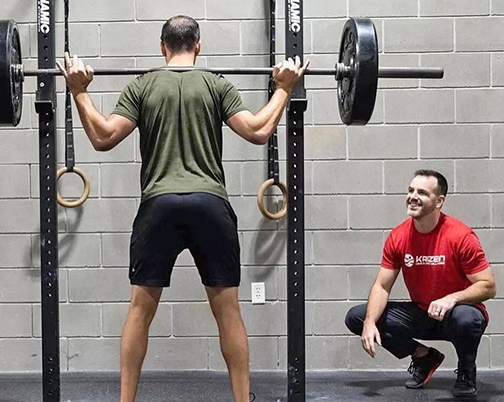
Bryan Ladd says he had wanted to be a physical therapist since shortly after he graduated from Aurora High School, but if someone had told him even five years ago that he was going to start his own business, he would have laughed at them. But here he is today as founder and owner of Kaizen Health and Wellness clinic in the Des Moines suburb of Urbandale, Iowa.
Ladd’s journey from his growing up years in Aurora, to studying at Hastings College, to where he is today has taken him around the nation, to service in the U.S. Navy and half way around the world to Okanawa, Japan and back again. Then, 16 years after his high school graduation, it brought him back to his hometown to speak at Aurora’s homecoming on Sept. 22.
Along the way he has earned a doctorate, grown in his physical therapy and strength training expertise, learned management skills, served his country and gained an appreciation of a Japanese philosophy of management that serves as a guiding principle for his company, to the point he even named his business after it.
Following high school graduation in 2007, Ladd went off to Hastings College on a football scholarship, admittedly not really knowing what he wanted to do with his life. Always interested in sports and football in particular, Ladd says in college he developed an interest in becoming a certified strength and conditioning specialist, such as work for college and professional sports teams. He said that interest was sparked by a book his mother gave him that was used for study by those planning to take the certification test.
“That was something I had never heard of before,” Ladd said. “I didn’t know there were strength coaches, so that was kind of eye opening. I thought ‘Wow, I kind of like that! I want to do that!’ And so I kind of looked into that. I did a job shadow with the Huskers and really thought that’s what I was going to do. At Hastings I majored in exercise science and I was gonna be a strength coach.”
However, life has a funny way of changing one’s plans, and for Ladd that change came about through someone who would later become extremely important in his life.
“And then I met my now wife (Deana) who was in nursing school at the time,” Ladd recalled. “And she said, I think you’d be a good physical therapist, and you should look into that. Back then there was only one physical therapist in Aurora. And so I kind of thought, ‘Well, he had a good job. He was pretty fun. That was kind of easy. I think I could do that.’”
So, Ladd says, he began job shadowing physical therapists at various locations and ended up getting a job at a clinic in Hastings where he fell in love with the work.
“I kind of saw it as a way where I can kind of mix healthcare with that strength and conditioning aspect; a little bit of best of both worlds,” Ladd said. “The thing that really appealed to me though is there are jobs everywhere and they make pretty good money.”
Ladd says he also realized the downside of being a strength coach was that it would mean not staying in one place for long.
“So definitely the downside is, as soon as the coach is fired, you’re fired too,” Ladd said. “So you’re moving around all the time.”
Ladd finds that reasoning a bit ironic now because after he joined the Navy he spent the next several years moving all over the map.
After getting his physical therapy degree at Des Moines University in Iowa (graduating in 2014), Ladd was commissioned into the U.S. Navy as a physical therapist and was stationed initially at the naval hospital in Bremerton, Wash. He speaks fondly of his years in the Pacific Northwest.
“It’s right across the Puget Sound from Seattle; it was like a half hour ferry ride directly from Bremerton to Seattle,” Ladd recalled. “So kind of cool area to live in because you’ve got the mountains and the ocean right there, so a little it looks a little bit different than Nebraska and Iowa.”
Stateside assignments also took Ladd and his young family to Rhode Island, Texas and California before he was shipped off for a three year assignment at the U.S. Naval Hospital at Okinawa, Japan.
“I went out to Okinawa thinking I’d be a staff physical therapist, but the department head was leaving about the same time I was getting there and no one else wanted it,” Ladd said. “I thought at the time the Navy was gonna be a 20 year thing at that point so that was kind of the next progression of my career, so I took over as department head and did that for three years.”
Burnout and a fresh start
Toward the end of that time, however, Ladd began to struggle with burnout, and he noticed he wasn’t the only one in his profession suffering from that malady.
“All my friends and colleagues on the civilian side, they were getting burned out because they were just seeing a ton of patients every day in and out so they were getting burned out from that volume,” Ladd said, adding that for him the burnout was coming from his experience with the intransigence of the Navy. “My own scenario was the exact opposite of that. As department head I could kind of set my own schedule and I was only seeing six or so patients a day so it really wasn’t bad from that standpoint. It was more of the red tape and bureaucracy of the Navy that kind of did me in and after years of that it just gets to be a little too much... They always say the Navy is a big ship and it turns slowly. It just takes forever to try and get anything changed and you have to go through so many different layers and then usually by the time something’s starting to work, someone will transfer out and a new person will come in and that will get squashed. And so it’s just kind of this vicious cycle that there’s not really a great answer to.”
Ready to be done with the Navy, Ladd decided to go out and do his own thing, but then came the question of what and where?
“I was looking around at all my friends on the civilian side—all my friends from PT school—they were all burned out and didn’t really want to be physical therapists anymore and I didn’t really want to go work at a hospital or a nursing home. And so, the more I looked at it, I was like, ‘I guess I gotta start my own business.’”
Ladd admits the thought of doing so had never really crossed his mind before that and even five years earlier the idea would have been laughable to him.
“I had no desire to start a business,” Ladd said, referring to himself at that point as a “reluctant entrepreneur.”
However, having gained managerial experience through his time in the Navy, Ladd decided to strike out on his own after his discharge in September of 2018 and “dove headfirst into entrepreneurship.
“And here we are four years later,” he said. “Now we’re in our own standalone space and I’ve got two therapists that work under me and it’s been a lot of fun.”
Ladd says owning his own business is a complete 180 from his experience in the Navy.
“One of the things I like about being a business owner is if I want to make a change right now I can just make it,” Ladd said, “and we just try it and then if it doesn’t work we’ll change it back. We can treat how we want and when we want, versus having big oversight over top of us. It’s so funny because I probably work way more hours now but it’s enjoyable and it’s something I’m passionate about.”
Discovering kaizen
Ladd’s time in Japan also taught him the value of being open to change and improvement and it’s a concept that he has incorporated into his business model.
“Kaizen is the Japanese word for continuous improvement and so the literal translation is ‘change good,’” Ladd said. “I first got introduced to it when I went to Okinawa. In the hospital I was working at, every department had a Kaizen board. And basically anyone in that department could go to the board at any time and write down an idea they had.”
Following the posting of an idea it would be vetted and eventually implemented if it survived the consideration process. Ladd said the Toyota Corporation also uses the Kaizen concept in its manufacturing process.
“It’s one of the ways they’ve become one of the most efficient manufacturers in the world, because they still use it today,” Ladd said. “And I think the last time I had heard, it was like, every employee has to come up with several Kaizens a day on how they can make their job more efficient and smoother.”
Ladd says he not only adopted the Kaizen philosophy into his business model but he adapted it to health and wellness as well.
“No matter where you’re at in your health and wellness journey, there’s always room for improvement,” Ladd said. “There’s always room for us to strive for more. And so that’s kind of how Kaizen Health and Wellness came about. We kind of liked that idea of continuously improving.”
A different kind of PT
Seeing the burnout being experienced by himself and other practitioners, Ladd says he sought to break out of the usual paradigms associated with physical therapy. He says most people have a perception of physical therapy that is associated with the use of weights like dumbbells and stretching elastic bands and other common techniques that have gained a negative connotation especially with patients who are more physically fit. Ladd spoke of what are referred to as PT mills, which are large chain businesses that deal with mass volumes of patients on a daily basis, with therapists seeing three to five patients at a time. Ladd said many athletes don’t want to go to physical therapy because they don’t think they will get personalized service or get pushed to the level they need to be. That’s the reason, he explained, why the words “physical therapy” aren’t in the name of his business.
Speaking of PT mills, Ladd said, “No one’s really getting that individualized care. There’s kind of cookie cutter exercises given, but we really try to take an individualized approach to each and every patient and give them very specific things that they need. And we can work one on one with them throughout their process to get them back to doing whatever they were, whether it’s running a marathon or back to CrossFit or back to playing football.”
Ladd said his clinic works with patients at all levels of mobility to mitigate pain and get them moving again at whatever level they were accustomed, keeping in mind the axiom that “movement is medicine.” Going beyond dumbbells and elastic bands, Kaizen also employs an array of techniques including cupping, scraping, body tempering, dry needling, blood flow restriction cuffs and others.
Coming full circle
Recently Kaizen signed an agreement to become the exclusive physical therapists for the Iowa Barnstormers of the Indoor Football League (IFL) to provide not only PT but strength and conditioning training. (Incidentally, the IFL is known for being the league that gave Kurt Warner his start in the pros.)
“My wife now has said we’ve gone full-circle,” Ladd said, noting his youthful desire to become a strength and conditioning specialist.
Speaking of Ladd’s wife, he and Deana are the parents of four children, including 8-year-old Jack; Henry, 6; Luke, 3 and their daughter Alice who is 4 months old. His mother, Kris Schroeder moved to Ankeny, Iowa from Aurora a while back and now lives about 20 minutes away from her grandchildren.
Aurora is home
While his career path has taken him many places, Ladd says he still considers Aurora home and is grateful to the town for giving him his start in life. He notes that growing up with a single mother and with his father living Maine, there were several men who served as role models and helped him become who he is today. Especially important to him were his football coaches and he names coaches Randy Huebert and Kyle Peterson as men who had a big influence on him.
“Lee Penner was another big influence on my life,” Ladd said, adding that he worked several summers during high school and college for Penner Manufacturing. “I graduated physical therapy school in May and left for the Navy in September, and I came back in that time frame and worked for him again. So I spent a lot of time at Penner Manufacturing, Penner Patient Care and at the Penner household too, so they definitely had a big impact on my life.”
“Growing up in that community, I think, set me up for success,” Ladd concluded, “and I’m really appreciative of everyone who kind of came into my life and helped me grow into the person that I am today. And so I Aurora’s not home right now, but it will always hold that special place in my heart.”