
NPPD consultant shares insight during ADC event in Aurora
Just days after making two major announcements regarding housing and business development in the community, Aurora hosted a luncheon at the Bremer Center Friday focusing on the need for and impact of on-going economic development efforts.
As executive director of the Aurora Development Corporation, which hosted the event, Kelsey Bergen welcomed a crowd of approximately 30 people representing local business and industry, as well as state and regional economic development partners.
Though not on the agenda weeks ago when the event was scheduled, Bergen announced breaking news on two separate fronts. She shared that the ADC helped support the Aurora Housing Development Corporation’s application for a second round of Rural Workforce Housing funding, with word coming Thursday that $500,000 of local match funding earned a $1 million grant. Earlier in the week, Bergen also attended the Aurora City Council meeting, where city leaders approved plans for an anchor tenant to make a $20 million investment in ADC’s Mission Critical site on Highway 14. (Read more details about both of those projects elsewhere in this edition).
“Growth creates growth and we certainly see that on the housing side,” Bergen said of the housing grant. “For every house that we build that is the potential for at least two workers to come to our workforce.”
As for the Mission Critical project set to begin construction this summer, Bergen said that is hoped to be the first of many announcements involving the 135-acre site.
“We’re really kind of hoping that this sets us up to launch what might be the agricultural hub of the Midwest,” she said. “We’re excited to be able to see some growth that’s been a long-time coming.”
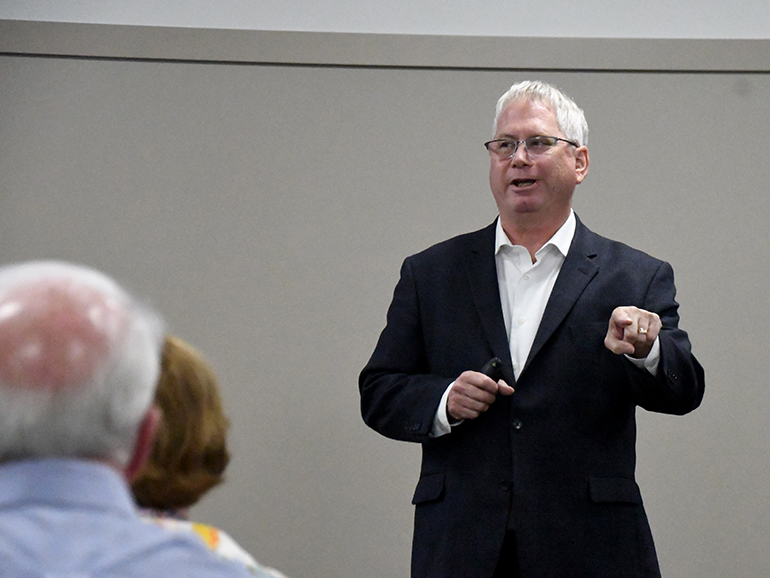
NPPD senior economic development consultant Rick Nelson applauded the community’s recent success, noting during a keynote address that he has long admired Aurora’s commitment to continued growth.
“One of the things I appreciate about Aurora is that the community has always recognized the importance of relationships,” Nelson said. “We’ve got SCEDD (South Central Economic Development District) here, we’ve got NPPD here and we’ve got Black Hills Energy here (at Friday’s luncheon)… There is a long-time history of that which the community can be proud of.”
Nelson reflected on his 40-year career, recalling a Chamber banquet years ago where he heard a line that speaks to how those relationships are developed.
“You know you are in Aurora,” he recalled hearing, “when you stop by the Ford dealership asking for directions and you get a personalized hour-and-a-half tour (from Ken Wortman) of the community.”
Nelson then reflected that in his early days economic development was all about jobs. The railroad, he reported, was one of the biggest instigators of deliberate economic development activity, focusing on utilities, jobs and local investment.
“Today it’s really not as much about job creation as wealth creation, improving jobs that you have, bringing in higher quality jobs,” he explained. “It’s also more about placemaking — making your community a place where people want to come and live, where businesses want to come and locate. The intentional practice of improving your community’s economic well-being and quality of life, I think that really sums up what economic development is.”
Differing goals
In his vast experience working on economic development projects across the state, Nelson said no two communities define the concept the same way. For some, he said, it’s about attracting businesses, while for others it’s about retaining businesses, retaining the local school, or perhaps replacing or getting a grocery store.
“I remember coming to Aurora and learning about the ‘Aurora Way,’” he recalled. “You have a more conservative approach to economic development with a strong history of volunteerism and philanthropy, and when you recruit people to Aurora you say you expect the same things of them. That’s been a successful plan of action you guys have had.”
Nelson then shared a number of slides to help demonstrate how the process of recruiting and retaining business (the ultimate definition of economic development in many circles) has changed dramatically in recent years. One of the keys, he said, is having relationships with available resources, such as NPPD, SCEDD, Black Hills Energy and others.
“Again, it all started with the railroads and back then it was smokestack chasing,” he said. “Manufacturing was the heart of economic development and still really is, although the definition of primary jobs has changed. The reason why manufacturing is key to economic development and the growth of the community is its multiplier effect of the money coming into your community, especially if they’re selling products outside the region, outside the state or outside the country. That’s money coming back into your community that leads to the need for more jobs, people have more personal income and people are spending more.”
In more recent years, Nelson said workforce development has become a key focus for economic development organizations across the state and nation, including the Aurora Development Corporation, as more and more businesses struggle to find workers to fill available jobs.
“I also think that one of the biggest hurdles that we have is the parents. It’s us,” he said, referring to Nebraska youth who are told they need to move away to be successful in life. “We’re telling our kids they have to go away to be successful and we need to help expose them to what opportunities are here locally.”
Labor study
Nelson also noted that with so many changes on the job front, “labor force” is no longer defined as a local pool of candidates, but instead refers to a regional workforce.
He reported, for example, that NPPD conducted a labor study using 2019 data which determined that 60 percent of Hamilton County’s workforce has jobs outside the county, with a similar 50 percent of Aurora residents working outside the community.
“Another way to look at that is that if you’re a company coming to Aurora or Hamilton County there is an opportunity if you’re providing a good job for somebody if you can eliminate or reduce their commute and they don’t have to leave Hamilton County for that job,” he said.
The same study documented that approximately 2,100 people who work in Hamilton County live outside the area.
Nelson then went on to explain how other factors have changed or been redefined in terms of economic development since he started working with NPPD in the 1980s.
“When I started there was economic development and there was community development and they were two totally separate activities,” he said. “Well now, especially in rural communities and rural counties, that is another one of those rocks in the bucket of the local economic development organization.”
That “bucket” includes everything from education with schools to the hospital, culture, parks and rec, downtown development, dog parks, tourism and especially the availability of daycare services.
In fact, he concluded, NPPD recently did a study on the impact of inadequate daycare in Hamilton County. Nelson reported that the issue resulted in $2.1 million in lost income, due to the loss of worker availability, absenteeism and staff turnover. That number, he added, also resulted in an estimated $240,000 hit on potential retail sales.
While connections with representatives from various entities is important in the economic development game, Nelson said each and every citizen can play a role as well, whether they realize it or not.
“I have many stories about the impact or value of somebody not in the economic circle saying something,” he said. “It may have been about a business prospect in town when nobody knew they were there. You all have a role in economic development.”