
Scientist’s flash helped the Allies win the day, June 6, 1944
It’s midnight on June 6, 1944. Allied paratroopers are scattered in the fields and hedgerows of Normandy, France, but they’re ready to fight.
Hours later, at 6:30 a.m. naval forces crash onto the beaches and begin running through the sand of the shores they’ve codenamed GOLD, JUNO, SWORD, UTAH and OMAHA.
The whirring of allied air support can be heard overhead, prepared to drop high-powered weaponry.
Operation Overlord, or D-Day, was in full swing.
Nearly 156,000 soldiers aided in first step of the liberation of France on D-Day. By blindsiding and taking Nazi-occupied Normandy, the allied military forces initiated the turning point of the war.
In less than a week, all of Normandy’s beaches had been secured by allies and the number of troops in France had more than doubled.
By late August of 1944, Paris was liberated and the Battle of Normandy was over. Now, it was time for allied forces to enter Germany and meet Soviet troops, where the war would conclude with the Nazi’s defeat.
D-Day was a multi-faceted operation led by Supreme Allied Commander Gen. Dwight D. Eisenhower. Though there was help from military strategists and scientists around the world, without one man, D-Day may not have been possible. His name was Harold Edgerton.
Doc Edgerton and D-Day
Harold “Doc” Edgerton was born in Fremont and grew up in Aurora. After graduating from Aurora High School, Edgerton studied electrical engineering at the University of Nebraska-Lincoln (UNL). He then began teaching at the Massachusetts Institute of Technology (MIT).
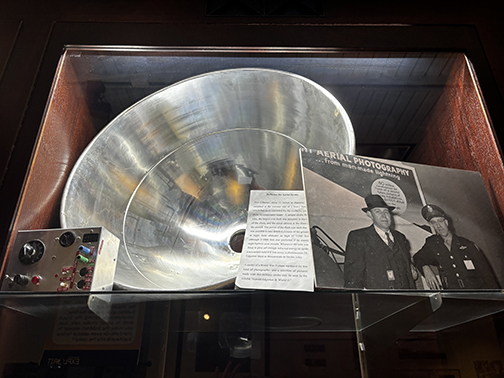
In 1939, Lt. Col. George Goddard, head of the U.S. Army’s aerial photography effort came to Edgerton.
“From personal experience as a pilot in World War I, Major Goddard was impressed with the need for night photographic cover, and during his first visit to our laboratories expressed his sincere conviction of the imperative need for night aerial photography,” Edgerton wrote in an article titled, “Night Aerial Photography.”
The allied forces needed a way to photograph large areas at night in order to track enemy movements. Goddard hoped Edgerton could modify his strobe light to allow the military to adequately illuminate photos from thousands of feet in the air.
Within a year, Edgerton and two of his colleagues, Charles Wyckoff and Frederick Barstow, had developed the first electronic flash system for aerial photography.
In its first test in 1941, the flash was loaded onto a B-18 which flew side-by-side with a camera plane. From 2,000 feet up, they were able to take pictures of the MIT campus and the Yankee baseball stadium.
But there was an issue. The U.S. Air Force said these military observation planes needed to fly at least 3,500 feet in the air to be safe from enemy interference. It was back to the drawing board for Edgerton.
Edgerton now had two problems to solve: the power of the flash and its weight.
Because the planes were going to be flying higher, the flash would need to be much more powerful and, therefore, bigger. That meant a larger plane would be needed to carry the flash.
Luckily, the B-24 Liberator was being developed even as Edgerton worked on his collossal flash.
When the B-24 equipped with Edgerton’s 6,000-pound remastered flash device were ready to test, more problems arose.
The flash lamps were failing during flight, so Edgerton had to make multiple trips to the plant where they were being made in Ohio. Then, the only B-24 plane assigned to the project went up in flames while being refueled.
Edgerton and his colleagues were able to pull through, however. They perfected the electrical flashes and they were installed into B-24s and B-25s. These planes were flown to Dayton, Ohio to be tested where they “exceeded expectations of its performance,” Edgerton reported.
In April of 1944, when American troops had come to a halt at Cassino, Italy, the allied forces needed to know how Germany was still receiving supplies despite all possible transport routes having been destroyed.
One B-24 equipped with Edgerton’s flash and cameras went directly to San Severo, Italy.
During this trip, the B-24 was found to be too heavy and slow to be effective in reconnaissance photography. Worse, it was an easy target for enemy fire.
So, the photo equipment was re-installed in two new A-20 planes.
After working out the last kinks and testing for three months in Italy, Edgerton’s equipment caught the attention of forces across the pond.
“Nevertheless, after three months’ work, it was a great satisfaction to learn that the results of two test flights were regarded so highly that similar equipment was requested in England,” Edgerton wrote in his article.
In May of 1944, Edgerton was transferred to England. He could tell something big was coming.
“The equipment which was not needed in Italy was flown via Africa to Chalgrove, England, where the 155th Night Photo Squadron was being created from a group of former night fighter pilots. Immediately we could sense that something important was in the making,” Edgerton wrote.
A few days after Edgerton arrived, the first plane was equipped with his flash, and pilots were given training on how to use it.
Many training flights were taken over England in late May to prepare pilots for what was to come.
On the night of June 5, 1944 the British pilots who had been trained with Edgerton’s photography equipment made their flights over Normandy, France. They’re mission was to capture photos of important crossroads leading to the invasion site of D-Day.
They got back to England and rushed their vulnerable, exposed film to the photo laboratory where they found that there was no activity in the areas photographed.
The German troops would be taken completely by surprise come morning.
Then, at midnight on June 6, 1944, one of the most important days in World War II began.
Editor’s note: All information and photos for this article were gathered from the Plainsman Museum and Edgerton Explorit Center in Aurora.